Free, Printable Cricket Blank Score Sheets for T20 Matches

Keeping score during a T20 match on a crumpled takeaway menu always ends in absolute disaster. One minute you are watching a routine spinner, the next someone smashes three straight sixes over long-on, the opposition screams for a wide, and you are debating whether Dave ran two or just ran halfway down the pitch to yell at his partner. Fast 20-over cricket moves far too quickly for sloppy napkin math. Without an organized system, your Sunday league match will inevitably devolve into a diplomatic crisis before the first innings even wraps up.
Therefore, using a dedicated Cricket Score Sheet for T20 Matches is completely non-negotiable. Designed specifically for fast-paced play, a proper scorecard keeps historical records accurate, bowlers entirely honest, and teammates from arguing over every single delivery.
You can easily download our free printable PDF templates below to stay thoroughly organized on match day and maintain total control over the game flow.
[ Download PDF ] | [ Download PNG ]
Key Features of the Cricket Score Sheet for T20 Matches Layout
Standard multi-day scorebooks are simply not built for short-format cricket. Managing 120 deliveries per side requires a high-visibility design built for extreme speed. Our specialized Cricket Score Sheet for T20 Matches ensures even a frantic powerplay is logged with complete precision and zero confusion.
-
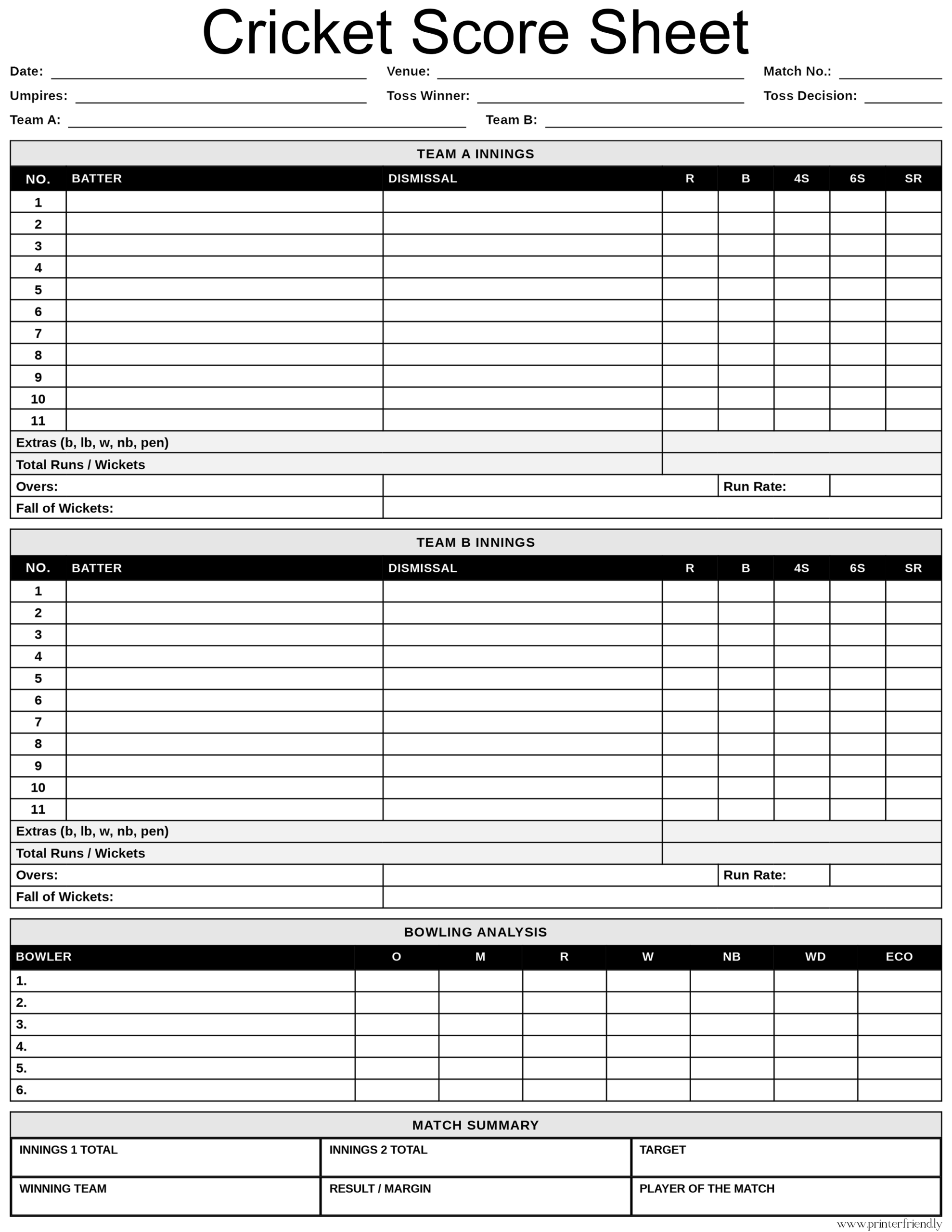
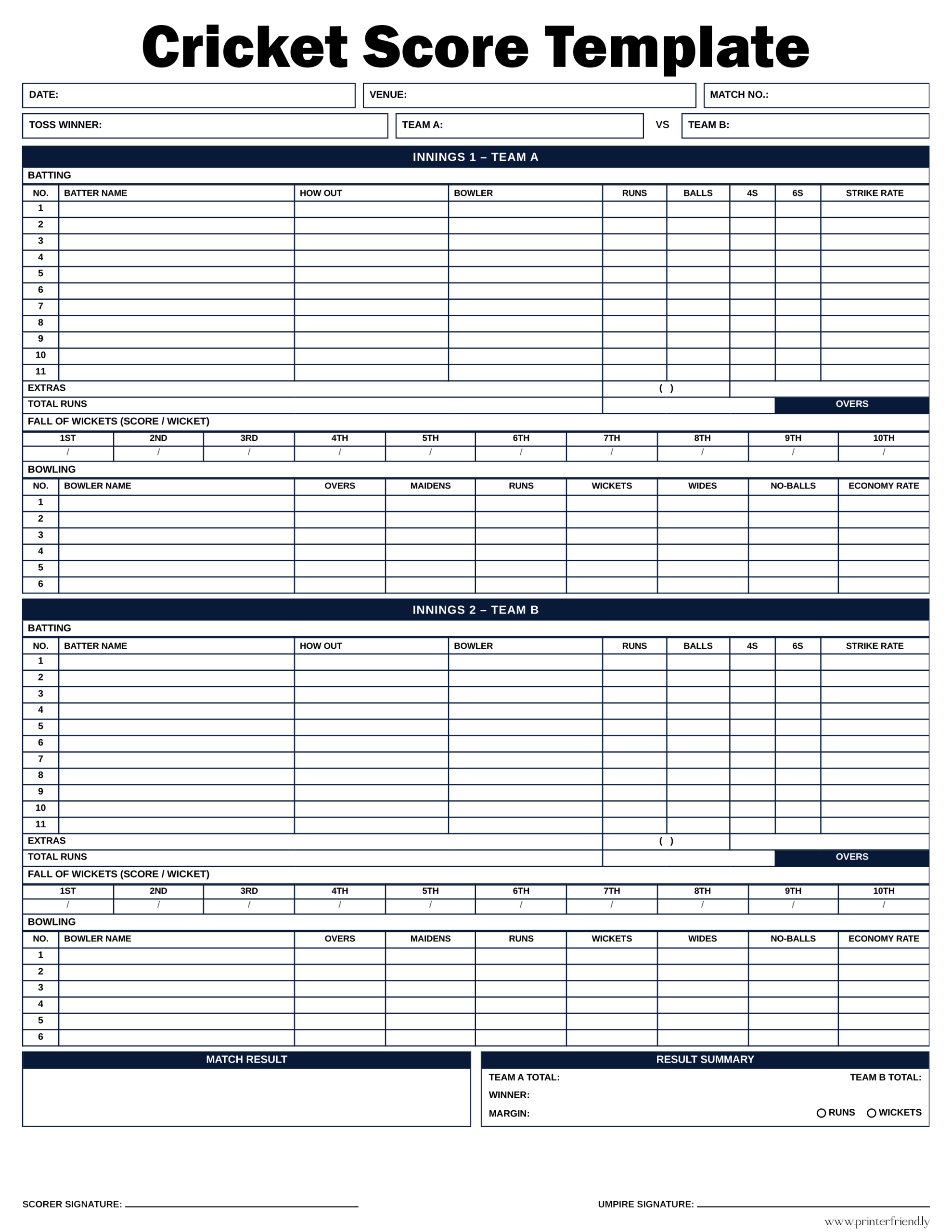
20-Over Innings Framework: We created dedicated rows for 11 batters with side-by-side columns for runs (R), balls faced (B), boundaries (4s & 6s), and strike rates (SR), allowing you to evaluate power-hitters instantly.
-
Comprehensive Bowling Figures Grid: The sheet provides ample space for up to 6 bowlers, tracking overs (O), maidens (M), runs conceded (R), wickets (W), wides (WD), no-balls (NB), and economy rates (ECON) without any visual clutter.
-
Detailed Fall of Wickets (FOW) Table: You can log the exact team score and over number for all 10 wickets sequentially to clearly track game momentum shifts, partnership breakages, and batting collapses.
-
Categorized Extras & Summary Box: Separate fields for wide balls (WD), no-balls (NB), leg byes (LB), and byes (B) ensure totals balance seamlessly without mystery runs ruining your post-match audit.

[ Download PDF ] |
How to Log a T20 Match Step-by-Step
Scoring requires constant, unwavering focus—taking your eyes off the field for even 30 seconds can ruin your entire tally. Using a structured Cricket Score Sheet for T20 Matches keeps your scorebook immaculate from the coin toss all the way to the final sign-off.
Step 1: Pre-Match Setup & Coin Toss
First, meticulously fill out essential header details, including the exact date, venue name, match number, and umpire names. Document the toss outcome clearly and list the full 11-player batting lineup alongside the opening bowlers before the bowler delivers the first ball to avoid scrambling later.
Step 2: Ball-by-Ball Tracking & Live Entry
Next, record runs under the active batter as soon as the ball is hit and fielded. Log extras immediately in their dedicated fields (remember that wides and no-balls add penalty runs and extra balls to the official tally). On dismissals, you should immediately complete the ‘How Out’ column, list the bowler involved, and update the Fall of Wickets table.
Step 3: Mid-Innings Audit & Mathematical Cross-Check
At the end of the 20th over or when the team is all-out, sum all batter runs plus extras for the total score, verify that bowler overs equal the team total, and calculate the Current Run Rate (CRR = runs/overs) alongside individual bowler economy rates to ensure absolute mathematical accuracy.
Step 4: Finalizing Match Results & Official Sign-Off
Finally, track required target runs meticulously during the second-innings chase. Once finished, record the final scores, the winning margin, and the Player of the Match. Both official scorers and umpires must sign the sheet to officially validate the log.
Handling Special Scenarios: Retired Hurt & Super Overs
Even in fast-paced recreational T20 matches, unpredictable situations frequently arise that test a scorer’s flexibility. Knowing how to document rare match events keeps your official records professional and dispute-free.
-
Tracking Retired Hurt or Out: If a batter must leave the field due to injury, mark them as ‘Retired Hurt’ in the dismissal column. This allows them to potentially return later if other wickets fall. If they choose not to return, they are recorded as ‘Retired Out’.
-
Scoring a Super Over Tie-Breaker: When a T20 match ends in a tie, a Super Over decides the winner. Since standard score sheets focus on the main 20 overs, use the blank notes section at the bottom or a designated continuation box to log the 3 specific batters and 1 designated bowler per team for the tie-breaking extra over.
Cricket Score Sheet for T20 Matches vs. Standard ODI Scorecard
Long-form matches leave plenty of time between overs for complex statistical entries, but short-format cricket demands incredible speed. A custom Cricket Score Sheet for T20 Matches cuts out unused historical fields in favor of high-visibility grids.
| Feature | T20 Score Sheet Layout | Standard ODI / Multi-Day Sheet |
| Overs Limit per Innings | Maximum 20 Overs per side | 50 Overs or Unlimited (Test) |
| Bowler Allowance | Max 4 overs per bowler (up to 6 bowlers) | Max 10 overs per bowler |
| Visual Density | Bold, high-contrast grid for quick outdoor logging | Complex multi-page statistical columns |
| Key Metrics Focus | Strike Rate (SR), Economy (ECON), Extras Breakdown | Long-spell tracking, session totals |
| Speed Efficiency | Rapid entry; fits both innings on a single sheet | Requires flipping between pages |
Using a tailored layout ensures whoever holds the clipboard keeps pace with rapid boundaries and quick bowling rotations without losing track of the game state.
Frequently Asked Questions (FAQs)

[ Download PDF ] | [ Download PNG ]
Can this score sheet be used for street, tape-ball, or local club T20 matches?
Yes! You can fully adapt it for gully cricket, tape-ball games, school leagues, and local recreational 20-over matches because the core mechanics of tracking runs, wickets, and overs remain identical regardless of the equipment used.
How do you calculate a bowler’s economy rate on a manual scorecard?
Divide total runs conceded by overs bowled. For example, conceding 26 runs in 4 overs equals a 6.50 economy rate (26 divided by 4). For partial overs, convert extra balls into decimal fractions (e.g., 2 balls bowled in an over equals 0.33).
What extras should be recorded separately on the scorecard?
Always log WD (Wide), NB (No-Ball), LB (Leg Bye), and B (Bye) in their dedicated breakdown rows rather than lumping them together. This ensures overall team totals remain accurate and easy to audit during disputes.
Related blank sports score sheet templates:
- Printable Cricket Score Sheets
- Pakistan Super League Playoff Odds, Predictions, and Printable PSL Bracket
- Printable Pickleball Score Sheet Templates
- Blank hockey score sheets

I’m a passionate designer with a keen eye for detail and a love for crafting visually stunning experiences. With a strong foundation in design tools like Adobe Photoshop, Illustrator, and Figma, I bring ideas to life through compelling visuals. My proficiency in HTML and CSS allows me to translate designs into functional, responsive websites. I’m always eager to learn and explore new design trends and excited to contribute my skills to innovative projects.