Children’s Shoe Size Chart: US, UK and EU Shoe Size Conversion Guide

Shopping for kids’ shoes online is a high-stakes gamble. For example, one day their sneakers fit, but the next day, your toddler wakes up having sprouted two inches overnight. As a result, their toes are left smashed against the front wall like commuters on a packed subway. Furthermore, ordering online doesn’t help: a size 8 from one brand could fit an elephant, while another looks like footwear for a doll. Therefore, using our children’s shoe size chart: US, UK & EU guide takes the guessing game out of checkout and eliminates endless returns.
Whether you are buying European boots, British loafers, or American sneakers for an infant, toddler, or growing youth, this guide breaks down global sizing standards, offers a simple home measurement method, and ensures a perfect fit. In addition, you can grab an easy-to-use, printable PDF template to keep on hand for the next growth spurt.
[ Download PDF ] | [ Download PNG ]
International Kids’ Shoe Size Conversion Table
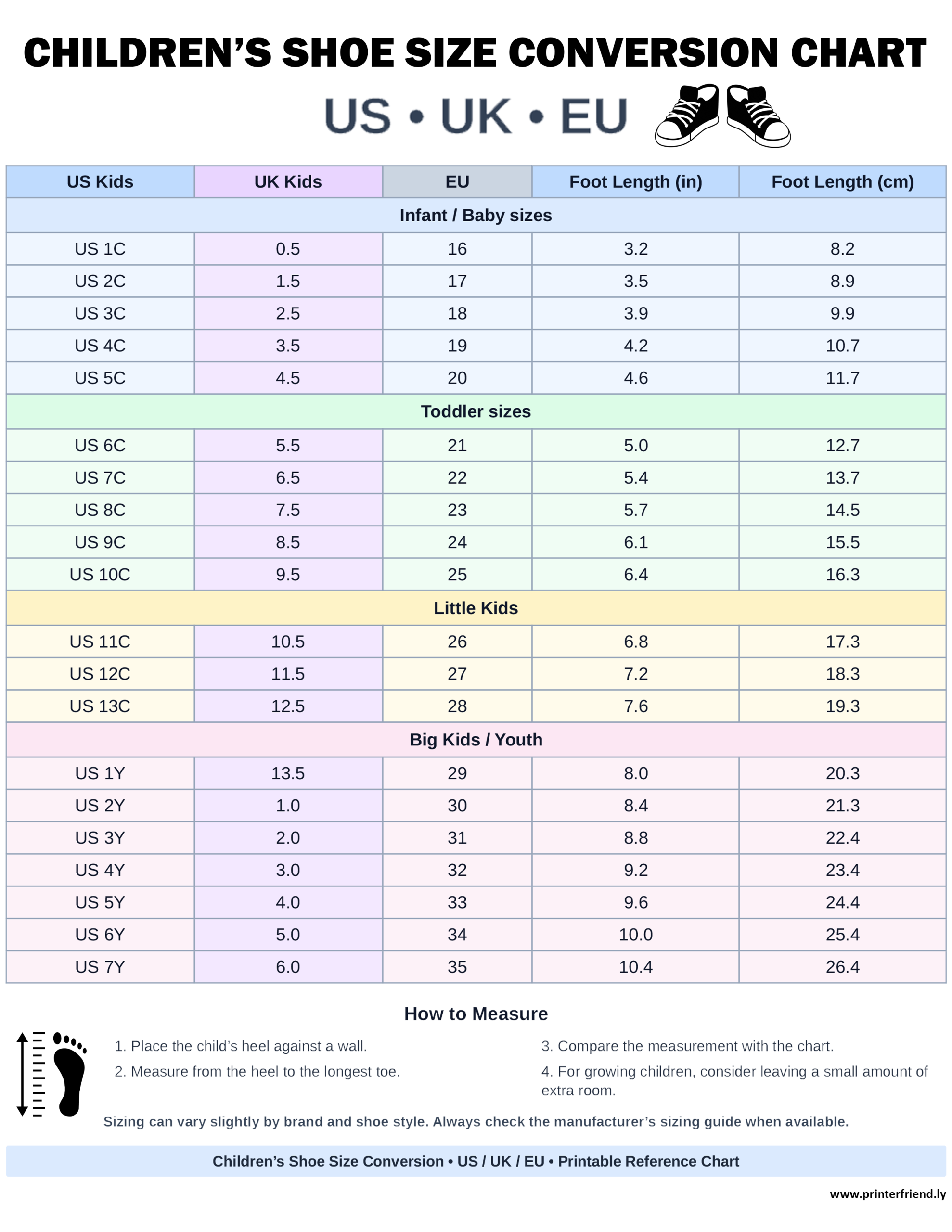
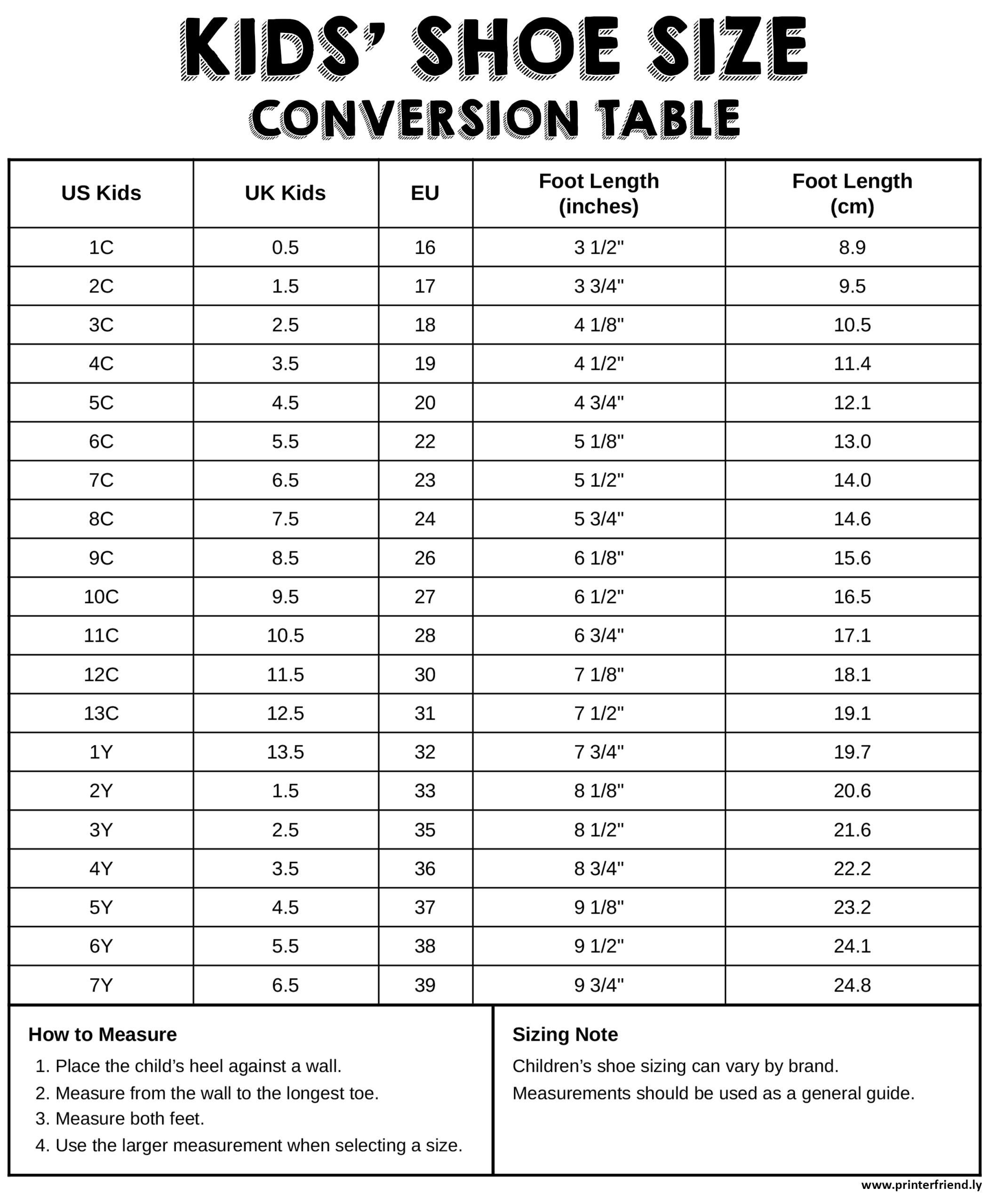
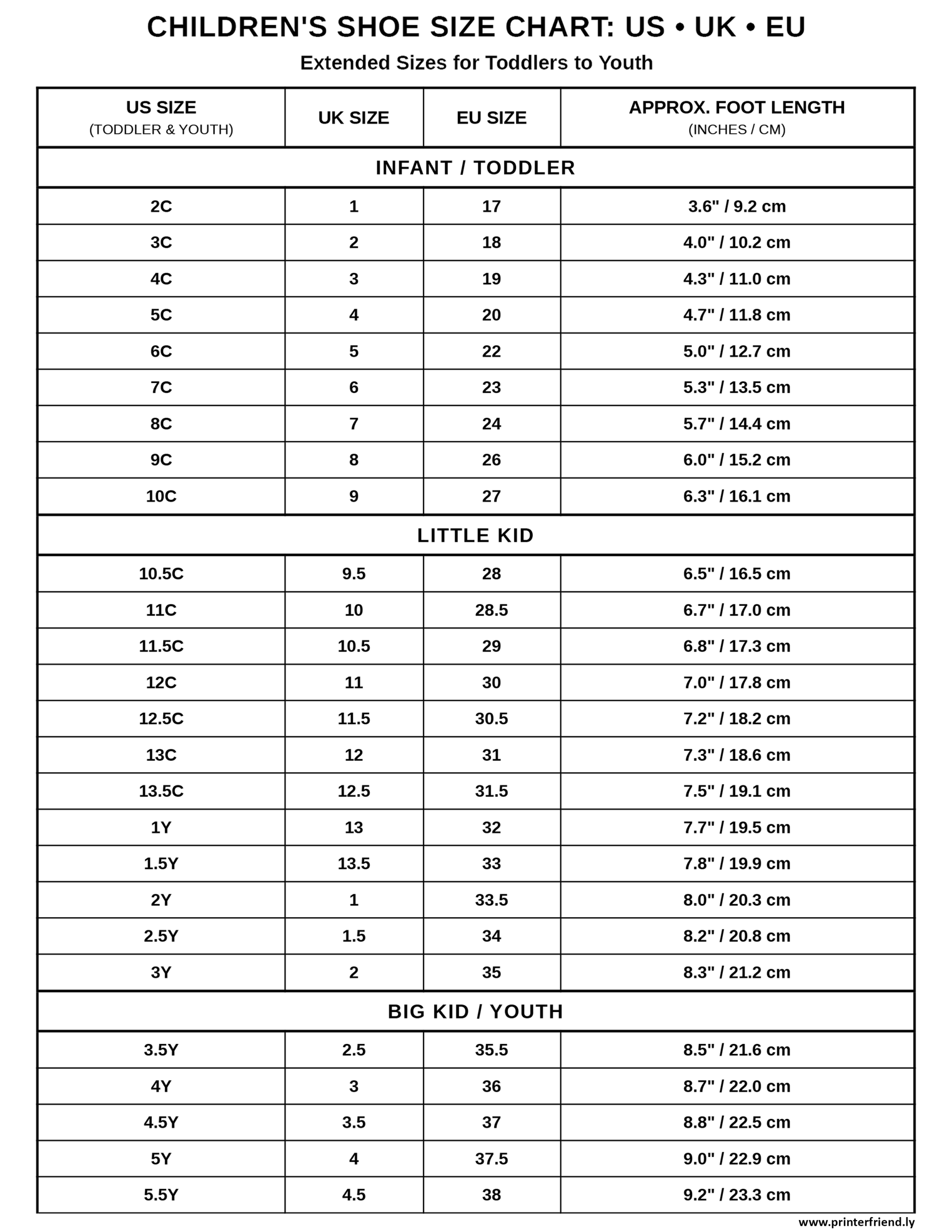
Navigating global shoe brands means translating three distinct sizing systems. Specifically, American shoes use an age-bracketed scale, British shoes use an offset inch scale, and European shoes rely on continuous millimeter increments. Consequently, using a unified reference grid lets you cross-reference length measurements across regions before placing an online order.
First and foremost, always measure your child’s feet in centimeters (cm) or inches first, because raw physical length is the only universal constant across manufacturers. Additionally, use this children’s shoe size chart master reference table to match foot length directly to standard regional tag sizes.
Regional Shoe Size Conversion Chart
| US Kids Size | UK Kids Size | EU Size | Foot Length (Inches) | Foot Length (CM) | Typical Age Range |
| 1C | 0.5 | 16 | 3.5″ | 8.9 cm | Infant (0–6 mos) |
| 2C | 1.5 | 17 | 3.75″ | 9.5 cm | Infant (6–9 mos) |
| 3C | 2.5 | 18 | 4.125″ | 10.5 cm | Infant (9–12 mos) |
| 4C | 3.5 | 19 | 4.5″ | 11.4 cm | Toddler (12–18 mos) |
| 5C | 4.5 | 20 | 4.75″ | 12.1 cm | Toddler (18–24 mos) |
| 6C | 5.5 | 22 | 5.125″ | 13.0 cm | Toddler (2 years) |
| 7C | 6.5 | 23 | 5.5″ | 14.0 cm | Toddler (2–3 years) |
| 8C | 7.5 | 24 | 5.75″ | 14.6 cm | Toddler (3 years) |
| 9C | 8.5 | 26 | 6.125″ | 15.6 cm | Toddler (3–4 years) |
| 10C | 9.5 | 27 | 6.5″ | 16.5 cm | Toddler (4 years) |
| 11C | 10.5 | 28 | 6.75″ | 17.1 cm | Little Kid (4–5 years) |
| 12C | 11.5 | 30 | 7.125″ | 18.1 cm | Little Kid (5 years) |
| 13C | 12.5 | 31 | 7.5″ | 19.1 cm | Little Kid (5–6 years) |
| 1Y | 13.5 | 32 | 7.75″ | 19.7 cm | Youth (6–7 years) |
| 2Y | 1.5 | 33 | 8.125″ | 20.6 cm | Youth (7–8 years) |
| 3Y | 2.5 | 35 | 8.5″ | 21.6 cm | Youth (8–9 years) |
| 4Y | 3.5 | 36 | 8.75″ | 22.2 cm | Youth (9–10 years) |
| 5Y | 4.5 | 37 | 9.125″ | 23.2 cm | Youth (10–11 years) |
| 6Y | 5.5 | 38 | 9.5″ | 24.1 cm | Youth (11–12 years) |
| 7Y | 6.5 | 39 | 9.75″ | 24.8 cm | Youth (12+ years) |
Note: Sizing can vary slightly depending on shoe construction and brand padding. Therefore, treat table conversions as an ideal baseline starting point.
How to Measure Your Child’s Foot at Home (Step-by-Step)
Trying to hold a tape measure against the bottom of a squirming child’s foot usually results in a wrong size. In fact, flexible tape bends around the arch and heel, which leads to inaccurate length numbers.
Simple At-Home Measurement Steps
To solve this problem, use the flat paper-and-wall method to determine the exact heel-to-toe length in centimeters (cm) before cross-referencing your numbers with our children’s shoe size chart:
Quick Measurement Summary:
- Tape a paper flat on a hard floor against a smooth wall.
- Stand child barefoot with heel touching the wall.
- Trace/mark the tip of the longest toe with a pencil.
- Measure paper edge to mark; use the larger foot!
- Set Up: First, tape a piece of plain paper flat on a hard floor (wood or tile) directly against a flat wall.
- Stand and Position: Next, have your child stand barefoot on the paper with their heel resting lightly against the wall. In addition, make sure their weight is evenly distributed on both feet.
- Mark the Tip: Then, hold a pencil straight up and make a horizontal mark at the tip of the longest toe. (Remember: in many cases, the second toe is longer than the big toe!)
- Measure Foot Length: After that, use a ruler to measure from the edge of the paper touching the wall to your pencil line.
- Compare Both Feet: Finally, keep in mind that it is completely normal for one foot to be slightly larger than the other. Therefore, always calculate sizing using the measurement of the larger foot.

[ Download PDF ] | [ Download PNG ]
Factor in Growth Allowance and Wiggle Room
Buying shoes that match your child’s exact foot length is a common mistake. This is because soft, developing bones need clearance to flex, extend while running, and expand as your child grows. In fact, a shoe with zero toe clearance can cause foot cramping and ingrown nails within weeks.
At the same time, buying shoes two sizes too big creates trip hazards. However, finding the right balance requires adding a standard growth buffer to your baseline measurements.
- Toe Clearance Rule: Actual Foot Length + 3/8″ to 1/2″ Growth Allowance = Total Shoe Clearance Needed
- Recommended Allowance: For best results, add 3/8 inch to 1/2 inch (0.8 cm to 1.2 cm) of room to your child’s measured foot length.
- Seasonal Adjustments: Specifically, stick closer to 1/2 inch for winter boots (to accommodate thick socks) and 3/8 inch for summer sneakers or sandals.
- The Thumb Test: For instance, when trying on shoes, have your child stand up and press your thumb down flat at the front of the shoe. Specifically, you should feel roughly one thumb’s width of space between their toe and the end of the shoe.
Overall, always match your adjusted length against our children’s shoe size chart: US, UK & EU to confirm the right tag size.
Key Regional Sizing Differences Explained
Understanding why sizing scales differ across regions makes buying imported shoes much easier. In particular, international manufacturers build footwear using different regional standards and historical measurement units.
Decoding International Sizing Scales
Ultimately, understanding these structural mechanics makes reading an international children’s shoe size chart: US, UK & EU much simpler.
- US Sizing Scale: First, the US system uses inches and splits into two distinct loops. Sizes 1C through 13C cover infants and toddlers, after which the numbering resets to 1Y through 7Y for big kids and youth.
- UK Sizing Scale: Second, the UK scale uses barleycorn units (1/3 inch) on a continuous scale. As a result, UK sizes run approximately one full size smaller than equivalent US sizes (e.g., US 8C equals UK 7C).
- EU Sizing Scale: Finally, European sizing is based on “Paris Points” (each point equals 2/3 of a centimeter). Because European sizes progress continuously in smaller metric increments, they often provide a very precise fit for children who fall between American half-sizes.
Additionally, keep brand styles in mind—for example, athletic sneakers often run snug and narrow, whereas outdoor boots tend to leave extra interior room.
Fit Checklist: Ensuring a Well-Fitted Shoe

[ Download PDF ] | [ Download PNG ]
A size chart gives you a great starting point, but physical shoe construction (width, instep height, and sole flexibility) determines final comfort. Therefore, before letting your child wear new shoes outside, run through this quick home evaluation.
Fit Checklist Matrix:
- TOE SPACE: Thumb-width clearance at front tip.
- HEEL LOCK: No heel slippage or lifting while walking.
- MIDFOOT: Gently hugs without tight red marks.
- GAIT TEST: Natural, confident stride on floor.
If all four checks pass, you can be confident your picks from the children’s shoe size chart: US, UK & EU will keep growing feet comfortable.
- Toe Clearance Check: First, confirm there is 1/2 inch of space in front of the longest toe when standing.
- Heel Grip Test: Next, watch your child walk across a hard floor. Specifically, the heel cup should hold the back of the foot without slipping up or out.
- Width Inspection: Afterward, take the shoes off after five minutes of indoor walking and check for red pressure lines along the pinky toes or instep.
- Natural Gait Test: Finally, make sure your child walks with a smooth, natural stride rather than clumping or dragging their feet.
Related Shoe Size Conversion Charts:

I’m a passionate designer with a keen eye for detail and a love for crafting visually stunning experiences. With a strong foundation in design tools like Adobe Photoshop, Illustrator, and Figma, I bring ideas to life through compelling visuals. My proficiency in HTML and CSS allows me to translate designs into functional, responsive websites. I’m always eager to learn and explore new design trends and excited to contribute my skills to innovative projects.