Printable 6-Team Double-Elimination Bracket: Free PDF, Schedule and Rules

Organizing a six-team tournament is a common scenario in recreational leagues, youth sports, and esports tournaments, but choosing the right competition structure can make or break event day. Single-elimination brackets cut half your field after one match, sending teams home early. On the flip side, a full round-robin requires 15 individual games, leading to scheduling bottlenecks and player exhaustion.
That’s why our printable 6-team double-elimination bracket is widely considered the ultimate compromise for mid-sized fields. This free PDF provides a balanced, competitive environment that guarantees multiple matches for every squad without overwhelming your venue’s schedule.
[ Download PDF ] | [ Download PNG ]
This PDF format provides robust minimum-match assurance built on a forgiving second-chance format. Capping out at 10 to 11 total games, the tournament bracket offers event directors a schedule-efficient, rapid-turnaround structure that keeps energy high from the first whistle to the championship reset.
How the Two-Loss Rule Works in a 6-Team Double-Elim Bracket
The core principle of a 6-team double-elimination bracket is strict fairness: no squad is officially eliminated until they suffer two match losses. This protects teams from getting knocked out by a single slow start or an unlucky call.
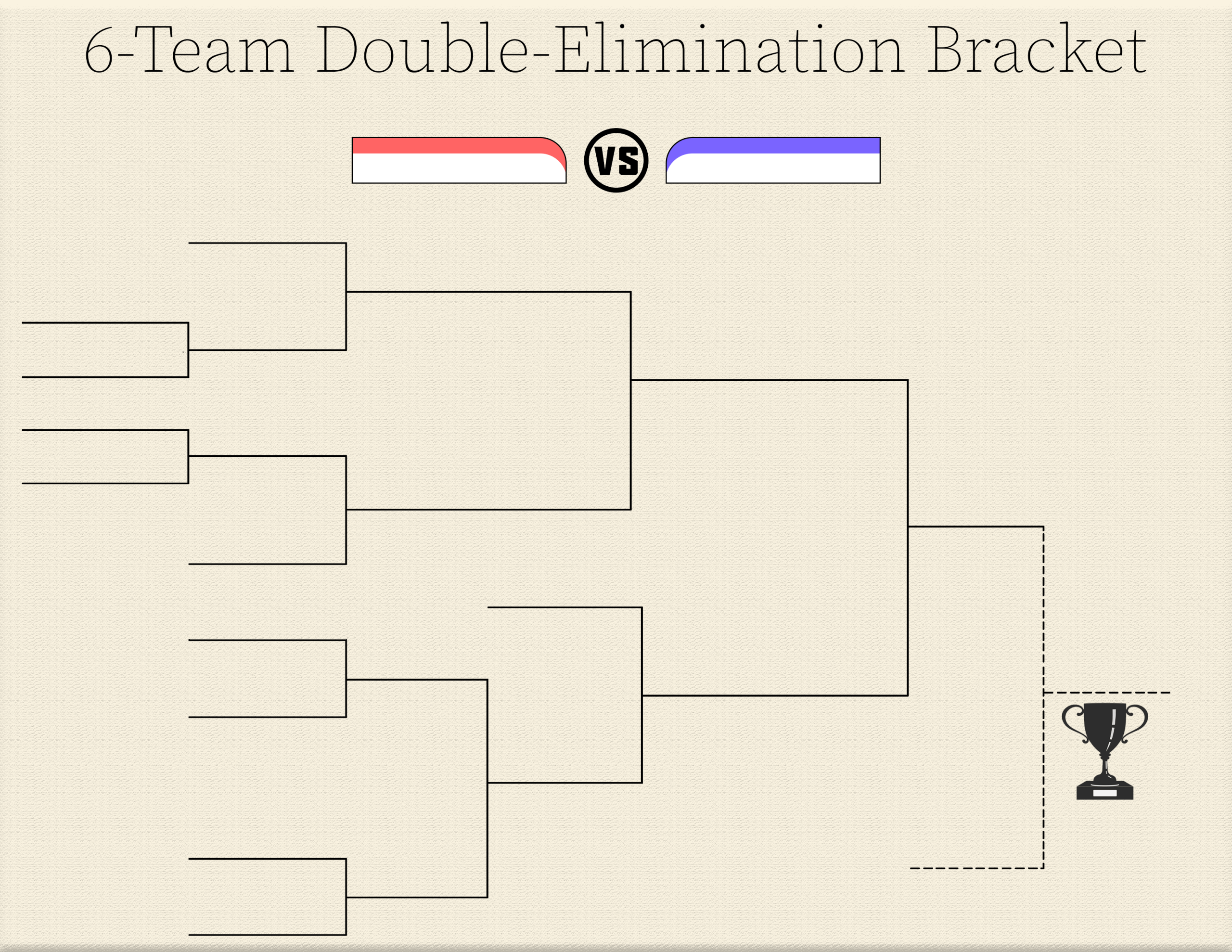
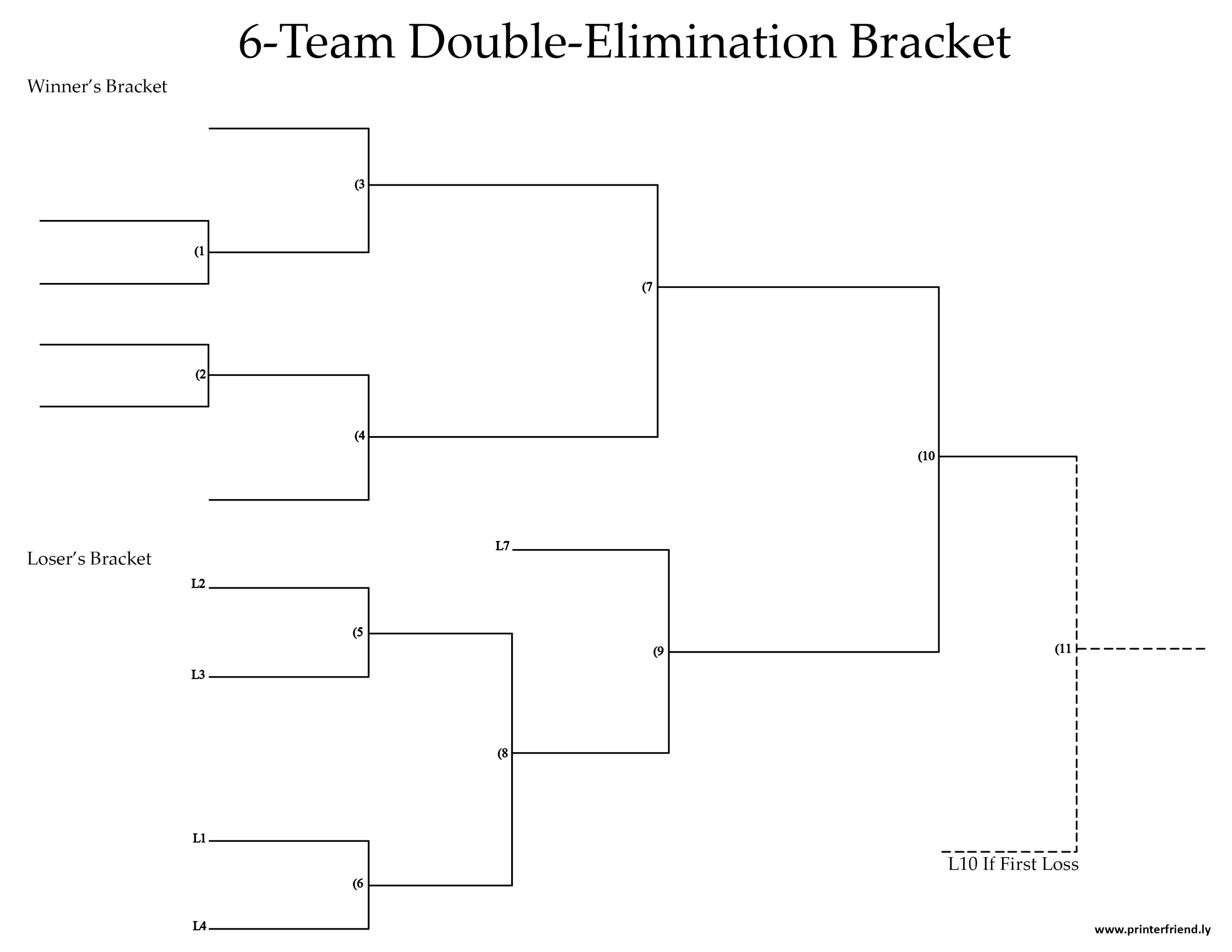
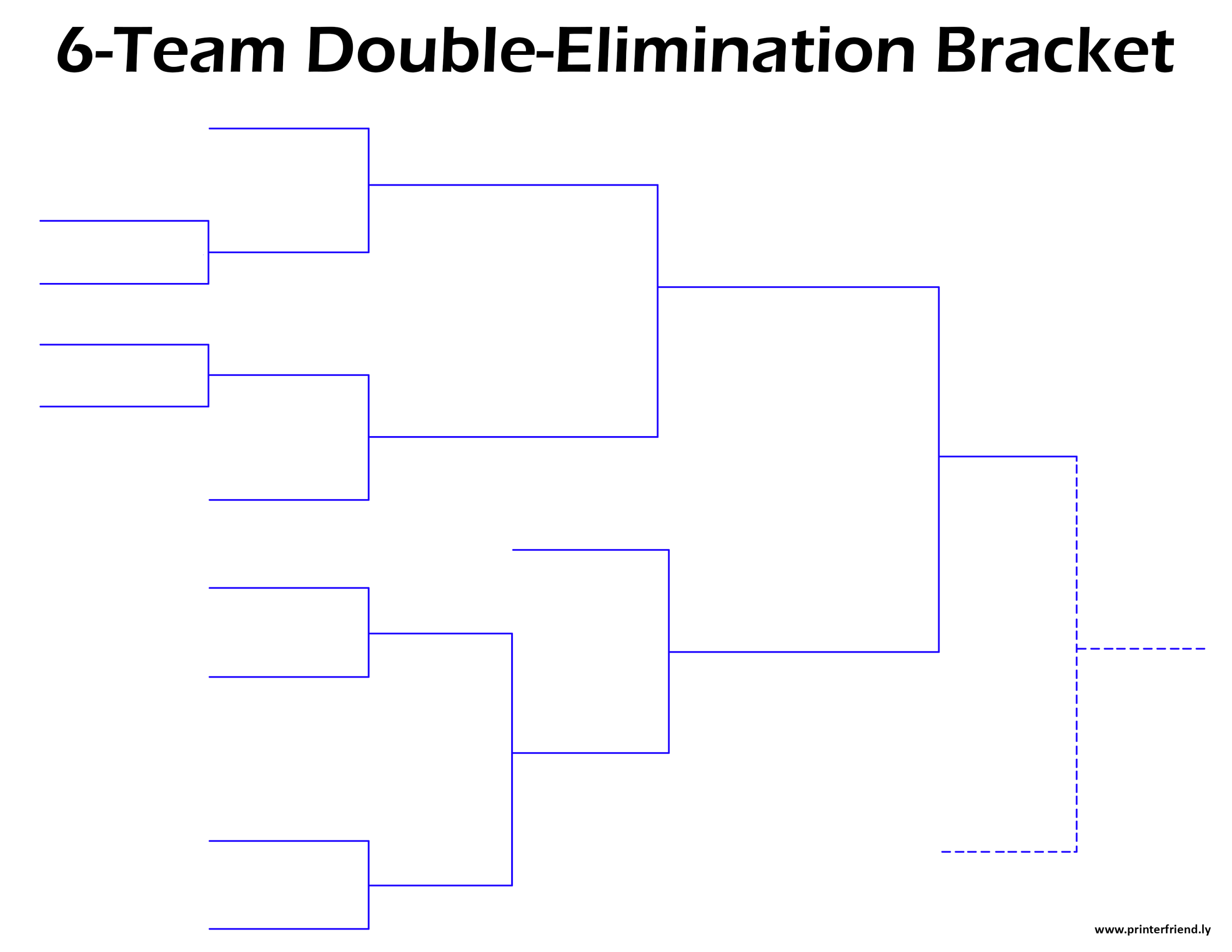
Because six is not a power of two (like 4, 8, or 16), the top two seeds earn a valuable first-round bye into Round 2 (Games 3 and 4). Meanwhile, Seeds 3 through 6 battle in opening play-in games (Games 1 and 2). Teams dropping their opening matches drop directly into the lower bracket for a fair-chance guaranteed comeback run, while winners fight to remain as the undefeated seed in upper-bracket play.
Mapping the Bracket Flow: Upper vs. Lower Tracks
Navigating match progression in a 6-team double-elimination bracket requires a clear understanding of how teams split after Round 1. Unlike single-elimination formats where a single misstep ends your day, this structure divides your field into two distinct parallel tracks: an upper path for undefeated competitors and a lower path for teams mounting a comeback.
This dual-track layout creates an intense survival narrative throughout the event. While the upper bracket rewards dominance with fewer total games and longer rest periods, the lower bracket tests a squad’s raw endurance, forcing them to navigate back-to-back elimination matches. Understanding how teams transition between these two routes ensures smooth table management and keeps participants clear on their exact pathway to the finals:
- Winner’s Bracket (Upper Track):
- Game 1: Seed 4 faces Seed 5 in opening play-in action.
- Game 2: Seed 3 faces Seed 6 in opening play-in action.
- Game 3: Seed 1 (on bye) plays the winner of Game 1.
- Game 4: Seed 2 (on bye) plays the winner of Game 2.
- Game 7: The Game 3 winner battles the Game 4 winner in the Winner’s Bracket Final. The victor advances directly to Game 10.
- Loser’s Bracket (Lower Track):
- Game 5: L2 (loser of G2) faces L3 (loser of G3) in elimination play.
- Game 6: L1 (loser of G1) faces L4 (loser of G4) in elimination play.
- Game 8: The Game 5 winner battles the Game 6 winner in the lower quarterfinals.
- Game 9: The Game 8 winner faces L7 (loser of G7) in the Loser’s Bracket Final.
This dual-path arrangement preserves unbiased progression, ensuring that every finalist earns their place on the court.

[ Download PDF ] | [ Download PNG ]
Match Sequencing & Consolation Routing (L1 to L7)
To keep scorekeepers from losing their minds, standard shorthand in a 6-team double-elimination bracket relies on clear match tags. Labels from L1 through L7 remove all guesswork when directing teams across courts.
| Game # | Matchup | Bracket Level | Winner Destination | Loser Destination |
| Game 1 | Seed 4 vs. Seed 5 | Winner’s Round 1 | Advances to Game 3 | Drops to Game 6 (L1) |
| Game 2 | Seed 3 vs. Seed 6 | Winner’s Round 1 | Advances to Game 4 | Drops to Game 5 (L2) |
| Game 3 | Seed 1 vs. Winner G1 | Winner’s Quarterfinal | Advances to Game 7 | Drops to Game 5 (L3) |
| Game 4 | Seed 2 vs. Winner G2 | Winner’s Quarterfinal | Advances to Game 7 | Drops to Game 6 (L4) |
| Game 5 | L2 vs. L3 | Loser’s Round 1 | Advances to Game 8 | Eliminated (T-5th Place) |
| Game 6 | L1 vs. L4 | Loser’s Round 1 | Advances to Game 8 | Eliminated (T-5th Place) |
| Game 7 | Winner G3 vs. Winner G4 | Winner’s Bracket Final | Advances to Game 10 | Drops to Game 9 (L7) |
| Game 8 | Winner G5 vs. Winner G6 | Loser’s Quarterfinal | Advances to Game 9 | Eliminated (4th Place) |
| Game 9 | Winner G8 vs. L7 | Loser’s Bracket Final | Advances to Game 10 | Eliminated (3rd Place) |
| Game 10 | Winner G7 vs. Winner G9 | Championship Match | Champion (if Winner G7 wins) | Moves to Game 11 (if first loss) |
| Game 11 | Winner G10 vs. Loser G10 | “If-Necessary” Reset | Champion | 2nd Place |
Following explicit consolation routing lets directors sequence matches smoothly, eliminating court downtime and maintaining full venue energy.
Championship Finals & The “If-Necessary” Reset Rule
The final round brings a dramatic structural wrinkle inherent to the 6-team double-elimination bracket. Entering Game 10, the upper-bracket survivor (Winner G7) enters with zero losses, while the lower-bracket challenger (Winner G9) enters with one loss.
If the undefeated upper seed wins Game 10, the championship match concludes, and they claim the trophy outright. However, if the lower-bracket challenger wins Game 10, they force a reset by handing the top seed its first defeat of the day. Because both teams now possess a 1-loss record, a secondary “if-necessary” game (Game 11) is triggered immediately. The victor of Game 11 captures the championship.
Double-Elim Brackets: Seeded vs. Blind-Draw
Choosing how to set up your 6-team double-elimination bracket depends on your group’s dynamic. A seeded structure works best when league standings or ranking data exist, rewarding top performers with those critical opening byes (Seeds 1 and 2). For casual pickup tournaments, corporate events, or social gaming, a randomized blind-draw ensures total fairness.
Regardless of your entry method, relying on a pre-built turnkey bracket design ensures you deliver an error-free printable chart for public display. Directors can also use digital templates to bracketize live scoring updates straight to participants’ phones.
Event Day Operations: Rest Intervals, Scoring, and Tie-Breaks

[ Download PDF ] | [ Download PNG ]
Operational success when running a 6-team double-elimination bracket relies heavily on managing player fatigue. Lower-bracket survivors often have to play Game 8, Game 9, and Game 10 in rapid succession. Tournament hosts should enforce a mandatory 15-minute rest interval before lower-bracket finals to keep matches competitive and prevent injury.
Enforce swift score-reporting protocols at the scorer’s table to guarantee a flawless tournament flow and seamless execution. Lastly, never resolve draws with coin flips or point differentials—always execute a sudden-death overtime period to preserve double-elimination integrity.
Related Double-Elimination Brackets:
- Printable Pickleball 32-Team Bracket – Double Elimination Tournament
- Free Pickleball Bracket: 64-Player Double Elimination Bracket
- Printable Pickleball 16-Player Double Elimination Bracket

I’m a passionate designer with a keen eye for detail and a love for crafting visually stunning experiences. With a strong foundation in design tools like Adobe Photoshop, Illustrator, and Figma, I bring ideas to life through compelling visuals. My proficiency in HTML and CSS allows me to translate designs into functional, responsive websites. I’m always eager to learn and explore new design trends and excited to contribute my skills to innovative projects.