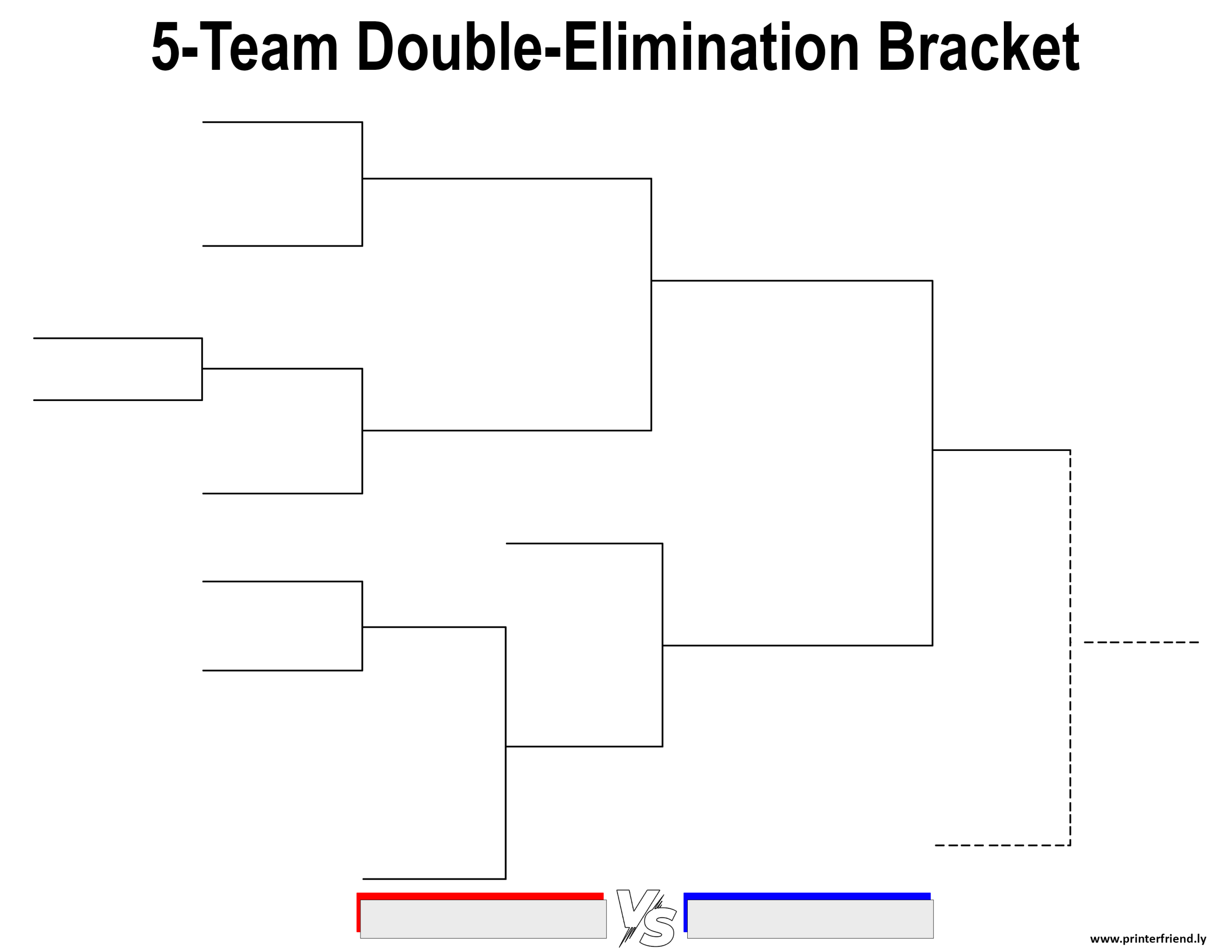
Printable 5-Team Double Elimination Bracket Template

An odd number of competitors is the bane of any tournament director’s existence, but five teams present a particularly annoying logistical puzzle. Run a standard round-robin, and you end up with ten lengthy matches where teams spend half the day sitting out on forced byes. Opt for single elimination instead, and two teams get packed up and sent home after playing just a single match.
That’s precisely why this free 5-team double-elimination bracket remains the secret weapon for seasoned event coordinators. It eliminates awkward mathematical standoffs while guaranteeing every single roster gets the playing time they paid for.
This printable PDF delivers absolute minimum-match assurance wrapped neatly in a forgiving second-chance format. Requiring just eight to nine total games, it provides a schedule-efficient, rapid-turnaround structure that keeps your venue buzzing and your schedule running like clockwork.
[ Download PDF ] | [ Download PNG ]
How the Two-Loss Rule Works
The governing philosophy of a 5-team double-elimination bracket is straightforward: no team is officially eliminated until they suffer two total match losses. This simple rule protects your event from fluke bad bounces and guarantees that every participant gets a legitimate, stress-free run at the trophy.
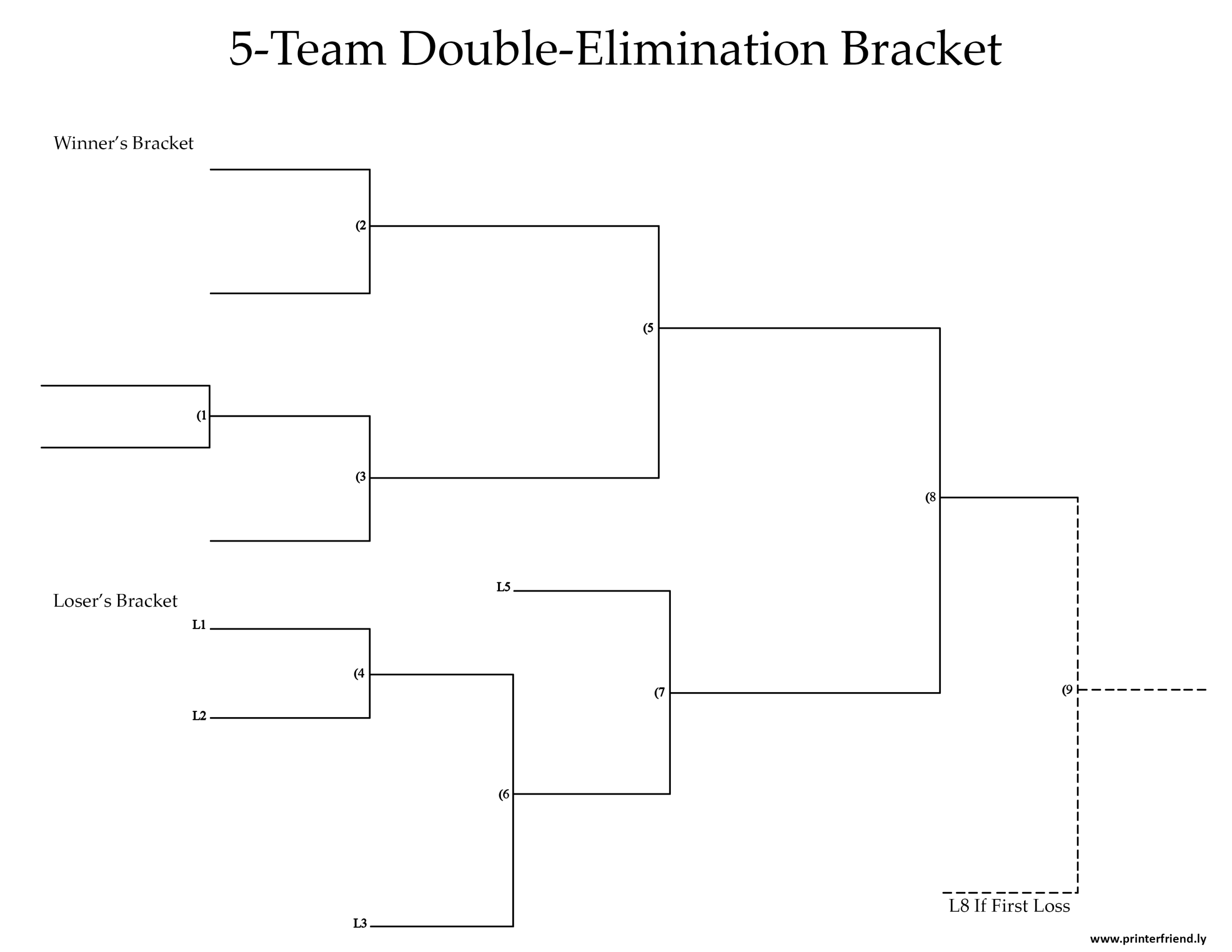
Because five is an odd number, higher-ranked teams are rewarded with a first-round bye based on regular-season performance or drawn seeds. In a standard setup, Seeds 1, 2, and 3 skip the opening round, while Seeds 4 and 5 clash in Game 1. The team dropping that play-in match receives a fair-chance guaranteed pathway through the lower bracket to rebound, while top teams battle to keep their status as the undefeated seed.

[ Download PDF ] | [ Download PNG ]
Navigating Bracket Pathways: Winner vs. Loser Flow
Navigating match progression in a 5-team double-elimination bracket requires a clear understanding of how teams split after Round 1. Unlike single-elimination formats where a single misstep ends your day, this structure divides your field into two distinct parallel tracks: an upper path for undefeated competitors and a lower path for teams mounting a comeback.
This dual-track layout creates an intense survival narrative throughout the event. While the upper bracket rewards dominance with fewer total games and longer rest periods, the lower bracket tests a squad’s raw endurance, forcing them to navigate back-to-back elimination matches. Understanding how teams transition between these two routes ensures smooth table management and keeps participants clear on their exact pathway to the finals:
- Winner’s Bracket (Upper Track):
- Game 1: Seed 4 faces Seed 5 in the play-in match.
- Game 2: Seed 1 plays Seed 2 in the upper quarterfinals.
- Game 3: Seed 3 faces the winner of Game 1.
- Game 5: The Game 2 winner battles the Game 3 winner in the Winner’s Bracket Final. The victor advances straight to Game 8.
- Loser’s Bracket (Lower Track):
- Game 4: L1 (loser of G1) faces L2 (loser of G2) in the first elimination match.
- Game 6: The winner of Game 4 advances to face L3 (loser of G3).
- Game 7: The winner of Game 6 advances to face L5 (loser of G5) in the Loser’s Bracket Final.
This layout maintains an unbiased progression, ensuring that every finalist earns their spot through clear performance.
Match Sequencing & Consolation Routing (L1 to L5)
To keep scorekeepers from losing their minds, standard shorthand in a 5-team double-elimination bracket relies on clear match tags. Labels from L1 down to L5 remove all guesswork when directing teams across the floor.
| Game # | Matchup | Bracket Level | Winner Destination | Loser Destination |
| Game 1 | Seed 4 vs. Seed 5 | Winner’s Bracket | Advances to Game 3 | Drops to Game 4 (L1) |
| Game 2 | Seed 1 vs. Seed 2 | Winner’s Bracket | Advances to Game 5 | Drops to Game 4 (L2) |
| Game 3 | Seed 3 vs. Winner G1 | Winner’s Bracket | Advances to Game 5 | Drops to Game 6 (L3) |
| Game 4 | L1 vs. L2 | Loser’s Bracket | Advances to Game 6 | Eliminated (5th Place) |
| Game 5 | Winner G2 vs. Winner G3 | Winner’s Bracket Final | Advances to Game 8 | Drops to Game 7 (L5) |
| Game 6 | Winner G4 vs. L3 | Loser’s Bracket Quarter | Advances to Game 7 | Eliminated (4th Place) |
| Game 7 | Winner G6 vs. L5 | Loser’s Bracket Final | Advances to Game 8 | Eliminated (3rd Place) |
| Game 8 | Winner G5 vs. Winner G7 | Championship Match | Champion (if Winner G5 wins) | Moves to Game 9 (if first loss) |
| Game 9 | Winner G8 vs. Loser G8 | “If-Necessary” Reset | Champion | 2nd Place |
Following explicit consolation routing lets directors sequence matches smoothly, eliminating awkward court downtime and keeping spectators fully engaged.
The Finals & The “If-Necessary” Reset Rule
The final round brings a dramatic structural wrinkle inherent to the 5-team double-elimination bracket. Entering Game 8, the upper-bracket survivor (Winner G5) holds a 0-loss record, while the lower-bracket challenger (Winner G7) enters with one loss already on their ledger.
If the undefeated upper seed wins Game 8, the championship match ends immediately, and they claim the trophy. However, if the lower-bracket victor wins Game 8, they force a reset by handing the top seed its very first defeat. Because both teams now sit at 1-1, a secondary “if-necessary” game (Game 9) is triggered on the spot. The winner of Game 9 takes the entire event.
Seeded vs. Blind-Draw
Choosing how to set up your 5-team double-elimination bracket depends on your group’s dynamic. A seeded structure works best when prior ranking data exists, rewarding top performers with those coveted early byes (Seeds 1, 2, and 3). For casual weekend meetups, rec leagues, or corporate tournaments, a randomized blind-draw keeps things casual and unpredictable.
Regardless of your entry method, relying on a pre-built turnkey bracket design ensures you deliver an error-free printable for physical scoreboards or bulletin boards. Directors can also leverage interactive digital files to bracketize the schedule, updating live scores directly onto participants’ mobile phones.
Event Day Tips: Rest Intervals, Scoring, and Tie-Breakers

[ Download PDF ] | [ Download PNG ]
Operational success when running a 5-team double-elimination bracket relies heavily on managing player fatigue. Because the lower-bracket survivor must navigate Game 6 and Game 7 back-to-back before reaching the finals, coordinators should enforce a mandatory 15-minute rest interval between lower-bracket rounds. This quick breather levels the playing field without stalling overall tournament pace.
Enforce swift score-reporting protocols at the scorer’s table to guarantee a flawless tournament flow and seamless execution. Lastly, never resolve draws with coin flips or arbitrary point math—always execute a sudden-death overtime period to preserve absolute competitive integrity.
Related Double-Elimination Brackets:
- Printable Pickleball 32-Team Bracket – Double Elimination Tournament
- Free Printable Pickleball 12-Player Double Elimination Bracket
- Printable Pickleball 16-Player Double Elimination Bracket

I’m a passionate designer with a keen eye for detail and a love for crafting visually stunning experiences. With a strong foundation in design tools like Adobe Photoshop, Illustrator, and Figma, I bring ideas to life through compelling visuals. My proficiency in HTML and CSS allows me to translate designs into functional, responsive websites. I’m always eager to learn and explore new design trends and excited to contribute my skills to innovative projects.