Free, Printable Baseball Scorecard and Score Sheet for Beginners
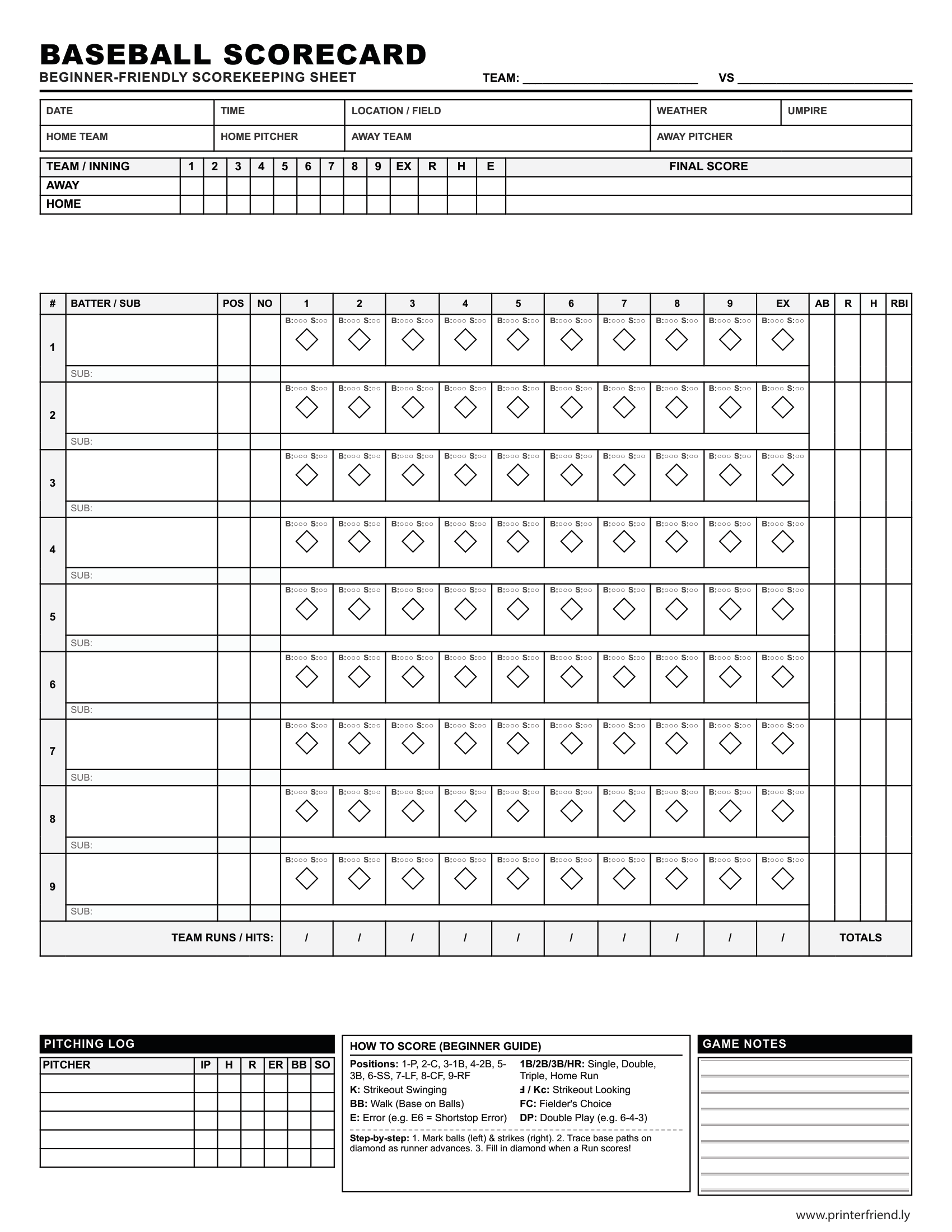
Taking up scorekeeping at a live game can feel a bit like trying to solve a high-level math equation while holding a melting hot dog in one hand and dodging a foul ball with the other. You look at the person sitting next to you calmly scribbling mysterious hieroglyphics into a little booklet, and suddenly you wonder if you missed a secret orientation meeting.
The good news is that learning to track a ballgame isn’t rocket science. Utilizing our printable baseball scorecard for beginners is a surprisingly fun way to connect with the action on a deeper level. With our trusty scorebook in hand, anyone can turn that chaotic box of empty squares into an intuitive visual story of all nine innings.
To make things easier, we offer high-res PDF baseball scorecard templates for free. So you aren’t scribbling in a notebook and can actually enjoy the game.
[ Download PDF ] | [ Download PNG ]
Baseball Scorekeeping 101: Navigating the Grid
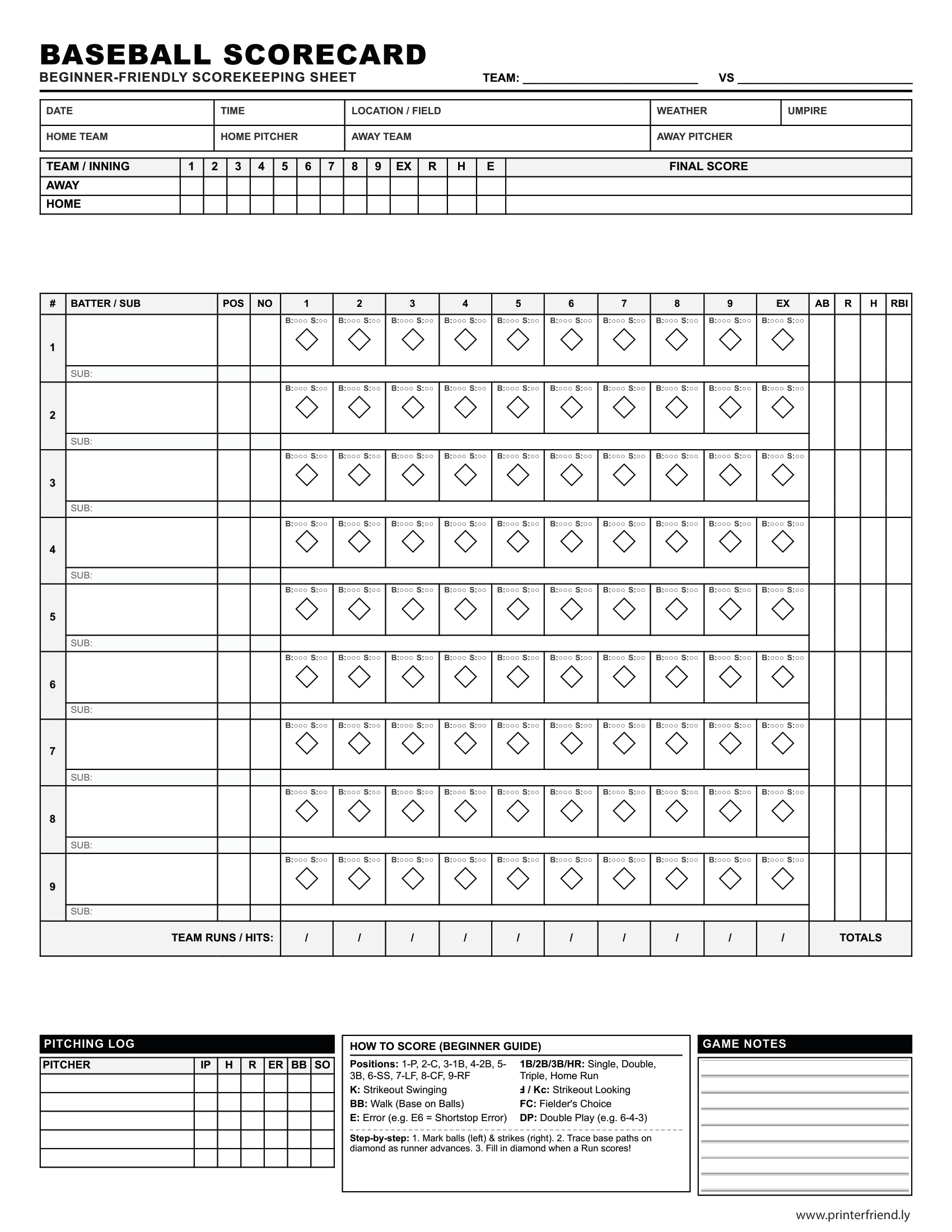
When you open up a game sheet for the first time, you are greeted by a massive grid of boxes that looks like a miniature baseball diamond repeated dozens of times. Each horizontal row represents a specific player in the batting order, while each vertical column corresponds to a single inning. To keep things simple, every position on the field is assigned a standardized number from 1 to 9, creating a universal system that every fan can read.
Understanding this system allows you to record every single at-bat with clarity. When a batter steps up to the plate, you track the count of balls and strikes in the small corner boxes before recording the outcome. Whether a player hits a clean single or strikes out, your notation keeps a running history of the action.
Using our free Baseball Scorecard for Beginners helps strip away the mystery so you can easily chart the game as it unfolds. To help you get started, here is how the field positions are numbered:
- 1: Pitcher
- 2: Catcher
- 3: First Baseman
- 4: Second Baseman
- 5: Third Baseman
- 6: Shortstop
- 7: Left Fielder
- 8: Center Fielder
- 9: Right Fielder
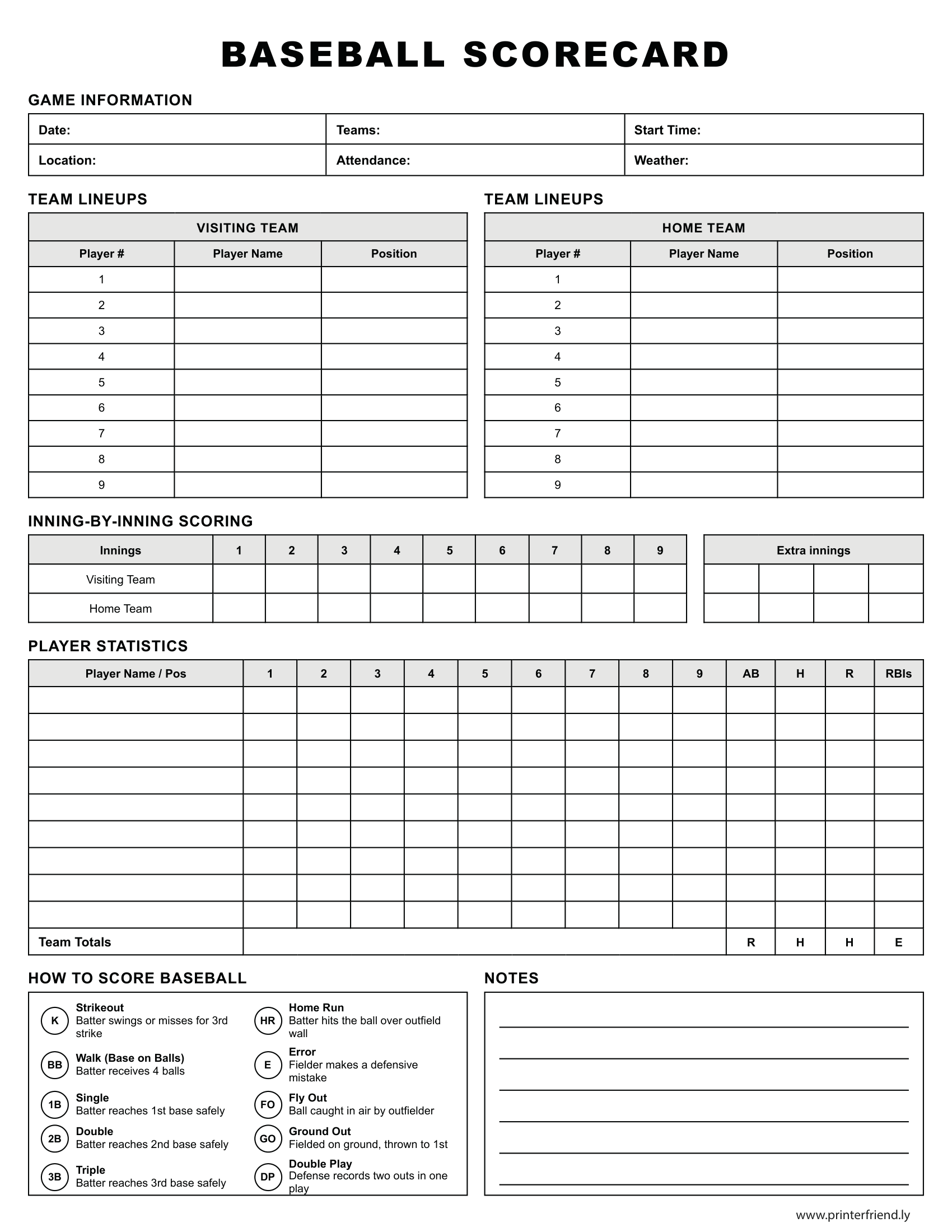
Every classic scorecard includes a helpful legend near the bottom to remind you of these positional numbers whenever you get stuck. Once you memorize these nine numbers, the entire printable baseball sheet begins to make sense.
[ Download PDF ] | [ Download PNG ]
A Newbie Guide to Marking Plays
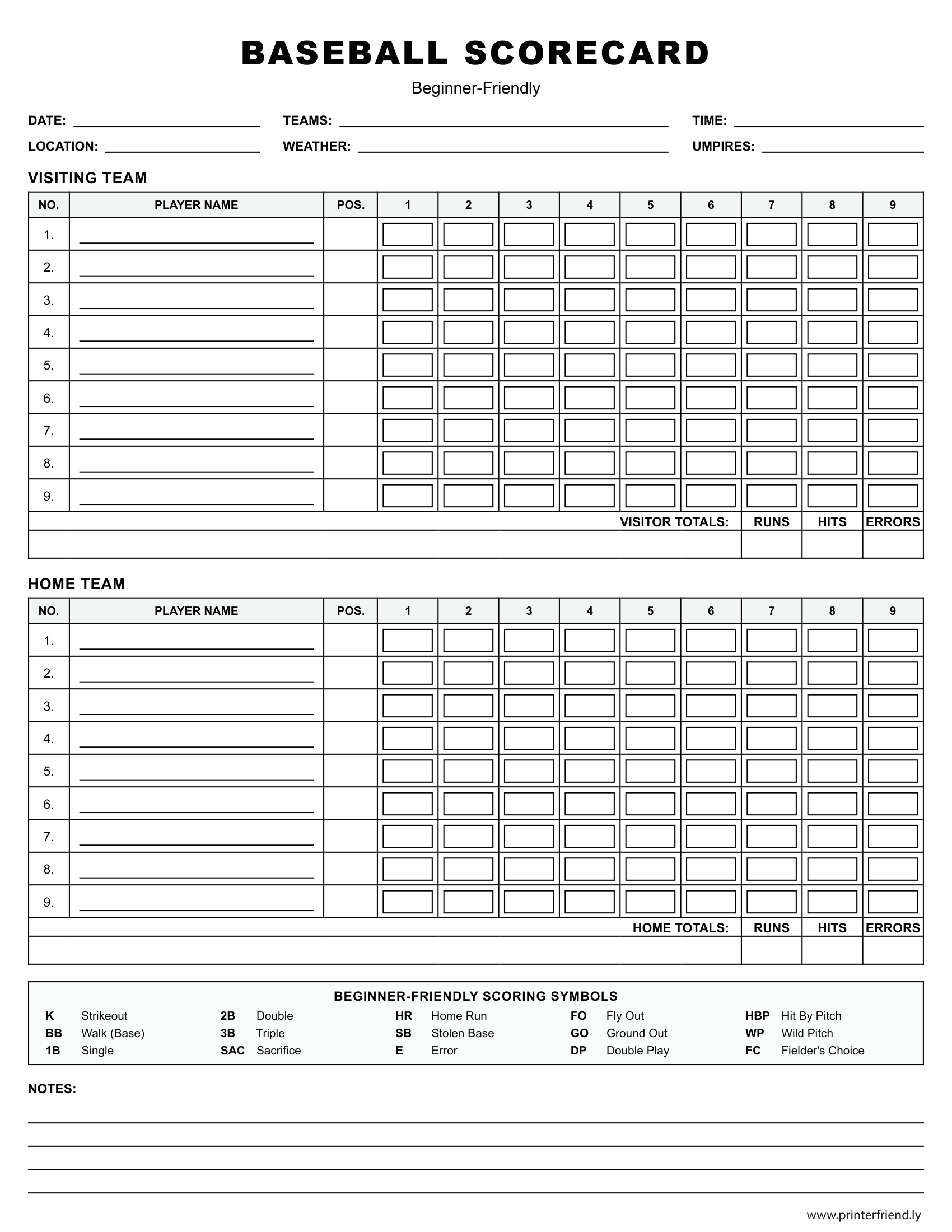
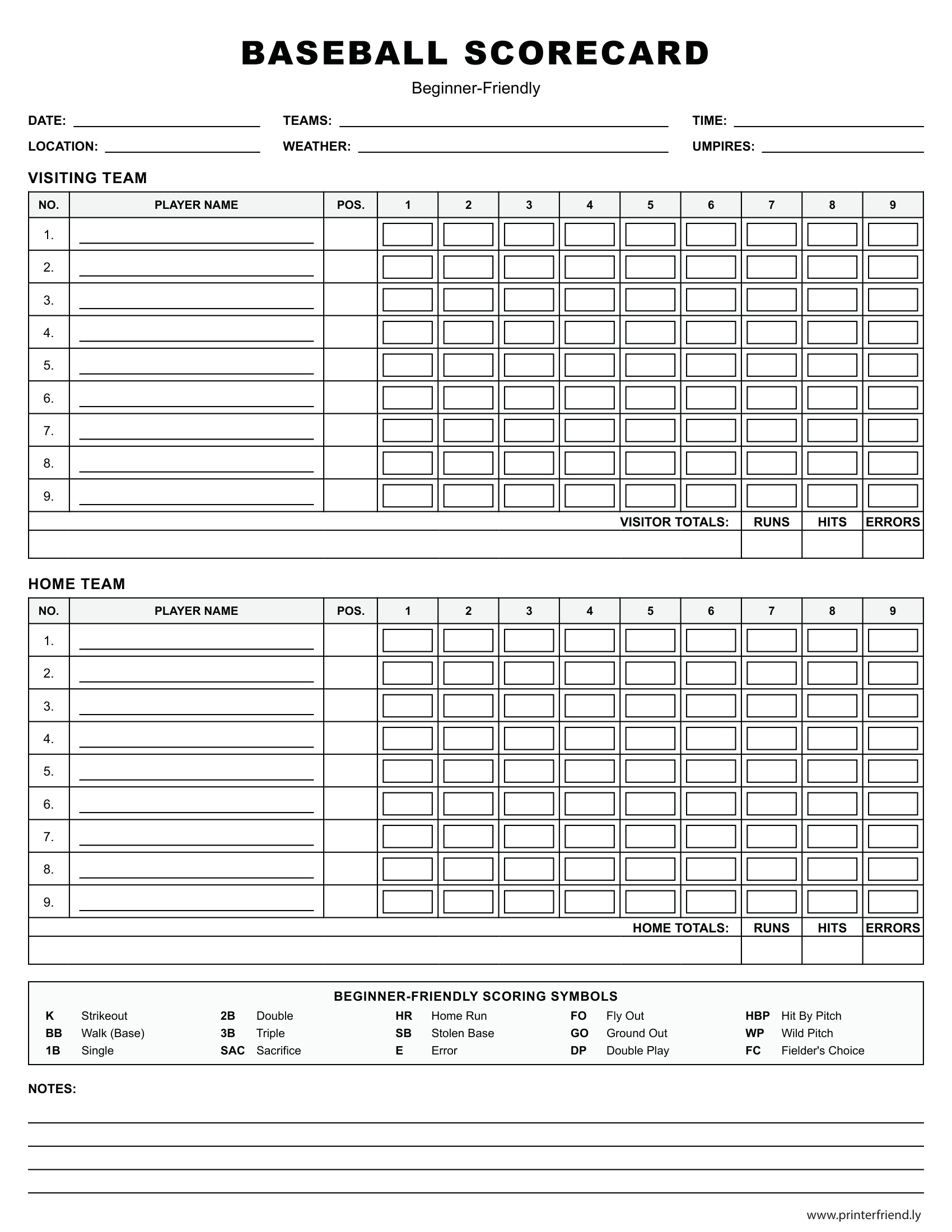
Now that you know where players stand, it is time to log what happens when the ball is hit into play. Instead of writing long sentences, scorekeepers abbreviate common plays using short letter codes. For example, a single is “1B,” a walk is “BB,” and a strikeout is “K.”
When a player hits the ball, you map their movement around the mini-diamond inside the square. You draw a line from home plate to first base for a single, and if a teammate drives them home, you circle or shade in the diamond to represent a run scored. This clear sequence of marks creates a visual history that allows you to document every highlight without missing a pitch.
Whenever you bring our printable Baseball Scorecard for Beginners to the ballpark, you will find that recording these quick shorthand codes becomes second nature.
Mastering the Baseball Scorecard Sheet for Clean Results
With a little bit of practice, what once felt like a confusing task quickly becomes a seamless and relaxing ballpark habit. Having mastered the fundamental symbols, you will find that keeping an error-free tally of hits, runs, and outs is both fun and rewarding. The entire process becomes surprisingly effortless after just a few games in the stands.
[ Download PDF ] | [ Download PNG ]
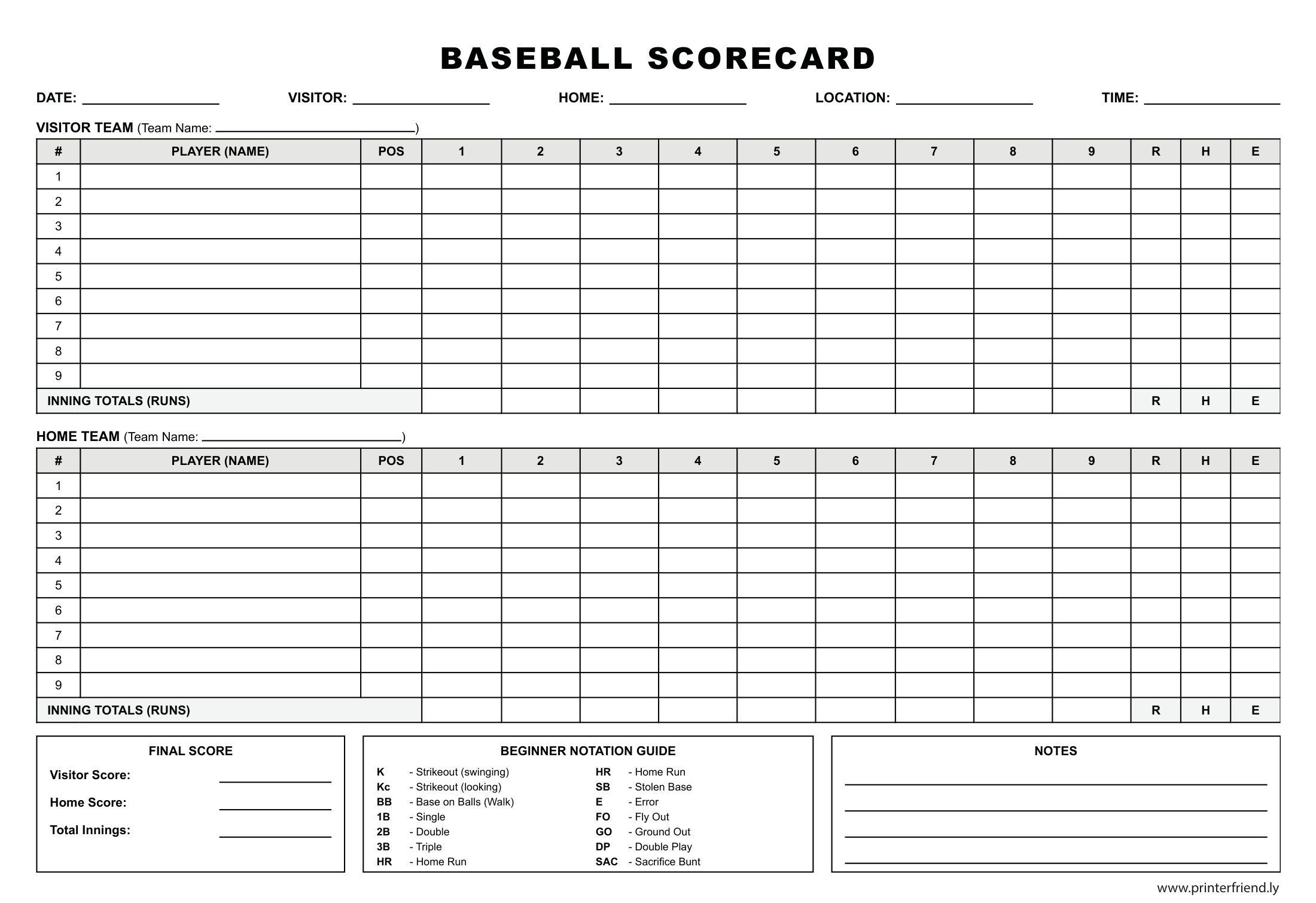
As games progress into late innings, keeping your sheet organized requires a systematic approach. Substituted players and pitching changes can throw off a casual viewer, but seasoned scorekeepers handle these mid-game shifts with ease. By drawing a simple line beneath a replaced player’s name and writing the substitute right below it, you preserve the natural flow of the lineup without cluttering your workspace.
A comprehensive record gives you a personal souvenir of the game that no mobile app can replicate. To ensure your paper remains streamlined and precise from the ceremonial first pitch to the final out, keep these practical habits in mind:
- Use a sharp pencil: Mistakes happen to everyone, and a good eraser keeps your page looking crisp and tidy.
- Stay attentive between pitches: Watch the umpire’s signals closely so your pitch counts and ball-strike balances stay accurate.
- Keep it simple early on: Don’t worry about capturing every minor defensive shift on your first try; focus on recording the primary plays first.
- Tally totals after each half-inning: Summarizing runs, hits, and errors right away prevents mathematical pile-ups at the end of the night.
Relying on our Baseball Scorecard for Beginners gives you all the tools you need to build confidence while enjoying America’s favorite pastime.
Beginner Track Baseball Scorecard Sheet Outline
[ Download PDF ] | [ Download PNG ]
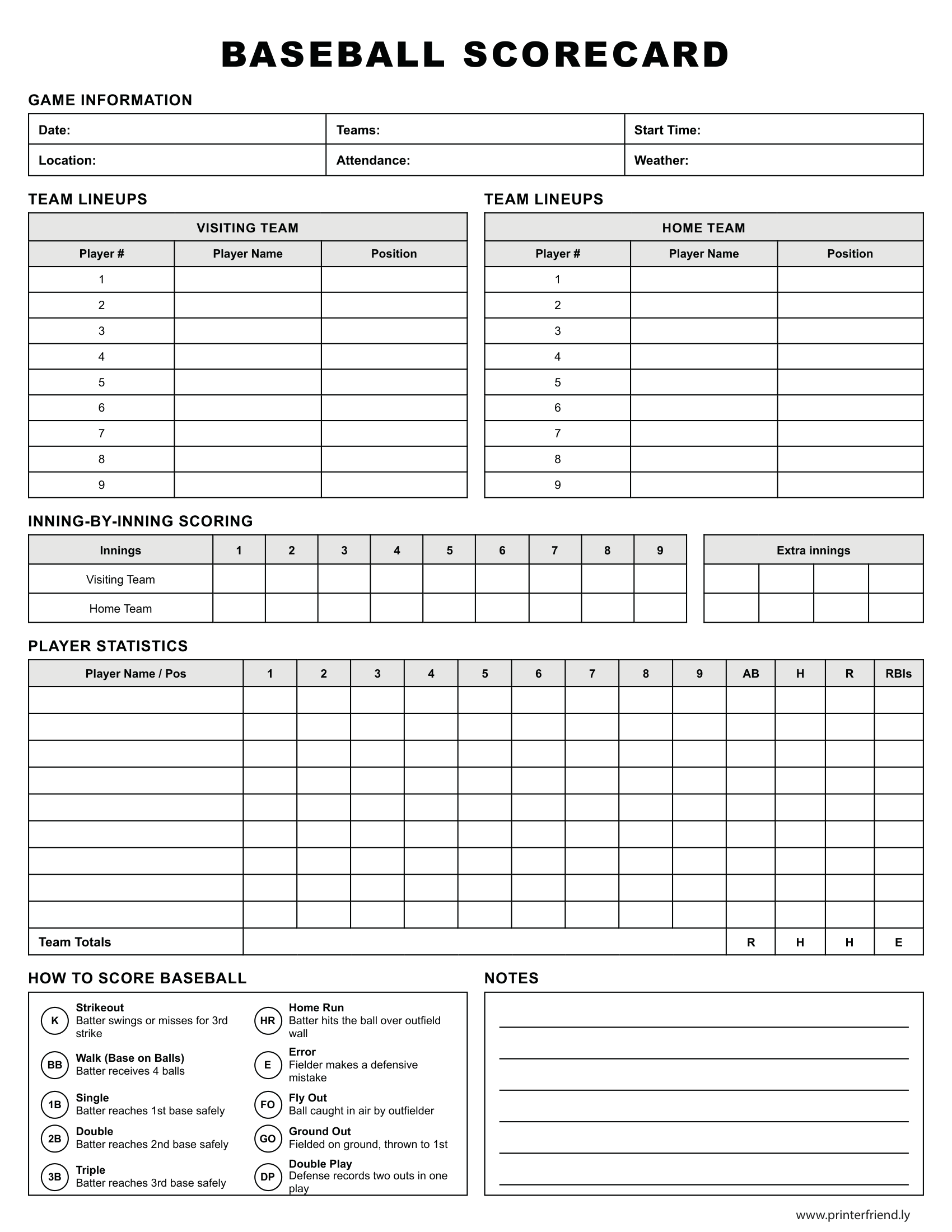
If you are planning a step-by-step approach to studying this craft, this structured roadmap outlines everything covered in our Baseball Scorecard for Beginners guide. Building your skills gradually ensures that you won’t feel overwhelmed when the bats start swinging fast.
Starting with fundamental layout mechanics before moving on to complex base-running scenarios will give you a rock-solid foundation. Here is a complete breakdown of what to learn at each stage:
- Module 1: The Basics and Field Layout
- Understanding grid orientation, inning headers, and individual batter boxes
- Memorizing the universal fielding position numbers (1 through 9)
- Identifying key abbreviations on the standard bottom legend
- Module 2: Recording At-Bats and Ball-Strike Counts
- Tracking balls, strikes, fouls, and full counts in box corners
- Marking basic hits (1B, 2B, 3B, HR) versus defensive outs (groundouts, flyouts)
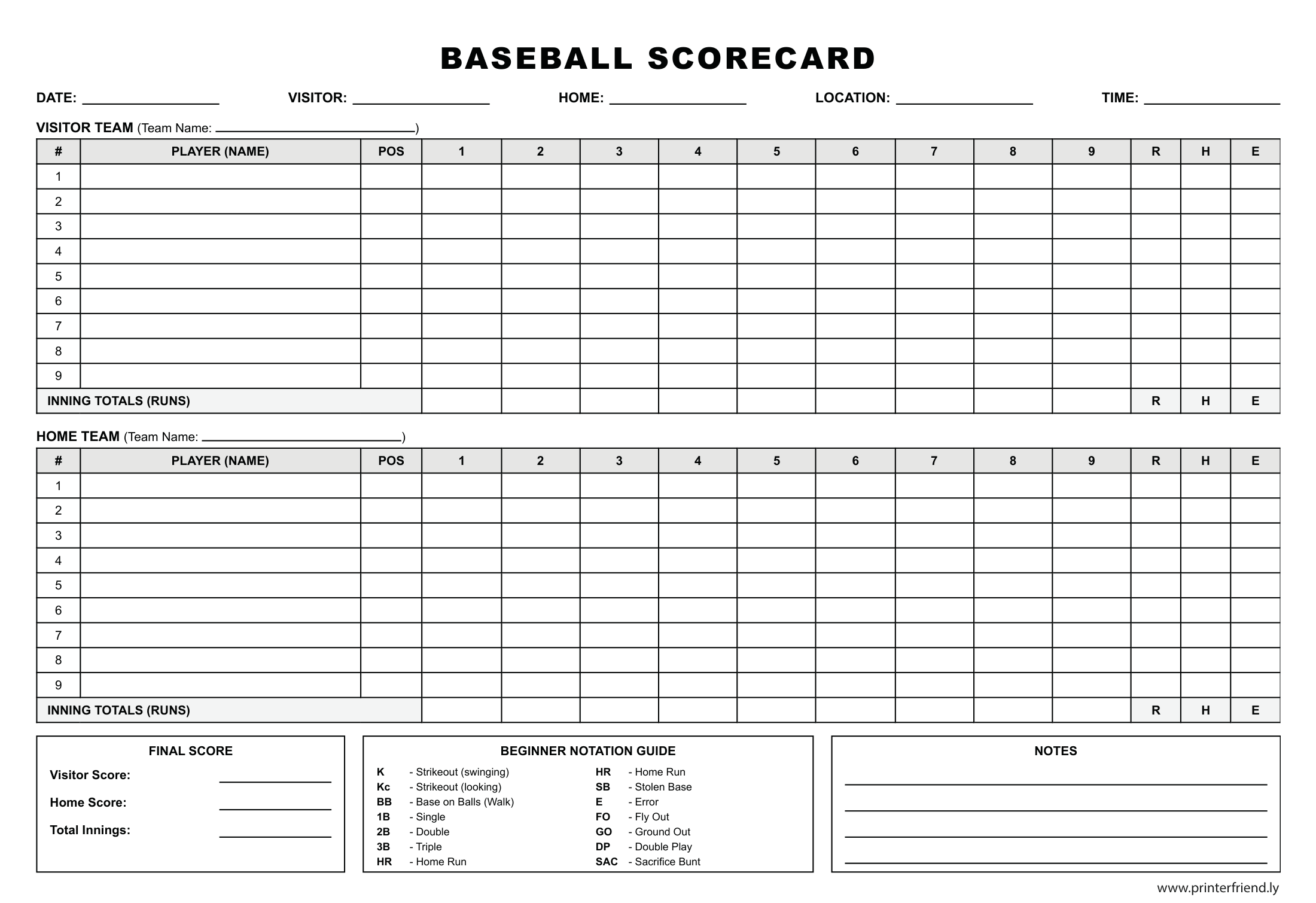
- Differentiating between swinging strikeouts (“K”) and looking strikeouts (“Kc”)
- Module 3: Base Running, Advances, and Scoring
- Drawing progress paths along the diamond lines as runners advance
- Recording steals, wild pitches, passed balls, and fielder’s choices
- Filling in or shading the central diamond to credit runs scored and earned RBIs
- Module 4: Roster Changes and Inning Summaries
- Managing mid-game substitutions, pinch hitters, and relief pitchers correctly
- Tallying total runs, hits, errors, and left-on-base runners per half-inning
- Closing out the official scorebook summary at the final whistle
By taking the time to review these core concepts before heading to the ballpark, you will be fully prepared to document every single play like a pro.
Explore more Score Sheet Templates:
- Free, Printable Cricket Blank Score Sheets for T20 Matches
- Printable Hockey Score Sheet Template for Every League Including the NHL
- Free, Printable Pickleball Score Sheet Templates

I’m a passionate designer with a keen eye for detail and a love for crafting visually stunning experiences. With a strong foundation in design tools like Adobe Photoshop, Illustrator, and Figma, I bring ideas to life through compelling visuals. My proficiency in HTML and CSS allows me to translate designs into functional, responsive websites. I’m always eager to learn and explore new design trends and excited to contribute my skills to innovative projects.