Free, Printable Cursive Handwriting Practice Sheets to Improve Handwriting

If your signature looks like a single wavy line drawn by someone riding a lawnmower, you’re in very good company. Let’s be honest: for a lot of us, cursive was something we learned in elementary school, abandoned the second we got laptops, and put on display when we need to sign a credit card receipt or lease agreement.
While typing rules modern communication, and autocorrect quietly covers for our worst habits, physical handwriting is far from obsolete. Dedicating time to cursive is a low-tech upgrade for your brain, fine motor skills, and memory retention, if only to ensure you can actually decipher your own grocery list tomorrow.
Whether you’re a student refining your style or an adult trying to prove that pens haven’t completely defeated you, mastering the core loops and slants is where the magic happens. Grab a printable cursive handwriting practice sheet, slow down, and turn those chaotic scribbles into an actual art form.
| Download PDF |
What We Included in Our Cursive Handwriting Practice Sheets
Our printable cursive handwriting practice sheets provide a structured, accessible foundation for learners of all skill levels.
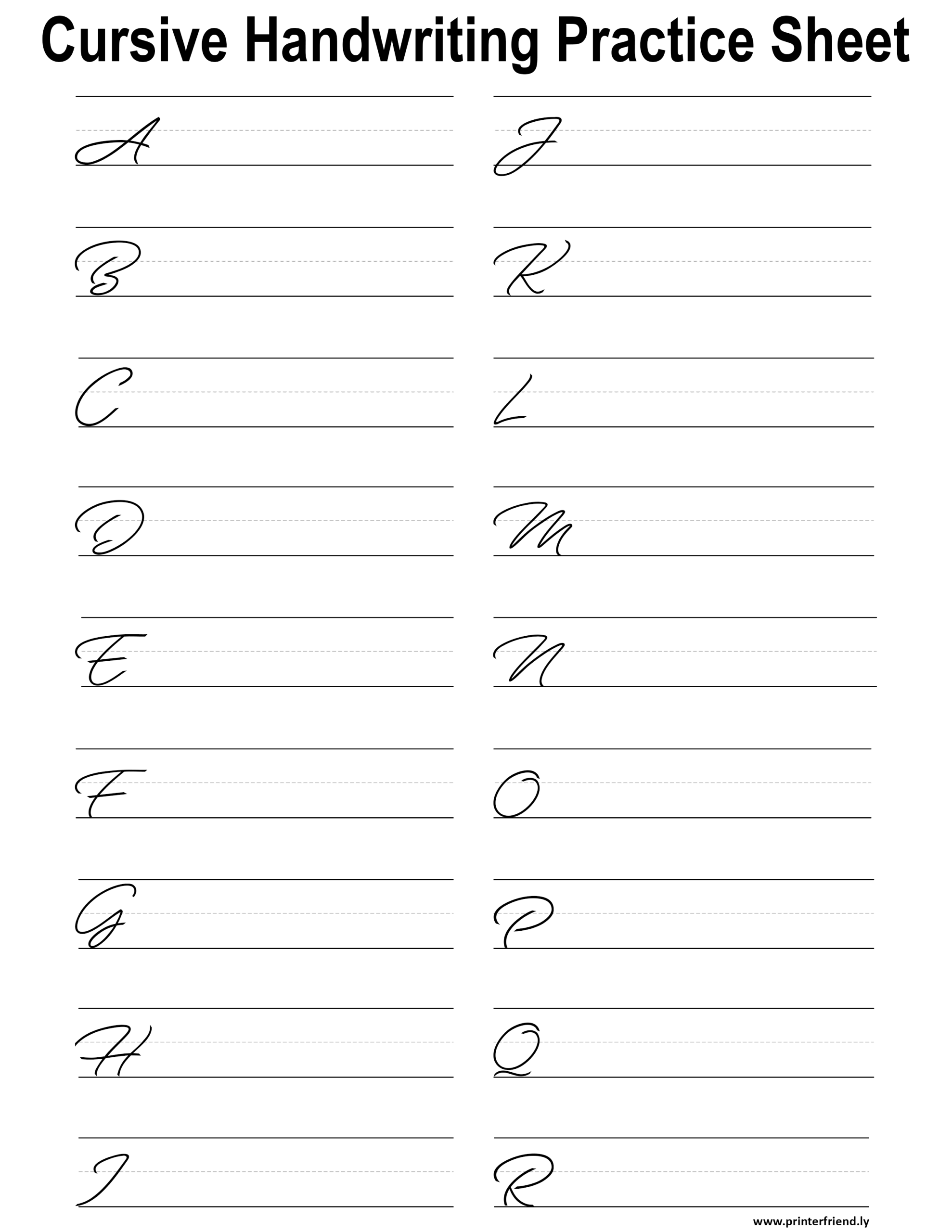
- Uppercase Alphabet and Numbers Reference Sheet: Features clean, solid uppercase letter models (A through Z) and numbers set on ruled lines for visual study and form reference.
- Dotted Alphabet Tracing Worksheets: Includes complete uppercase and lowercase letter pairs (Aa through Zz) alongside numbers in dotted tracing fonts to build fine motor control and stroke consistency.
- Dotted Word Tracing Worksheet: Features dotted practice words—including onion, vector, bloom, browser, Twelve, rhythm, aquarium, and quizzical—to master tricky letter connections and spacing.
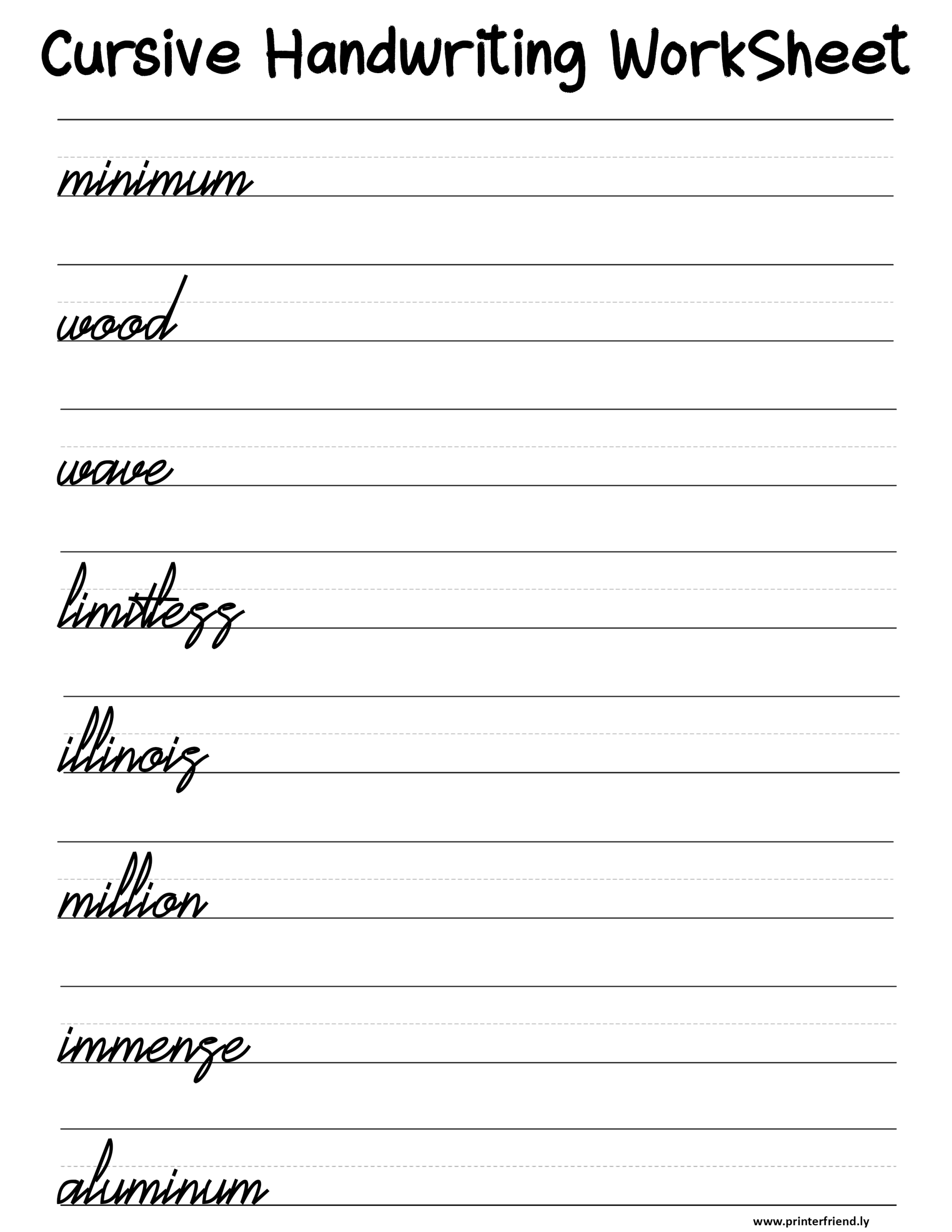
- Advanced Word Practice Sheet: Provides solid cursive models of complex word patterns (such as minimum, wood, wave, limitless, illinois, million, immense, and aluminum) for independent copying and speed building.
| Download PDF |
Understanding the Basics of Letter Formation
Before diving into complex words and multi-syllable vocabulary, it helps to break down the alphabet into manageable, individual parts.
- Focus on Structure: Spend dedicated time examining how individual uppercase and lowercase letters are constructed. Cursive relies on specific fundamental movements—such as undercurves, overcurves, slants, and loops. Paying close attention to entry strokes, exit tails, and overall height consistency ensures each character stands out clearly.
- Group by Letter Families: Rather than practicing strictly in alphabetical order, group letters that share similar initial strokes together. For instance, lowercase a, d, g, q, and c all originate from a counterclockwise oval foundation. Mastering these natural movement families accelerates your spatial awareness and stroke consistency.
- Build Consistency: Recognizing the unique curves and slants of each letter provides the necessary foundation before you start connecting them into fluid words. Uniformity in letter height relative to the midline (or x-height) is what separates messy handwriting from clean, professional penmanship.
- Establish Rhythm: Developing a steady pacing early on prevents common hand fatigue and keeps your letter proportions uniform across the entire page. Smooth, rhythmic movements ensure that your text maintains a balanced appearance from margin to margin. These core structural guidelines are built directly into standard printable cursive handwriting practice sheets for daily guidance.
| Download PDF |
How to Practice and Improve Your Technique
Once you are familiar with the basic shapes, the next step is regular, structured execution. Consistent practice is what turns awkward strokes into smooth, flowing handwriting.
- Optimize Posture and Paper Angle: Proper execution starts before your pen touches the paper. Sit up straight with both feet flat on the floor, and tilt your paper at roughly a 30-to-45-degree angle (slanted left for right-handers, slanted right for left-handers). This natural tilt makes achieving a uniform forward slant effortless.
- Trace and Repeat: Use guided sheets to trace individual letterforms carefully. Focus on driving the motion with your forearm and shoulder rather than squeezing tightly with your fingers. Repetition encodes physical movements into your procedural memory, making fluid loops second nature over time.
- Connect the Strokes: Focus on how individual letters flow into one another. Particular attention should be paid to high-connecting letters like b, o, v, and w, which join at the midline rather than returning to the baseline. Smooth, seamless transitions are the absolute secret to legible cursive script.
- Refine Your Style: Slow down during practice sessions to correct spacing, slope, and stroke height before attempting to write at full speed. Regular self-assessment allows you to catch minor habit drifts early, keeping your script sharp, elegant, and easy to read. Working consistently through structured printable cursive handwriting practice worksheets is the most reliable way to monitor this progress.
Troubleshooting: Common Mistakes and How to Fix Them

| Download PDF |
Even with the best tools, it is easy to fall into bad habits. By identifying these common pitfalls early, you can adjust your mechanics and see immediate improvements in legibility.
- Inconsistent Letter Slant: A fluctuating angle makes text appear disorganized. If your letters lean in varying directions, ensure your paper remains fixed at its initial angle throughout the writing session and use vertical guidelines as visual anchors.
- “Cluttered” or Cramped Connections: Beginners often join letters too tightly, compressing internal loops and making words unreadable. Proper spacing between letter stems is just as crucial as the connection stroke itself.
- Gripping the Pen Too Hard: Excessive hand tension restricts wrist movement and leads to rapid fatigue. Loosen your grip, allow the writing instrument to rest gently between your thumb and index finger, and glide across the page using whole-arm motion.
- Uneven Baseline Tracking: When letters drift off the baseline, text loses its structural balance. Focus on ensuring entry strokes start cleanly on the bottom line and exit strokes return to it before transitioning into the next letter.
- Distorted Ascenders and Descenders: Loops extending above the midline (like b, h, k) or below the baseline (like g, j, p) should maintain consistent height and width. Spotting these issues early while using your printable cursive handwriting practice sheets allows you to make instant, targeted corrections.
Related Handwriting Practice Sheets:
- Handwriting Worksheets for Children
- Free Printable Handwriting Practice Paper
- Practice Worksheets for Cursive ‘Q’
- Alphabet Tracing Worksheets

I’m a passionate designer with a keen eye for detail and a love for crafting visually stunning experiences. With a strong foundation in design tools like Adobe Photoshop, Illustrator, and Figma, I bring ideas to life through compelling visuals. My proficiency in HTML and CSS allows me to translate designs into functional, responsive websites. I’m always eager to learn and explore new design trends and excited to contribute my skills to innovative projects.


