Ultimate Printable Periodic Table: Free High-Rez Elements Chart for Students

Chemistry? Respect. You’re way ahead of me on that one.
Becoming a chem wizard starts with mastering atomic structure—because if you can’t trust your atoms, you can’t trust anything. They make up everything, after all.
Visual aids are really helpful for bridging the gap between abstract chemical concepts and practical lab application. By utilizing standardized charts, educators can significantly lower the barrier to entry for complex scientific topics.
So if you’re setting up a high school science lab, tutoring a struggling student, or reviewing chemical periodicity at home, having a high-resolution, at-a-glance periodic reference sheet makes all the difference – you’ll be surprised how much your students learn if they see something every single time they walk into the classroom.
Access our free-to-print, classroom-tested periodic table options below, offering instant-download access in ink-friendly, detailed atomic mass, and full-color layouts formatted for immediate use.
High-Resolution Printable Periodic Table Layouts for Every Learning Environment
Selecting the right visual tool is essential for accommodating diverse learning needs and managing school resource constraints. Whether you are aiming to reduce classroom printing costs or provide high-accessibility materials for students with visual impairments, these customized designs ensure every student has equal access to foundational scientific data. Our periodic table collection features three print-ready variations specifically formatted for standard US Letter (8.5″ x 11″) paper:
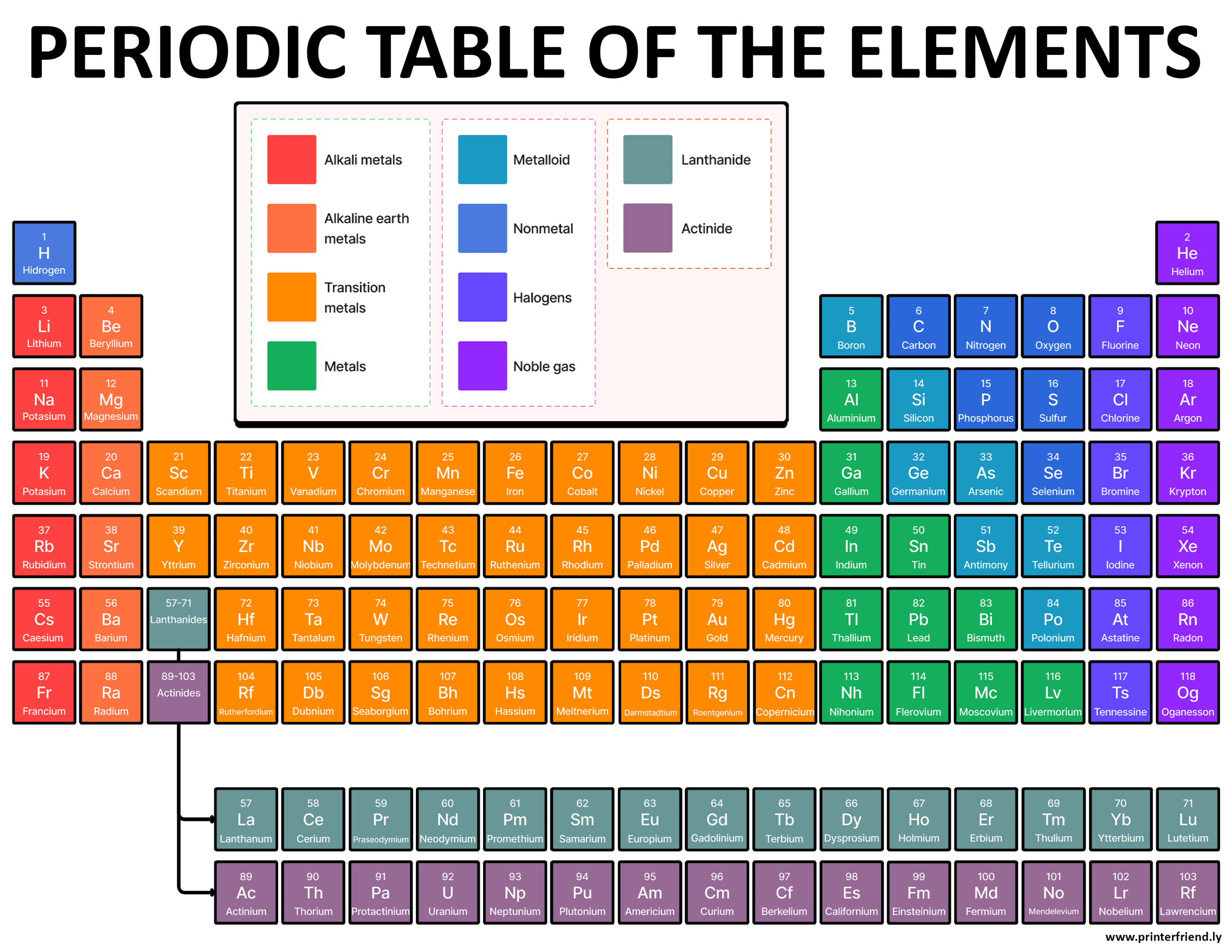
- Full-Color Group Edition: Features a clear color-coding legend to identify Alkali Metals, Alkaline Earth Metals, Transition Metals, Basic Metals, Metalloids, Nonmetals, Halogens, Noble Gases, Lanthanides, and Actinides.
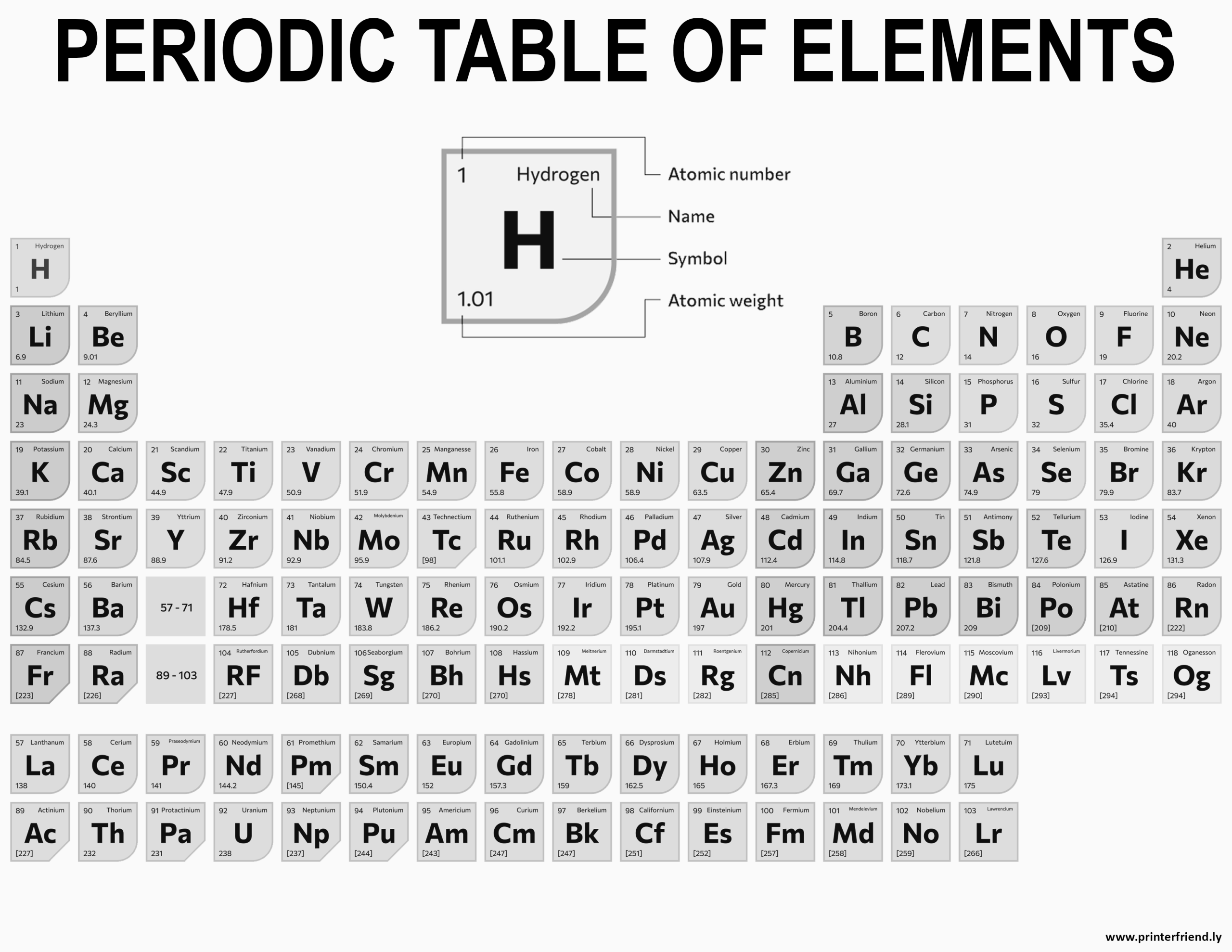
- Detailed Atomic Weight Edition (Black and White): An ink-friendly option featuring an enlarged center callout diagram detailing the exact positioning of the Atomic Number, Symbol, Name, and multi-decimal Atomic Mass.
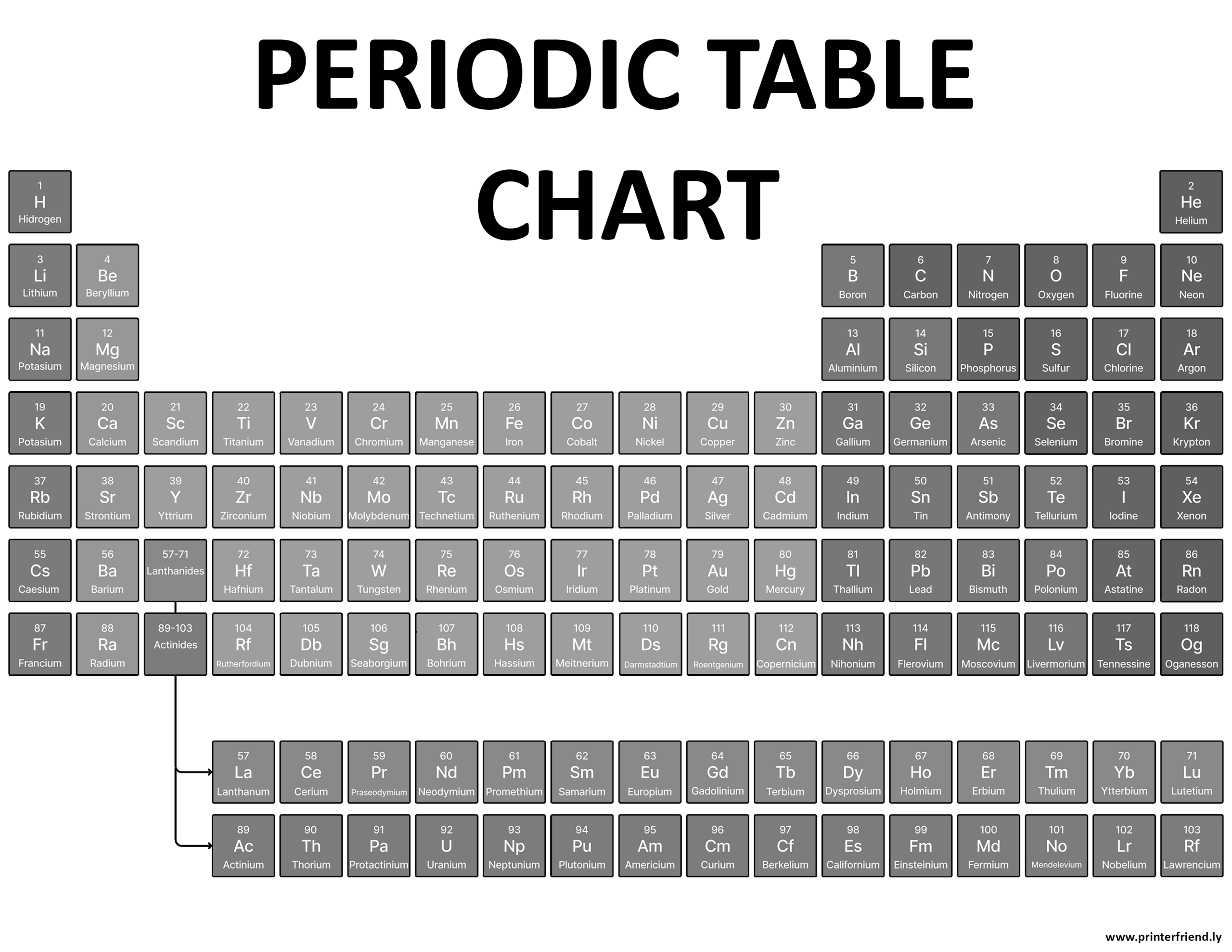
- High-Contrast Dark Tile Edition: Utilizes a gray-block tile background with high-visibility white text, allowing students to cross-reference elements, symbols, and atomic numbers effortlessly from a distance.
Essential IUPAC Periodic Table Values
All data strictly adheres to the latest International Union of Pure and Applied Chemistry standards, ensuring global accuracy for both students and working professionals. Understanding how these elements are organized allows students to predict chemical reactions, electronegativity trends, and bonding behaviors with much greater confidence.
Every printable periodic table in this collection arranges all 118 chemical elements in order of increasing atomic number (Z). Horizontal rows represent periods, while vertical columns represent groups (or families) that share similar valence electrons and predictable chemical behavior.
Each IUPAC-standardized element tile contains four fundamental markers:
- Atomic Number (Z): The number of protons located in the atomic nucleus.
- Chemical Symbol: The standardized one- or two-letter abbreviation.
- Element Name: The full English name.
- Atomic Weight / Mass (A): The average mass of naturally occurring isotopes.
Mass Number (A) = Protons (Z) + Neutrons (N)

Reading Element Tiles & Finding Neutrons
Mastering this fundamental calculation is the gateway to understanding more advanced concepts like isotopes, radioactive decay, and molar mass equations. By isolating these specific variables, students build a strong quantitative foundation. To calculate subatomic particles using our printable periodic table, locate the target element tile, isolate its core values, and decode the numbers using a simple three-step process.
Worked Example: Potassium (K)
- Locate Potassium: Find symbol K in Group 1 (Alkali Metals), Period 4.
- Identify Atomic Number (Z): The top integer is 19. A neutral Potassium atom has 19 protons and 19 electrons.
- Calculate Neutrons (N): Find the atomic weight (39.10 amu) and round it to the nearest whole mass number (39). Then, subtract the atomic number from the mass number:
N = A − Z
N = 39 − 19 = 20 neutrons
Periodic Table Practice & Tiered Skill Modules
Scaffolding these exercises ensures that learners build their math skills gradually without feeling overwhelmed by complex atomic theory. Transitioning from guided matrices to independent isotopic analysis encourages deep cognitive retention rather than simple rote memorization. Designed to complement our printable periodic table resources for Grades 7–10 (Physical Science and Introductory Chemistry), these worksheets let students practice proton, neutron, and electron calculations. Before starting, students should be comfortable with whole-number subtraction, rounding decimals, and reading chemical symbols.
We offer three durable teaching tiers:
- Easy (Guided Matrix): Provides given element symbols and atomic numbers; students practice calculating missing neutron counts.
- Standard (Complete Practice): A complete matrix for testing symbol memory, subatomic calculations, and atomic sequence 1 through 20.
- Challenge (Isotopic Analysis): Uses specific isotopic mass values (e.g., Carbon-14 vs. Carbon-12) to help students differentiate exact neutron variations.
Mistakes to Avoid: Calculating Subatomic Particles
When reading a periodic table of the elements, one of the most frequent missteps students make is confusing the atomic number with the mass number. The atomic number (Z) is always the smaller integer representing the proton count, whereas the atomic weight (A) is larger and typically includes a decimal point. Atomic weight reflects an average across natural isotopes rather than a direct, unrounded count of physical particles.
Another common error involves subtracting numbers before rounding. Subtracting an atomic number directly from an unrounded decimal atomic weight produces an impossible fractional neutron count. Students should always round the atomic weight to the nearest whole number to establish the mass number (A) before attempting subtraction.
Finally, improper capitalization frequently confuses chemical notation. Chemical symbols strictly demand an uppercase first letter followed by a lowercase second letter. Writing “CO” designates Carbon Monoxide (a compound), whereas “Co” correctly identifies Cobalt (an element). Enforcing proper case sensitivity early prevents misunderstandings down the road.
Educator’s Guide: Classroom & At-Home Strategies
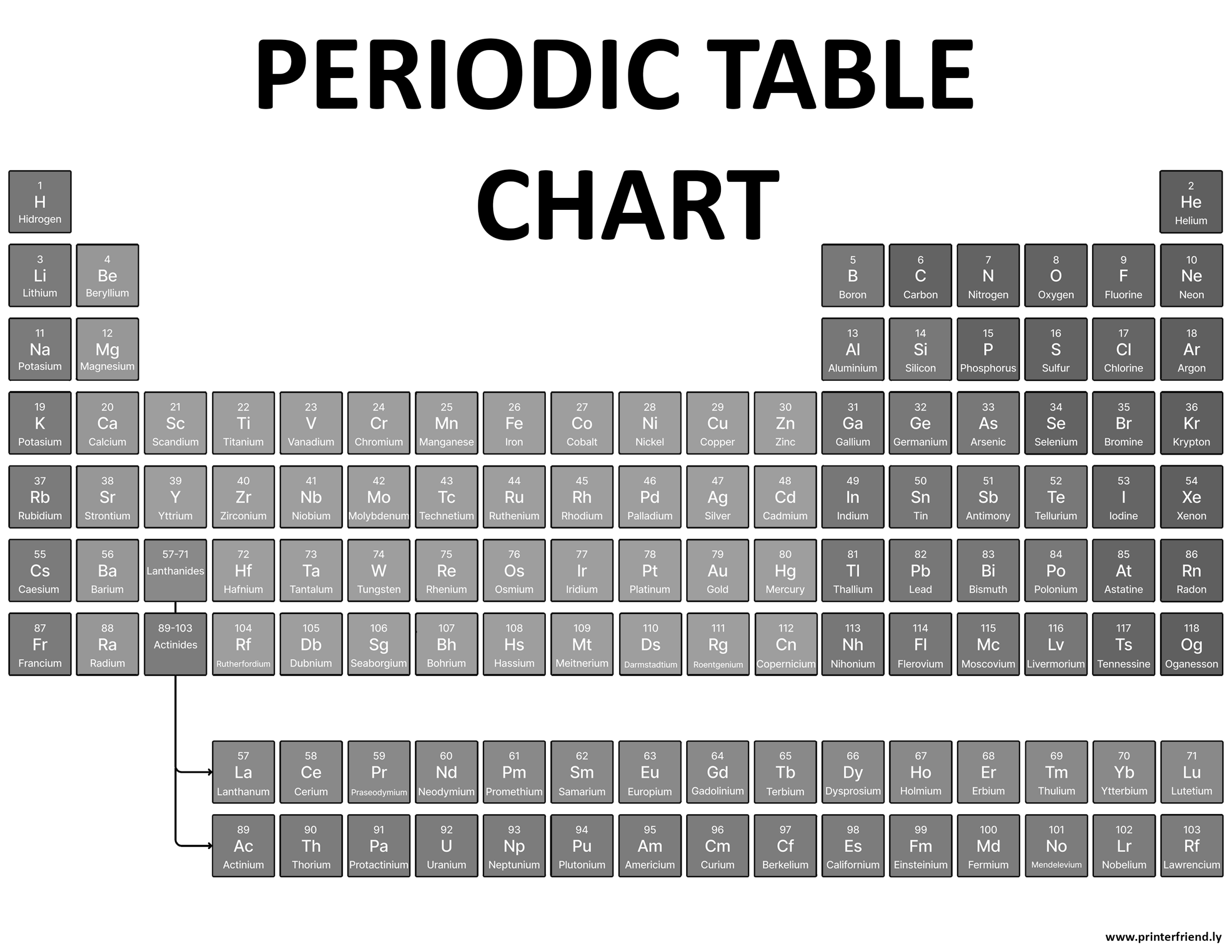
To maximize the longevity of these resources, consider laminating the charts or placing them in clear plastic sheet protectors. This allows students to use dry-erase markers for temporary annotations during complex stoichiometry equations or electron configuration exercises. Integrating our periodic table of elements into your teaching schedule is straightforward across classroom, tutoring, and homeschool settings:
- Classroom Integration: Print the Full-Color or Detailed B&W edition on heavy cardstock for students to keep in their binders as a durable, year-long reference.
- Differentiated Drills: Project the High-Contrast edition onto a whiteboard for fast-paced warm-up activities, symbol speed runs, or group matching games.
- Self-Paced Homework: Hand out practice worksheets during class while keeping the separate answer keys on hand for quick grading during review sessions.
Related Chemistry Printables:
- The Ultimate Mole Conversion Chart
- Milligram to Microgram Conversion Chart
- Dosage Conversion Chart for Oral and IV Doses

I’m a passionate designer with a keen eye for detail and a love for crafting visually stunning experiences. With a strong foundation in design tools like Adobe Photoshop, Illustrator, and Figma, I bring ideas to life through compelling visuals. My proficiency in HTML and CSS allows me to translate designs into functional, responsive websites. I’m always eager to learn and explore new design trends and excited to contribute my skills to innovative projects.