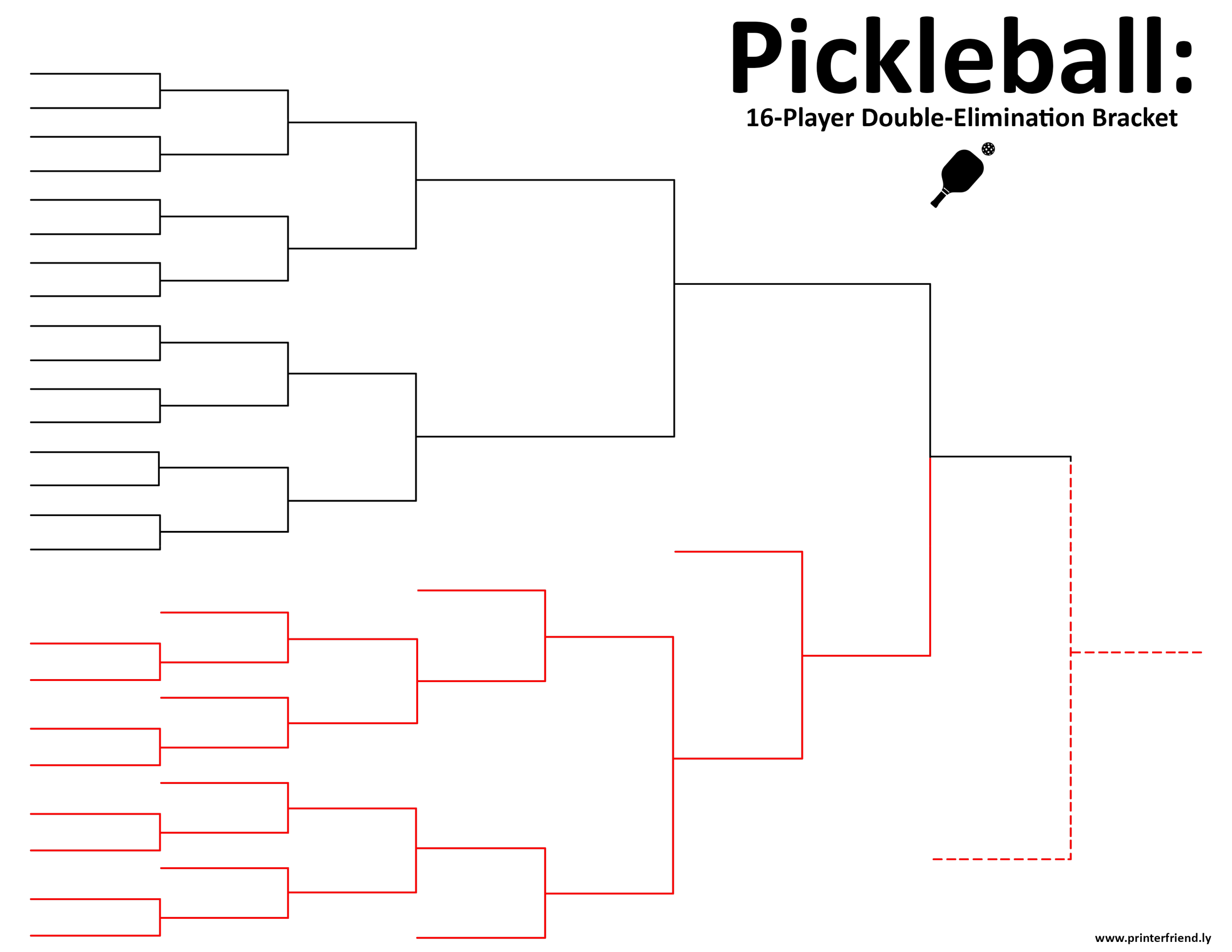
Printable16-Player Pickleball Double-Elimination Bracket

If you’ve ever organized a single-elimination tournament only to watch half your participants retreat to lawn chairs to drink seltzers and complain after one bad game. Welcome to your redemption arc. Mastering the 16-Player Pickleball Double-Elimination Bracket is the absolute gold standard for a 4-court venue. It keeps courts humming, prevents early player mutinies. And guarantees nobody pays an entry fee just to play twenty minutes of mediocre pickleball before driving home sad.
At its core. This bracket structure splits your venue into two distinct conferences per se.
The prestigious winner’s bracket and the scrappy opportunity bracket (where athletic dreams are rebuilt on pure grit and spite). Proper seeding establishes an equitable main draw, pairing your local court-kings against unseeded challengers in every opening matchup. And if someone flakes at the last minute because their dog ate their paddle grip?
[ Download PDF ] | [ Download PNG ]
Strategically inserting a bye keeps the entire grid moving forward without breaking a sweat.
Structural Mechanics of a 16-Player Pickleball Double-Elimination Bracket
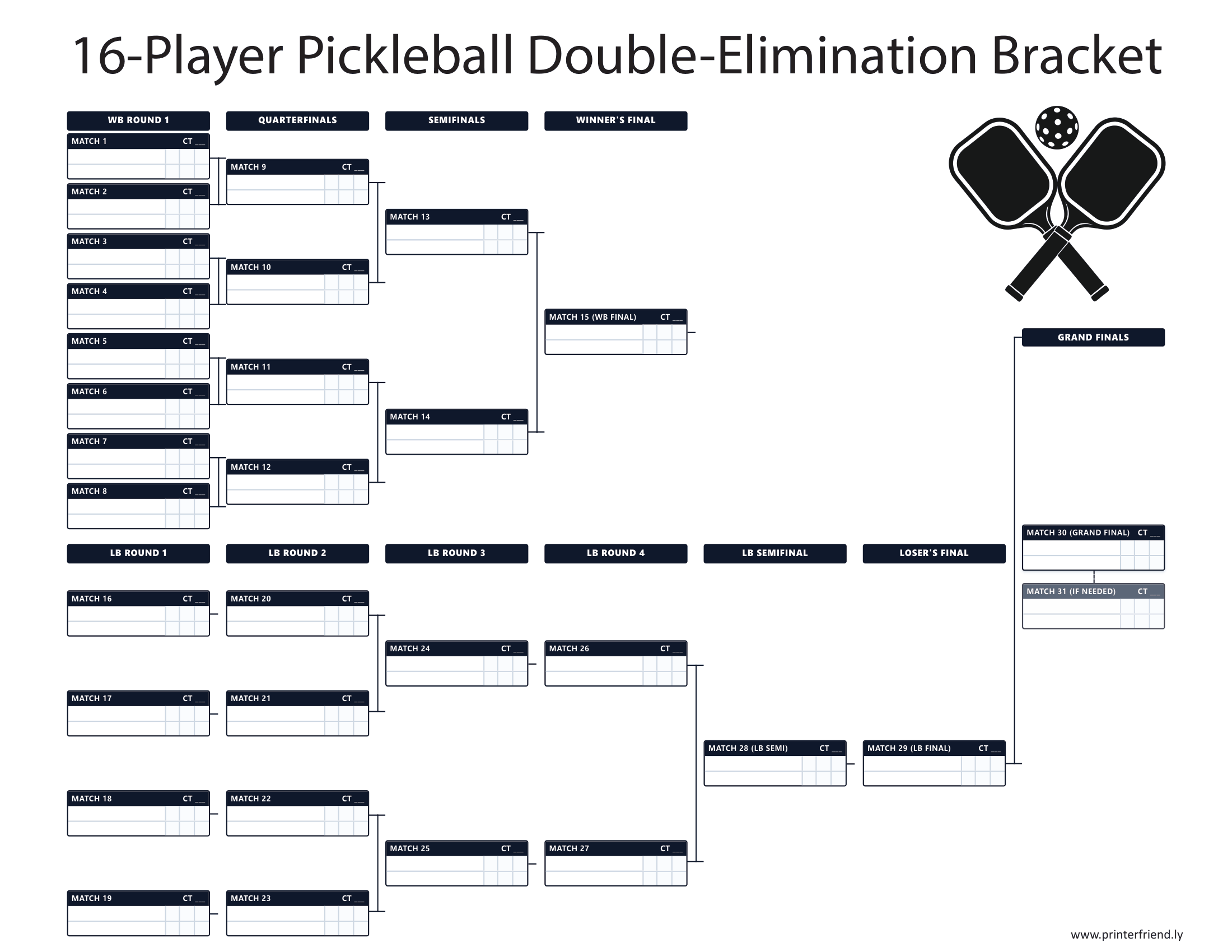
Setting up a 16-Player Pickleball Double-Elimination Bracket isn’t just about printing a piece of paper. It’s an exercise in logistical air-traffic control, with 16 players. You are committing to a total match load of 30 matches. Or 31 if the loser’s bracket winner forces an “if-necessary” rematch in the championship round. When you have four courts at your disposal, your primary job before anyone hits a ball is math and spatial management.
To maximize efficiency without overcrowding the court aprons, you must slot the first eight upper-bracket matches in two clean waves across your available courts. A clear visual chart on a master whiteboard gives players full visibility into court assignments, match numbers, and estimated start times.
- Match Pacing & Format: To keep court turnover swift during early rounds, route players through a single game to 15 (win by two) or timed 15-minute segments. Reserve traditional best-of-three games to 11 for the semifinals and finals.
- Wave Scheduling: Stagger the initial match times by 20 to 25 minutes. This creates a natural rotational buffer, preventing four matches from finishing simultaneously and overwhelming your administrative table.

[ Download PDF ] | [ Download PNG ]
Filling Out a 16-Player Pickleball Double-Elim Bracket
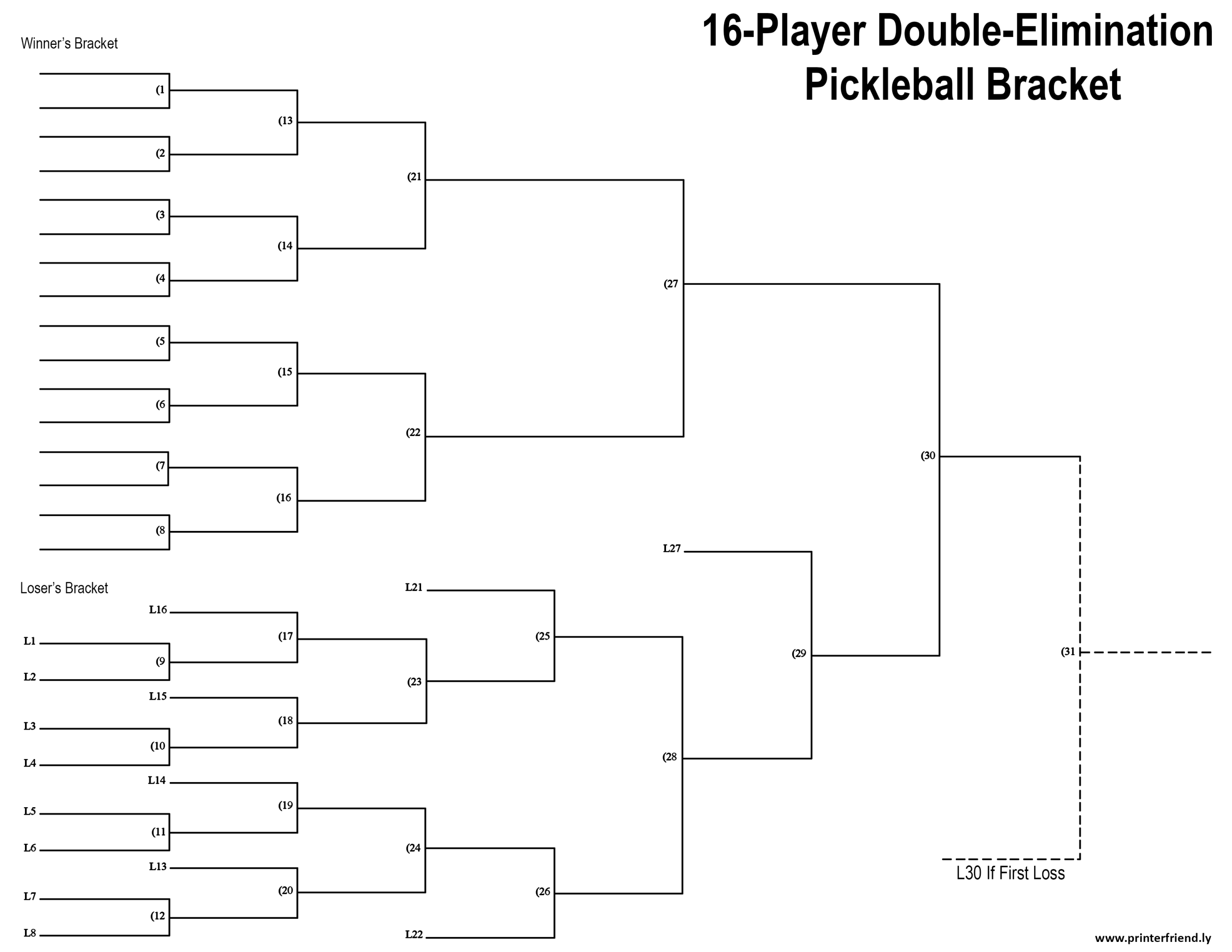
Filling out the 16-Player Pickleball Double-Elimination bracket correctly requires recording player movement in real-time. So nobody ends up playing on the wrong court—or worse, going home early by mistake. Each line on the template corresponds to a specific match number. And every match box has a designated destination for both the winner and the loser.
- Step 1 (Initial Entry): Write player names on the Round 1 lines based on your seedings (e.g., #1 seed at the top line, #16 seed directly below them for Match 1).
- Step 2 (Record Score): Once a match finishes, write the final score next to the players’ names in the Match 1 box.
- Step 3 (Advance the Winner): Write the winner’s name on the connecting line in the next round of the Winner’s Bracket.
- Step 4 (Relegate the Loser): Locate the designated loser line in the Lower Bracket (marked as “L1” for Loser of Match 1) and write the losing player’s name there.
Realistic Walkthrough Example:
Imagine Match 1 features #1 Seed Alex against #16 Seed Jordan. Alex wins the match 15–8.
- On your master bracket sheet, write “Alex (15)” and “Jordan (8)” in the Match 1 box.
- Draw a line advancing Alex into the Winner’s Bracket Quarterfinals (Match 9).
- Find the Lower Bracket line labeled L1 (which feeds into Match 16) and write Jordan on that line. Jordan is now set to play the loser of Match 2 for survival in the opportunity bracket.
Tournament Execution & Flow Management
Once the first serve flies, your role shifts from master architect to active air-traffic controller. The single biggest bottleneck when running a 16-Player Pickleball Double-Elimination Tournament happens right after Round 1, when defeated players wander off to find snacks while their next opponent waits impatiently on Court 3. Keeping the energy high requires continuous movement and proactive communication.
As players advance down the upper bracket path. Those who drop a match must immediately be relegated to the lower bracket. Giving these players a clear 15-minute window to grab water and rebound mentally ensures they stay warm, focused, and ready to fight back through the consolation rounds.
- Desk Management: Continuously monitor active courts with a designated score-tracker. The second a court clears, call the next match immediately over a PA speaker to avoid idle court time.
- Queue Management: Keep the “on deck” players posted right next to the administrative table so they can step onto the court the moment net handshakes finish.
The Championship Round & Event Wrap-Up
A 16-Player Pickleball Double-Elimination Tournament reaches its peak drama during the Grand Final, where the undefeated leader of the upper bracket meets the survivor of the lower bracket. Because the upper-bracket leader hasn’t lost a match yet, the lower-bracket challenger must win two consecutive matches to take home the title. If the challenger wins Match 30, it triggers the automatic “if-necessary” Match 31—the ultimate high-stakes showdown.
This setup acts as the ultimate fail-safe against fluke losses or early bad draws. By offering a guaranteed-play format where every entrant gets at least two full matches, you create a fair, balanced environment that players respect. Adopting standardized bracket rules eliminates late-game confusion and guarantees that the ultimate winner earned every single point.
Checklist & Tools for Your 16-Player Pickleball Double-Elimination Bracket

[ Download PDF ] | [ Download PNG ]
Running a 16-Player Pickleball Double-Elimination Tournament smoothly comes down to preparation and the right suite of tools. Relying on makeshift scribbles on a clipboard leads to score disputes, delayed courts, and frustrated participants. Upgrading your toolkit turns an overwhelming operational puzzle into a streamlined success.
Utilizing turnkey bracket templates or digital tournament software provides a frictionless experience for directors and competitors alike. These tools automate match movement, track court availability, and provide a seamless, real-time view of tournament progression.
- Master Equipment Checklist: Official outdoor/indoor pickleballs, net height measuring tools, dry-erase bracket boards, clipboards, score sheets, portable flip-scoreboards, and a digital master timer.
- Event Outcome: Combining solid bracket logistics with the right gear ensures a high-capacity event that keeps players raving—and registering for your next tournament before they even leave the venue.
Related Pickleball Templates:
- Printable Pickleball 12-Player Double Elimination Bracket
- Printable Pickleball 16-Player Double Elimination Bracket
- 64-Player Double Elimination Bracket for Larger Tournaments

I’m a passionate designer with a keen eye for detail and a love for crafting visually stunning experiences. With a strong foundation in design tools like Adobe Photoshop, Illustrator, and Figma, I bring ideas to life through compelling visuals. My proficiency in HTML and CSS allows me to translate designs into functional, responsive websites. I’m always eager to learn and explore new design trends and excited to contribute my skills to innovative projects.