Free, Printable Ethiopian Calendar Conversion Chart: Compare Ethiopian and Gregorian Dates

Working with dates across different calendars can feel oddly stressful. One minute, the date makes sense, and the next minute, the year looks completely wrong. The Ethiopian calendar follows a system that doesn’t line up neatly with the Gregorian calendar most countries use. Our Ethiopian calendar conversion chart steps in to calm that chaos by providing clear date matches without the need for mental math, guesswork, or awkward calendar debates.
This type of conversion table comes in handy more often than people expect. Planning trips, checking official documents, reviewing historical events, or coordinating schedules across borders all get easier with a reliable reference. The chart is available in PDF format for printing and in PNG format for digital use, so the conversion table stays accessible whether work’s happening at a desk, in a notebook, or on a phone during a busy day.
What Is the Formula for the Ethiopian Calendar Conversion Chart?
At first glance, converting Ethiopian dates can be confusing, especially when the year appears to be several numbers behind what most people expect. Our Ethiopian calendar conversion chart is based on a simple formula that explains this gap and makes date conversion easier to follow. Once the logic clicks, the system feels far less intimidating.
Everything starts with the Ethiopian Calendar Conversion formula, a straightforward rule that connects Ethiopian years to Gregorian ones:
- Gregorian year = Ethiopian year + 7 or 8
Which number applies depends on timing. If the date falls after the Ethiopian New Year, usually around September 11, you add 8. If the date falls before the Ethiopian New Year, you add 7. This explains why the year difference changes depending on the month.
Here’s how that formula works in real life. An Ethiopian calendar date showing the year 2016 in October lines up with 2024 on the Gregorian calendar. That same Ethiopian year, showing a July date lines up with 2023 instead. The math stays simple, but the calendar timing does the heavy lifting.
Using the conversion table alongside this approach saves time and eliminates the need for second-guessing. Instead of recalculating dates repeatedly, the table confirms exact matches at a glance, which is where the chart really earns its keep.

Why the Ethiopian Calendar Is Totally Unique
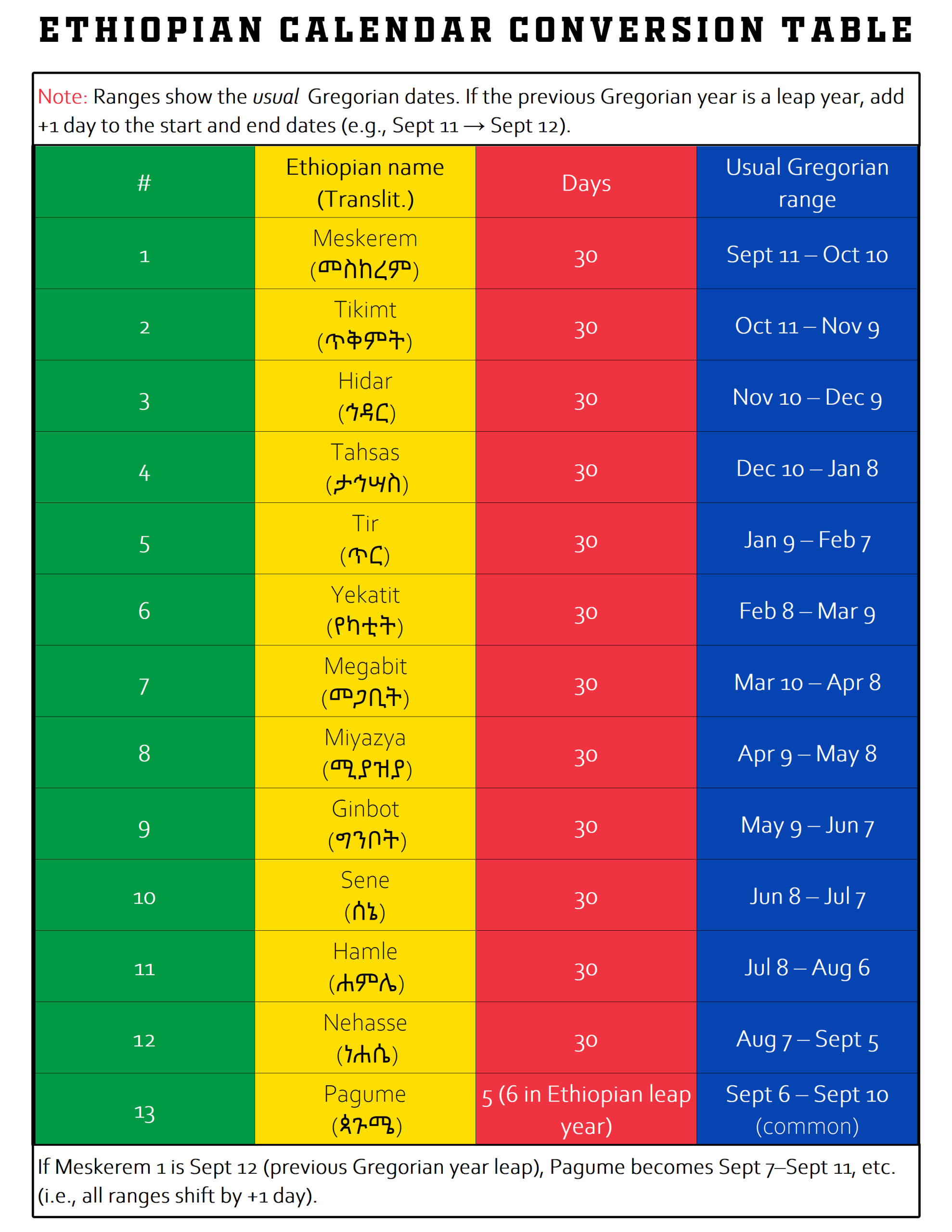
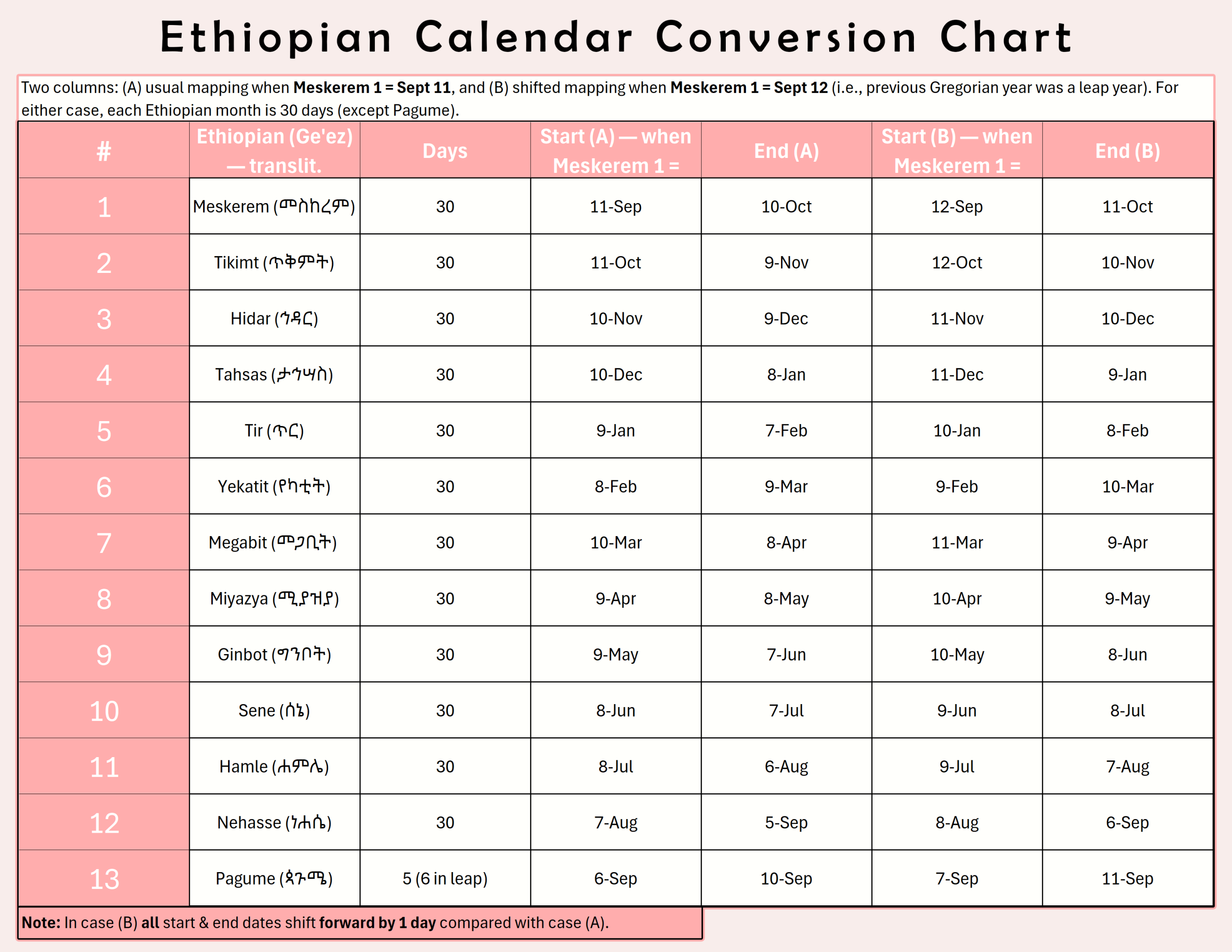
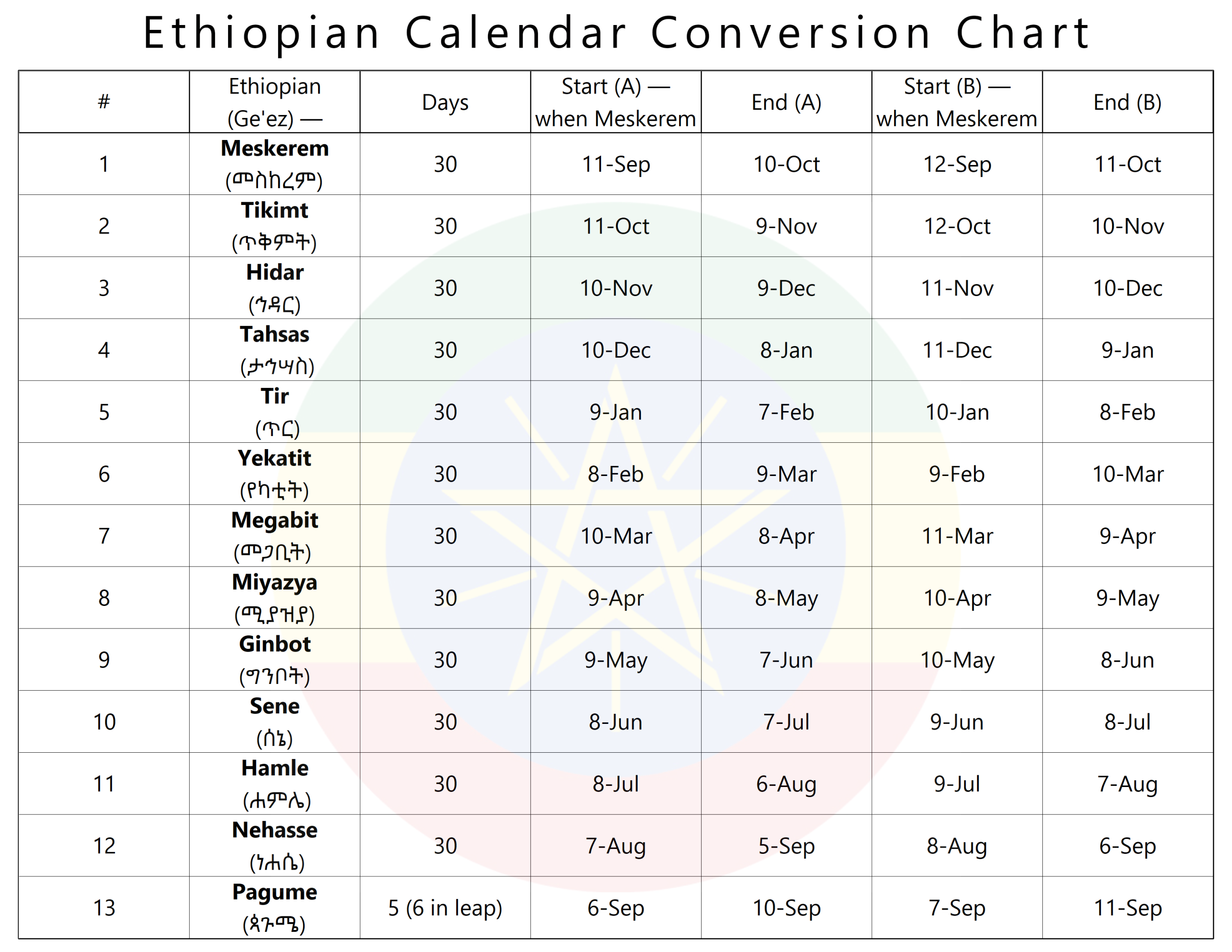
The Ethiopian calendar follows its own rhythm, and once the basics make sense, the system feels surprisingly logical. Each year has twelve months of thirty days, plus a short thirteenth month called Pagumē. That extra month has five days in most years and six days in a leap year, keeping the calendar roughly aligned with the solar year.
The New Year in Ethiopia doesn’t start in January. It usually falls on September 11 or September 12 during leap years. Because of this, the Ethiopian year typically runs from September 11 or 12 of one Gregorian year to September 10 or 11 of the next Gregorian year. For example, the Ethiopian year 2016 starts on September 11, 2023, and ends on September 10, 2024. This explains why Ethiopian years appear seven to eight years behind Gregorian years, even though time itself flows normally.
Leap years in the Ethiopian calendar follow a four-year cycle, similar to the Gregorian system, but the extra day lands in the small thirteenth month. Understanding the months, the New Year, and leap years makes reading Ethiopian dates far less confusing. Once these pieces click, following Ethiopian dates and using our Ethiopian calendar conversion chart becomes straightforward instead of overwhelming.
Download the Ethiopian Calendar Conversion Chart and Simplify Dates

Who knew dates could be this easy? Our Ethiopian calendar conversion chart is available in both PDF and PNG formats, so you can pick whichever format fits your style. Print the PDF and pin the table up, tuck the printed cheat sheet in a binder, or keep the reference on your desk for quick access. The PNG version slides neatly onto your phone, tablet, or laptop when you’re on the move.
- Easy-to-read Ethiopian calendar conversion cheat sheet which provides the month-by-month Gregorian date ranges (Sept 11 to Sept 12) for the Ethiopian calendar:
PDF – PNG - Printable Ethiopian calendar conversion chart clearly details the two possible Gregorian date ranges for each month, accounting for the leap year shift:
PDF – PNG - Essential Ethiopian calendar conversion table showing Gregorian date ranges for both usual years and leap years (Sept 11 and Sept 12 Meskerem start dates):
PDF – PNG
With both versions on hand, you’ll never have to guess dates again or do that awkward “wait, what year is this?” dance. Planning events, checking historical dates, or satisfying your curiosity becomes fast, simple, and surprisingly fun.
Download the chart, keep the reference close, and enjoy the confidence of knowing Ethiopian and Gregorian dates line up perfectly. Having the PDF or PNG at your fingertips is like carrying a tiny calendar wizard. Desk or digital, printed chart or screen version, this tool makes planning smoother and gives your brain a well-earned break.

I’m a passionate designer with a keen eye for detail and a love for crafting visually stunning experiences. With a strong foundation in design tools like Adobe Photoshop, Illustrator, and Figma, I bring ideas to life through compelling visuals. My proficiency in HTML and CSS allows me to translate designs into functional, responsive websites. I’m always eager to learn and explore new design trends and excited to contribute my skills to innovative projects.