Liquid Measurement Conversion Chart for Baking: Milliliters, Teaspoons, Tablespoons and Cups

Staring down a gorgeous French pastry recipe that demands 12 mL of vanilla extract while you are holding a standard set of US measuring spoons is a special kind of kitchen jump-scare. You stand there, flour smudged across your forehead, trying to calculate whether a milliliter is closer to a single raindrop or a generous splash of milk. Bridging the gap between precise metric values and customary kitchen tools is an essential skill—unless you actually enjoy playing Russian roulette with your baking chemistry.
Here’s the catch: liquids don’t forgive wild guesses. A few extra milliliters of a potent extract or liquid leavening agent can quickly transform a light, fluffy sponge cake into a dense, rubbery hockey puck. To make matters spicier, global measurement standards love to confuse us. A standard US Customary cup sits at 240 mL with a 15 mL tablespoon, while a Commonwealth metric cup jumps to 250 mL, and an Australian tablespoon reaches a beefy 20 mL. Differentiating liquid volume (mL) from weight (grams)—while juggling these regional quirks—is what keeps your baked goods edible.
[ Download PDF ] | [ Download PNG ]
Instead of smudging your phone screen with buttery thumbs during a frantic mid-prep internet search, keep a unified milliliters-teaspoons-tablespoons-cups conversion chart right on your counter. Think of it as your official kitchen peace treaty: it eliminates mid-recipe panic, establishes complete volumetric harmony, and saves your desserts from tragic math errors.
How to Convert, Transpose, and Scale Liquid Volumes
Baking is equal parts culinary magic and unforgiving chemistry. Scaling a recipe up for a crowd or down for a quick weeknight dessert isn’t as simple as blindly doubling or halving liquid ingredients.
When dealing with active liquid ingredients or strong aromatic oils, small-volume math gets tricky fast, making a reliable milliliters-teaspoons-tablespoons-cups conversion chart an invaluable tool during prep. To scale or convert small liquid volumes smoothly, you can calculate your required target unit using the following formula:
Target Volume =
× Batch Scale Factor
where the base value is 5 mL for teaspoons, 15 mL for tablespoons, and 240 mL for US cups. Miscalculating even a fraction of a teaspoon can easily overpower your dish or ruin a dough’s rise.
- Scale Up or Down: Convert tricky fractions of teaspoons and tablespoons into fluid-milliliter equivalents when halving, doubling, or splitting complex batch yields.
- Calculate on the Fly: Memorize key anchor values—like knowing 15 mL directly equals 1 tablespoon (or 3 teaspoons)—to transpose liquid volumes instantly without stopping your prep flow.
For ultra-precise applications like concentrated citrus extracts, floral waters, or liquid food colorings, standard plastic measuring spoons can sometimes lack the fidelity you need. Utilizing graduated cylinders, liquid measuring syringes, or narrow, clear calibrated cups allows you to hit exact decimal fills down to the milliliter effortlessly.

[ Download PDF ] | [ Download PNG ]
Liquid Volume Conversion Chart: Milliliters, Teaspoons, Tablespoons, and Cups
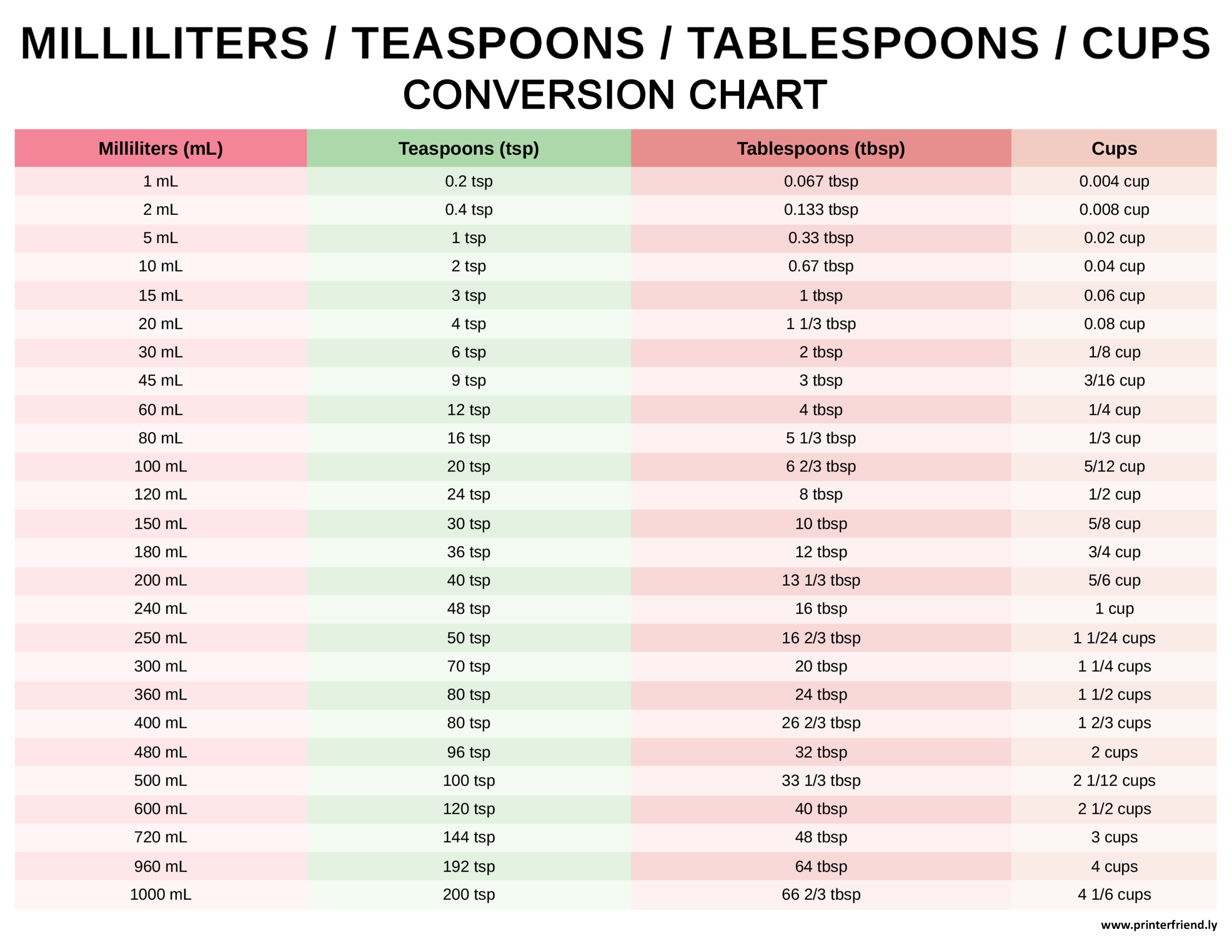
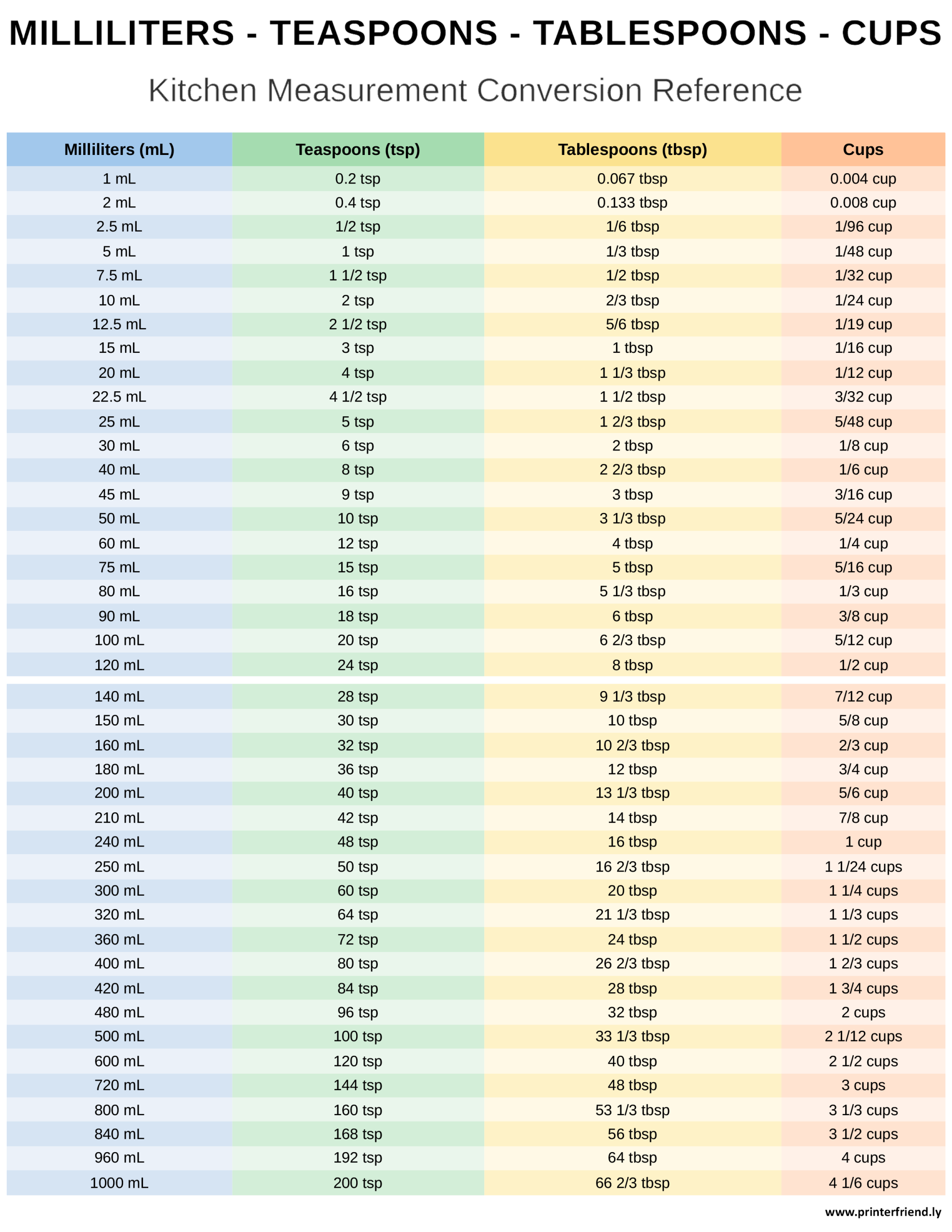
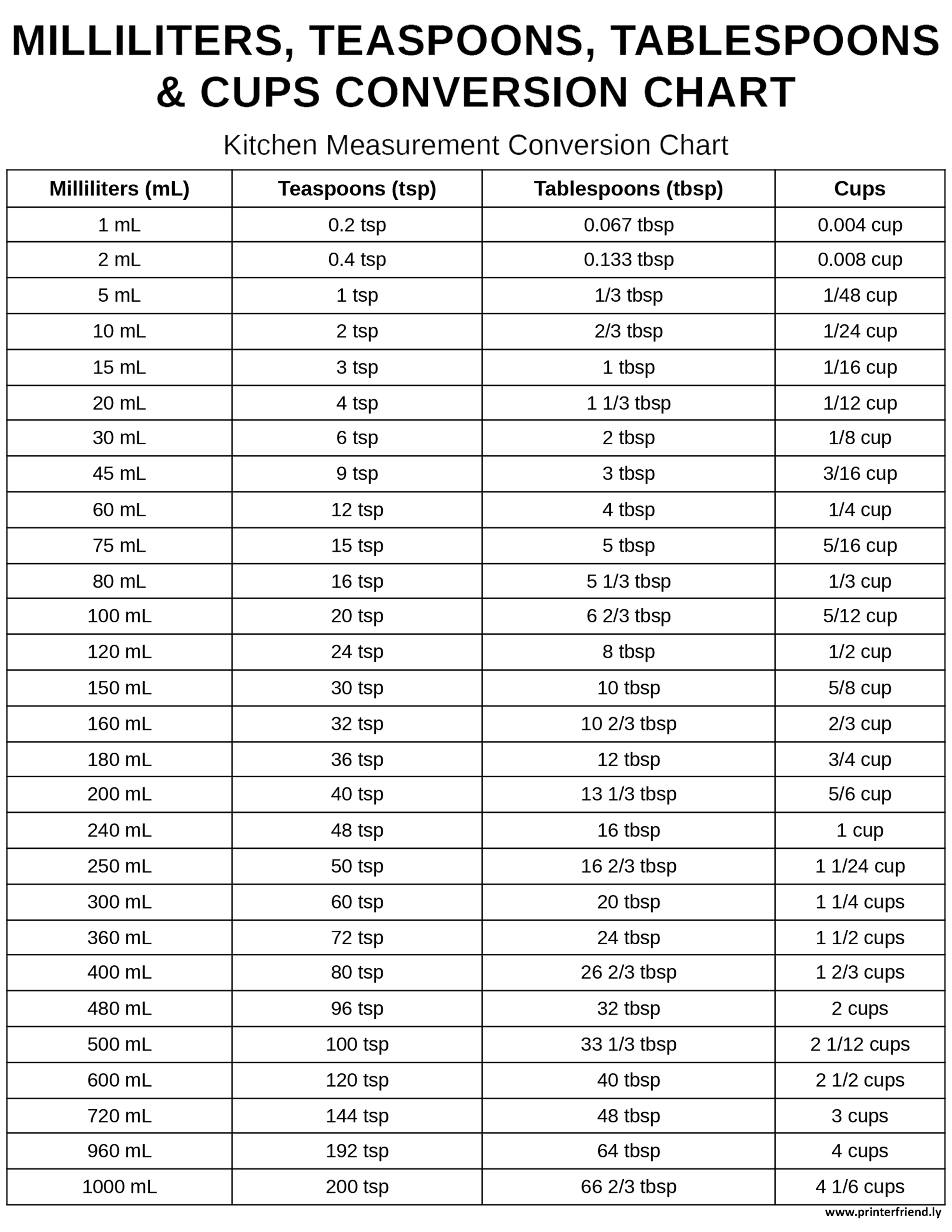
Removing mental gymnastics from your prep time starts with a clean, comprehensive lookup table. Whether you need quick mL to tbsp numbers or reliable teaspoons to milliliters translations, this milliliters-teaspoons-tablespoons-cups conversion chart covers your liquid volume conversion needs across metric and customary systems.
| Milliliters (mL) | Teaspoons (tsp) | Tablespoons (tbsp) | Cups (US Customary / fl oz) |
| 1 mL | 0.2 tsp | 0.067 tbsp | 0.004 cup (~0.03 fl oz) |
| 2 mL | 0.4 tsp | 0.133 tbsp | 0.008 cup (~0.07 fl oz) |
| 5 mL | 1 tsp | 1/3 tbsp | 1/48 cup (~0.17 fl oz) |
| 10 mL | 2 tsp | 2/3 tbsp | 1/24 cup (~0.34 fl oz) |
| 15 mL | 3 tsp | 1 tbsp | 1/16 cup (0.5 fl oz) |
| 20 mL | 4 tsp | 1 1/3 tbsp | 1/12 cup (~0.67 fl oz) |
| 30 mL | 6 tsp | 2 tbsp | 1/8 cup (1 fl oz) |
| 45 mL | 9 tsp | 3 tbsp | 3/16 cup (1.5 fl oz) |
| 60 mL | 12 tsp | 4 tbsp | 1/4 cup (2 fl oz) |
| 120 mL | 24 tsp | 8 tbsp | 1/2 cup (4 fl oz) |
| 150 mL | 30 tsp | 10 tbsp | 5/8 cup (5 fl oz) |
| 180 mL | 36 tsp | 12 tbsp | 3/4 cup (6 fl oz) |
| 240 mL | 48 tsp | 16 tbsp | 1 cup (8 fl oz) |
| 250 mL (Metric Cup) | 50 tsp | 16 2/3 tbsp | 1 1/24 cups (~8.45 fl oz) |
| 500 mL | 100 tsp | 33 1/3 tbsp | 2 1/12 cups (~16.9 fl oz) |
| 1000 mL (1 L) | 200 tsp | 66 2/3 tbsp | 4 1/6 cups (~33.8 fl oz) |
To keep your momentum going when your hands are covered in dough, anchor these fundamental metric-to-customary conversion baselines in memory:
- 1 Cup: 16 Tablespoons = 48 Teaspoons = 240 mL (US Customary) / 250 mL (Metric Standard)
- 1/2 Cup: 8 Tablespoons = 24 Teaspoons = 120 mL
- 1/4 Cup: 4 Tablespoons = 12 Teaspoons = 60 mL
- 1 Tablespoon: 3 Teaspoons = 15 mL
- 1 Teaspoon: 1/3 Tablespoon = 5 mL
How to Use our Milliliters, Teaspoons, Tablespoons, and Cups Conversion Chart
Smartphones and wet kitchen hands are natural enemies. Stopping every three minutes to wash sauce off your fingers just to wake up a sleeping tablet screen is a quick path to frustration. Mounting a physical printout of your milliliters-teaspoons-tablespoons-cups conversion chart inside a pantry door or affixing it to the fridge with a magnet keeps essential reference data in your line of sight without putting your electronics in harm’s way.
Before sending the chart to your printer, spend ten seconds reviewing your print settings. Poor print configuration can shrink tables, clip column edges, or render compact fractions as unreadable grey smudges.
- Printer Scaling: Force your printer setting to “Actual Size” (100%) so compact text and precise decimal values don’t distort or shrink.
- Paper Layout: Select standard US Letter paper (8.5 x 11 inches) in Portrait orientation for maximum vertical readability.
- Precision Standard: Apply exact rounded mL values when delicate baking demands batch-accurate tolerances, but feel free to round to the nearest spoon mark for casual soups and pan sauces.
Precision-Tested Execution: Achieving Batch-Accurate Results

[ Download PDF ] | [ Download PNG ]
Translating a global recipe into standard US kitchen tools isn’t just a math exercise—it’s about building consistent habits. Uniformity in your technique is what separates a lucky baking success from a signature dish you can recreate effortlessly every single time.
- Separate Liquid Volume from Weight: Never treat fluid volume (mL) as interchangeable with dry mass (grams). While 1 mL of pure water equals 1 gram, viscous liquids like molasses, honey, or vegetable oils do not follow a 1:1 ratio.
- Pre-Calculate Recipe Annotations: Pencil your converted unit values directly onto imported recipe cards before lighting the burner to eliminate mid-step calculations.
- Standardize Measurement Technique: Level off dry measuring spoons flat across the rim, and read liquid meniscus curves at eye level on a flat surface using transparent, calibrated glass containers.
Mastering these liquid volume conversions removes the guesswork from foreign measurements. With a reliable milliliters-teaspoons-tablespoons-cups conversion chart taped nearby and sound prep habits in place, you can dive into international cookbooks with total confidence and deliver batch-accurate, delicious results on every attempt.
Related Liquid Volume Conversion Charts:
- Cubic Centimeters (CC) to Milliliters (ML) Conversion Chart
- Liters (L) to Quarts (Qt) Conversion Chart
- Milliliters (mL) to Fluid Ounces (Oz) Conversion Chart

I’m a passionate designer with a keen eye for detail and a love for crafting visually stunning experiences. With a strong foundation in design tools like Adobe Photoshop, Illustrator, and Figma, I bring ideas to life through compelling visuals. My proficiency in HTML and CSS allows me to translate designs into functional, responsive websites. I’m always eager to learn and explore new design trends and excited to contribute my skills to innovative projects.