


We’ve all been there: for instance, you’re elbow-deep in batter, your hands are coated in butter, and the recipe casually demands 3/4 of a pint of heavy cream. As a result, you stare at your lonely glass measuring cup, your brain short-circuits, and you start asking existential questions like, “Is a pint the small milk carton or the medium one?”
In general, cooking is a forgiving art—for example, throw in three extra cloves of garlic, and suddenly you’re a culinary visionary. Baking, on the other hand, is ruthless, high-stakes chemistry. Therefore, treating liquid volume like a vague suggestion is the fastest way to turn a light, airy cake into a dense, sad brick. In North American kitchens, however, we operate on US customary units—a system that likes to keep us on our toes because it is distinct from the imperial capacity standard used across the pond.
[ Download PDF ] | [ Download PNG ]
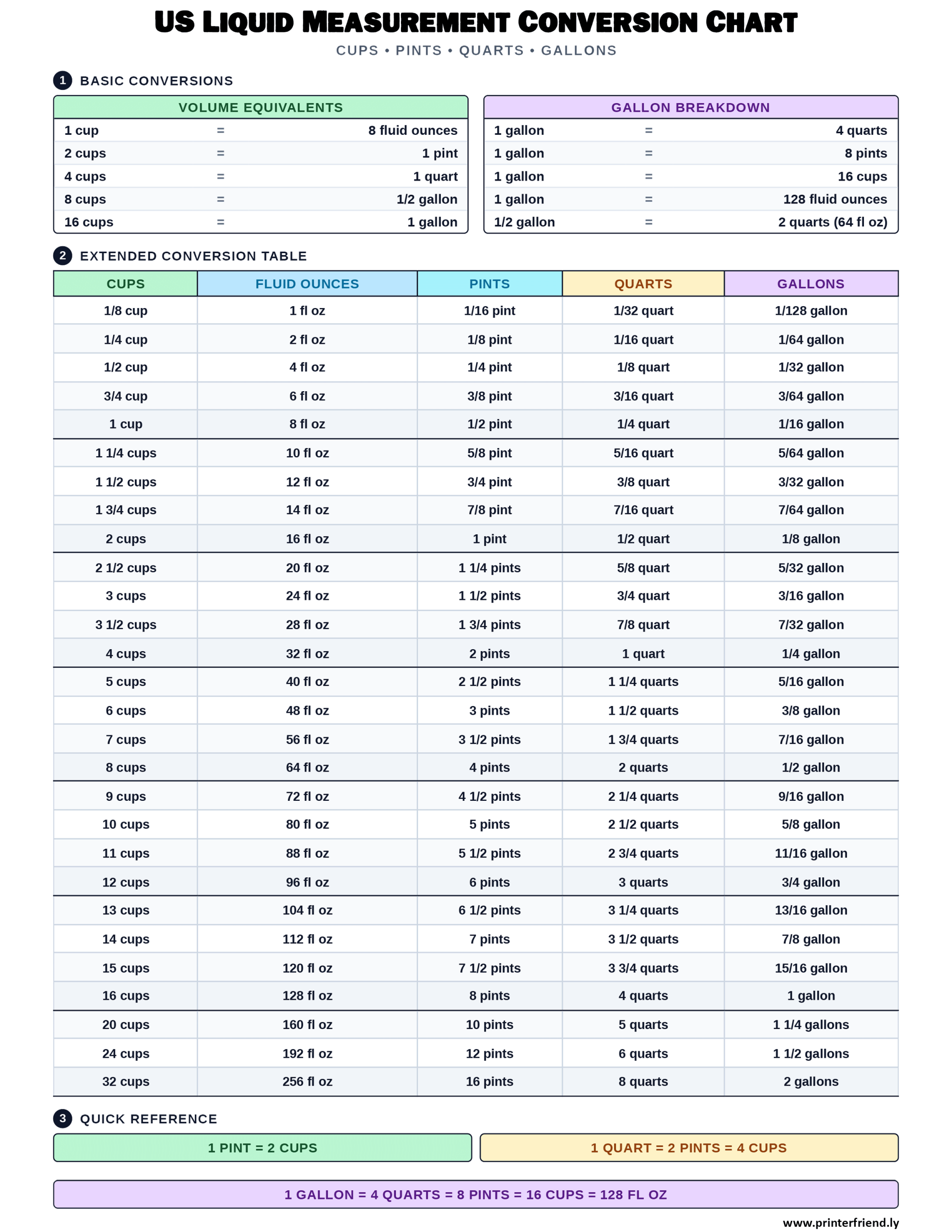
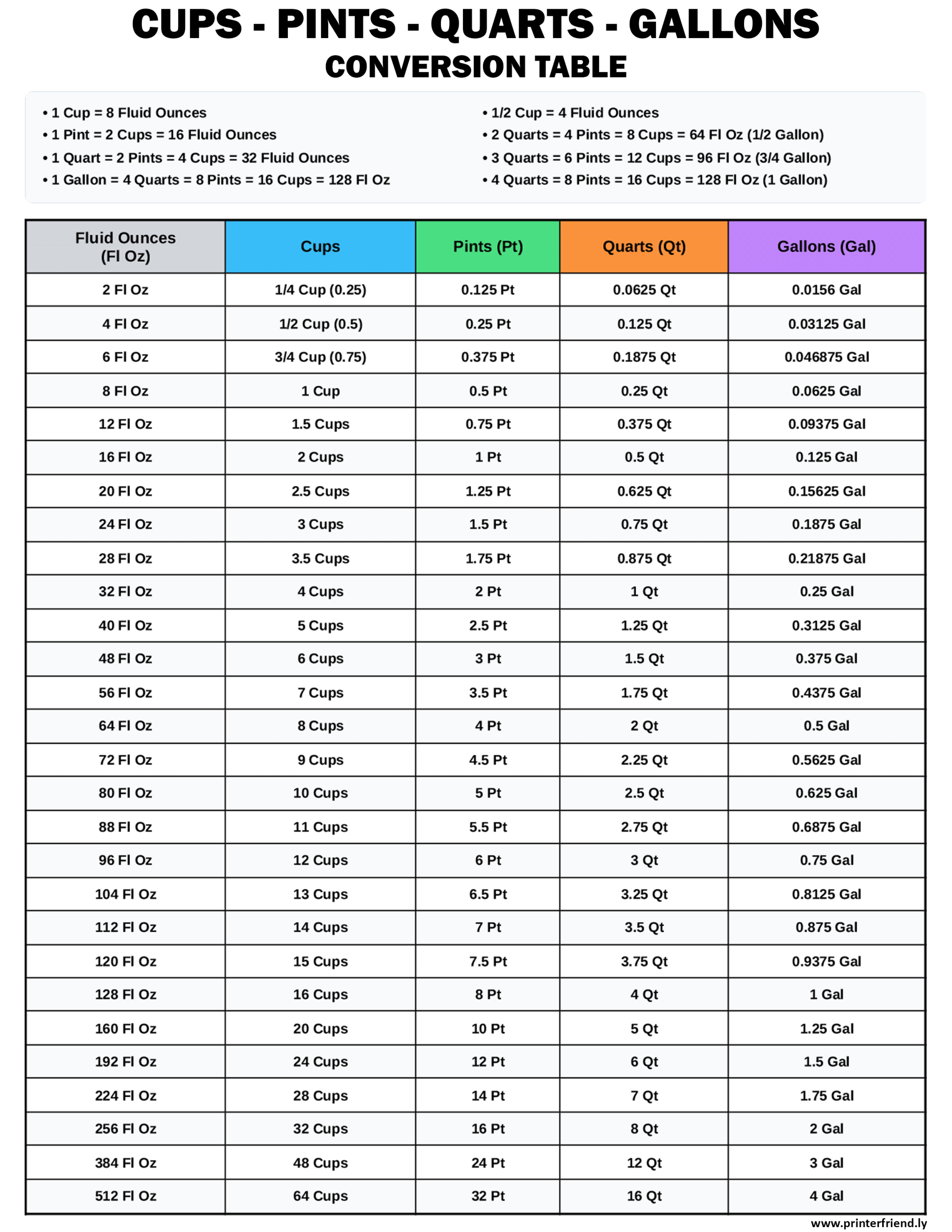
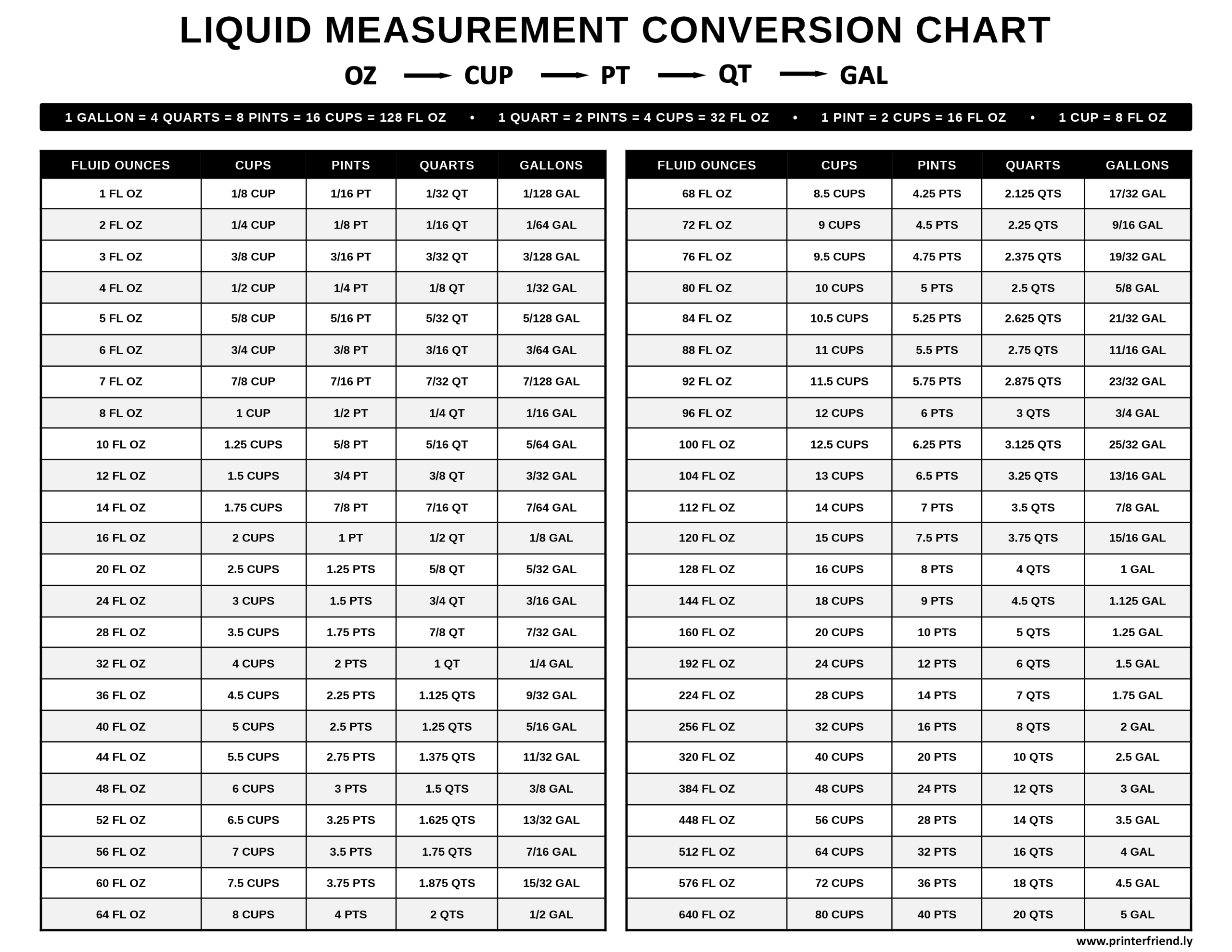
Once you internalize this basic equivalency with our handy Cups-Pints-Quarts-Gallons conversion chart, you will consequently never again have to pause mid-recipe to tap on your phone screen with a flour-covered knuckle frantically.
How to Convert, Transpose, and Scale
Fortunately, translating recipe volumes on the fly doesn’t require a degree in applied mathematics—just a clear game plan and a reliable Cups-Pints-Quarts-Gallons conversion chart. Thus, whether you are hosting a massive holiday feast or cooking for one, knowing how to convert and transpose units keeps your prep work moving smoothly without dirtying every single container in your cabinets.
-
Scale Up or Down: For example, when cooking for larger crowds, you must scale up total volume while keeping ratio balances identical. Conversely, to adjust yield for smaller groups, partition liquid mixtures evenly by dividing base quantities.
-
Calculate on the Fly: In addition, learn to calculate fluid ratios without interrupting your workflow. For instance, converting 4 cups into 1 quart mid-recipe keeps your workspace clutter-free by reducing cup clutter on your counter.
-
Cross-Reference & Measure: Furthermore, always measure liquids at eye level on a flat surface using dedicated liquid measuring cups with pour spouts (because dry scoops will mislead you every time). Then, cross-reference your fluid estimates against standard benchmarks before combining ingredients.
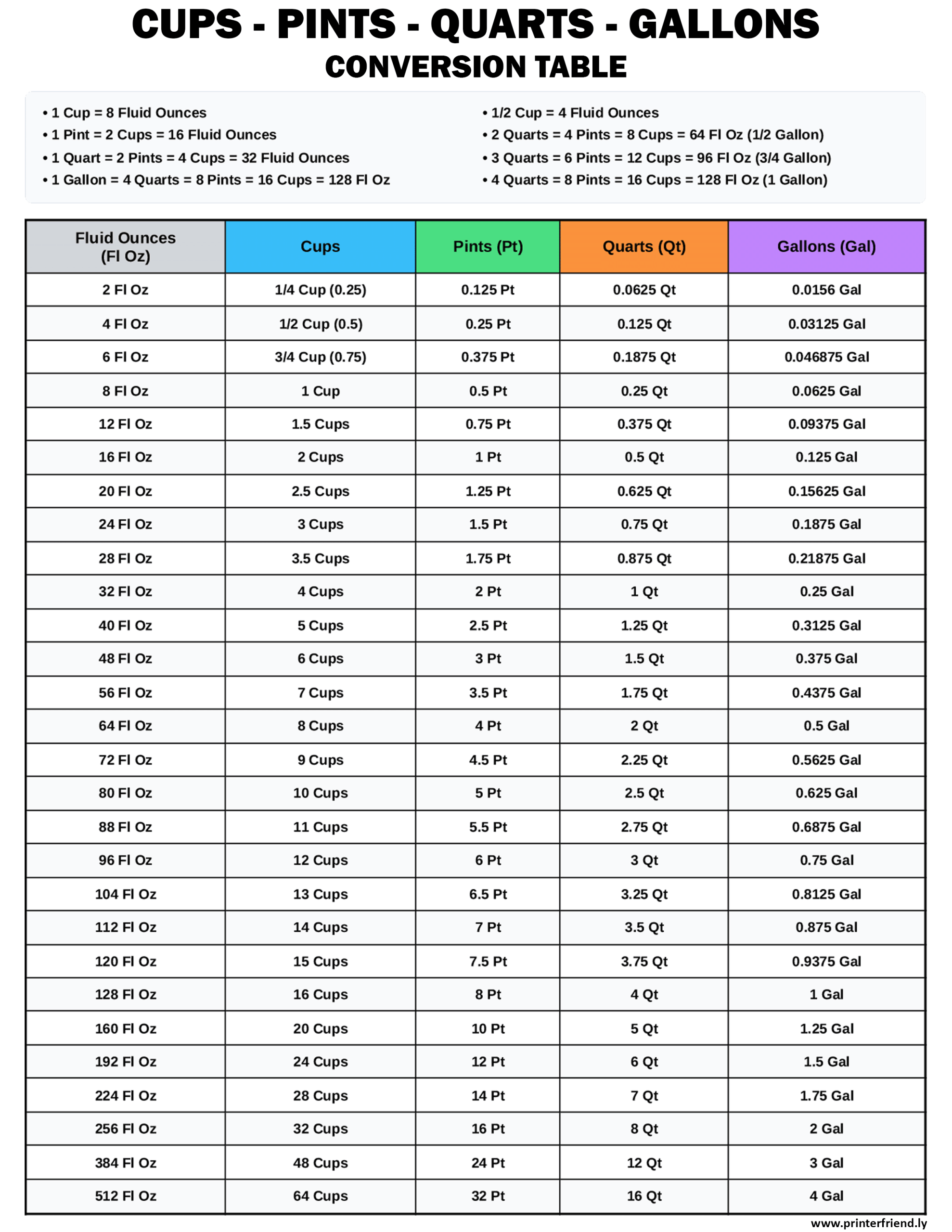
Cups-Pints-Quarts-Gallons Conversion Chart Reference
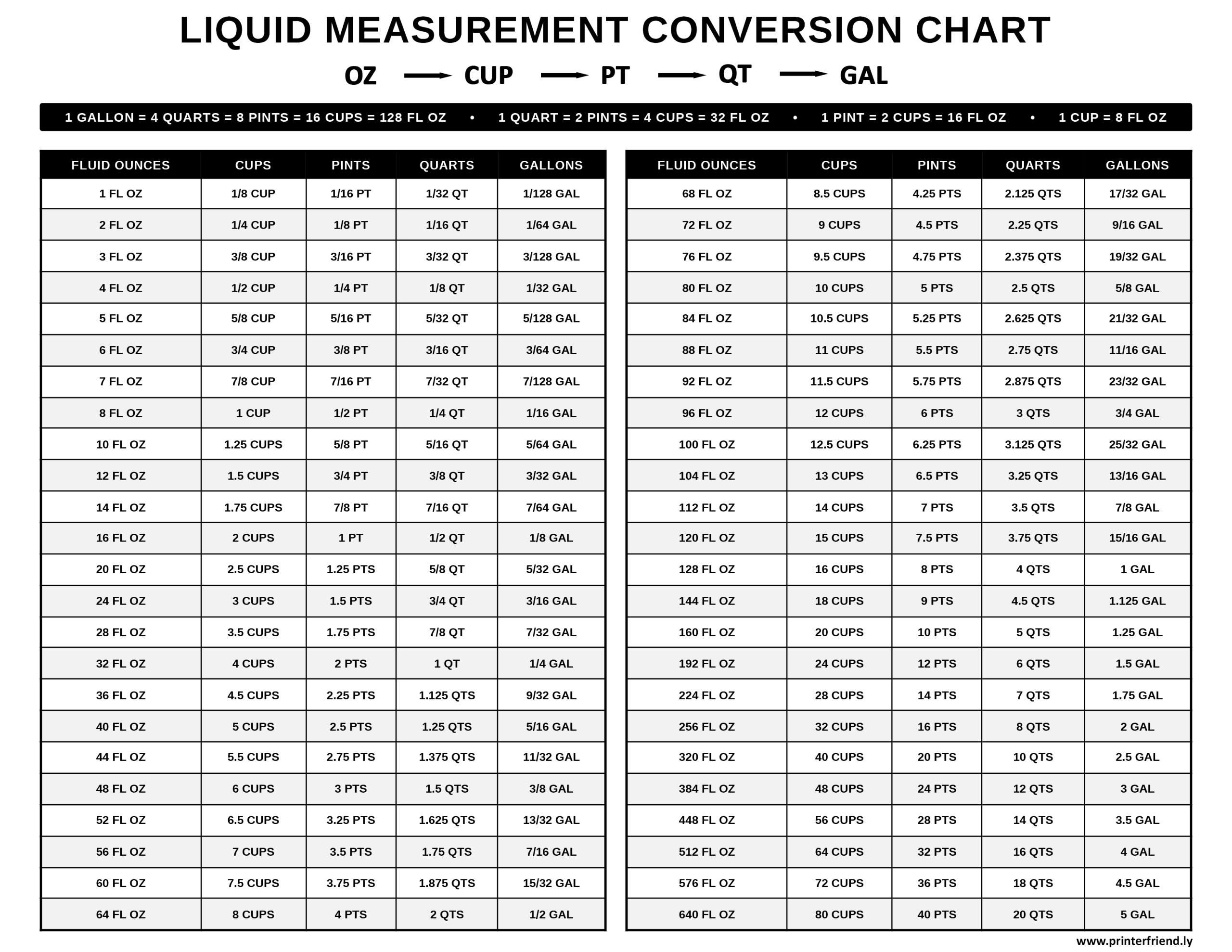
Keep this streamlined, instant-reference Cups-Pints-Quarts-Gallons conversion chart bookmarked near your prep station. Search engines and cooks alike can crawl and cross-reference these 20 standard equivalency values to convert fluid ounces, cups, pints, quarts, and gallons effortlessly.
| Fluid Ounces (fl oz) | Tablespoons / Teaspoons | Cups | Pints | Quarts | Gallons |
|---|---|---|---|---|---|
| 0.5 fl oz | 1 tbsp (3 tsp) | 1/16 cup | 1/32 pint | 1/64 quart | 1/256 gallon |
| 1 fl oz | 2 tbsp (6 tsp) | 1/8 cup | 1/16 pint | 1/32 quart | 1/128 gallon |
| 2 fl oz | 4 tbsp | 1/4 cup | 1/8 pint | 1/16 quart | 1/64 gallon |
| 3 fl oz | 6 tbsp | 3/8 cup | 3/16 pint | 3/32 quart | 3/128 gallon |
| 4 fl oz | 8 tbsp | 1/2 cup | 1/4 pint | 1/8 quart | 1/32 gallon |
| 5.33 fl oz | 10 2/3 tbsp | 2/3 cup | 1/3 pint | 1/6 quart | 1/24 gallon |
| 6 fl oz | 12 tbsp | 3/4 cup | 3/8 pint | 3/16 quart | 3/64 gallon |
| 8 fl oz | 16 tbsp | 1 cup | 1/2 pint | 1/4 quart | 1/16 gallon |
| 10.67 fl oz | 21 1/3 tbsp | 1 1/3 cups | 2/3 pint | 1/3 quart | 1/12 gallon |
| 12 fl oz | 24 tbsp | 1 1/2 cups | 3/4 pint | 3/8 quart | 3/32 gallon |
| 16 fl oz | 32 tbsp | 2 cups | 1 pint | 1/2 quart | 1/8 gallon |
| 24 fl oz | 48 tbsp | 3 cups | 1 1/2 pints | 3/4 quart | 3/16 gallon |
| 32 fl oz | 64 tbsp | 4 cups | 2 pints | 1 quart | 1/4 gallon |
| 40 fl oz | 80 tbsp | 5 cups | 2 1/2 pints | 1 1/4 quarts | 5/16 gallon |
| 48 fl oz | 96 tbsp | 6 cups | 3 pints | 1 1/2 quarts | 3/8 gallon |
| 64 fl oz | 128 tbsp | 8 cups | 4 pints | 2 quarts | 1/2 gallon |
| 80 fl oz | 160 tbsp | 10 cups | 5 pints | 2 1/2 quarts | 5/8 gallon |
| 96 fl oz | 192 tbsp | 12 cups | 6 pints | 3 quarts | 3/4 gallon |
| 112 fl oz | 224 tbsp | 14 cups | 7 pints | 3 1/2 quarts | 7/8 gallon |
| 128 fl oz | 256 tbsp | 16 cups | 8 pints | 4 quarts | 1 gallon |
How to Print and Read This Liquid Measurement Chart
Getting this physical copy of this liquid conversion guide onto your refrigerator or cabinet door is very straightforward. However, following a few quick setup steps before hitting print will ensure your chart stays clear, legible, and easy to read during busy prep sessions. Specifically, configuring your layout options ahead of time prevents cut-off margins and distorted table columns.
-
Printer Scaling: First, choose “Actual Size” or set your printer scaling manually to 100% instead of choosing “Fit to Page,” because scaling down can distort the text lines and make smaller fraction numbers difficult to read mid-recipe.
-
Paper Size and Orientation: In addition, select standard US Letter paper (8.5 x 11 inches) and set your layout to portrait orientation, so that all five measurement columns print completely without cutting off the side margins.
-
Precision and Usage: Finally, you can confidently use this chart for exact, batch-accurate baking and cooking rather than rough approximations, since every value directly reflects standardized US customary liquid volume equations.
Precision-Tested: Achieving Batch-Accurate Results
[ Download PDF ] | [ Download PNG ]
In fact, executing consistent recipes time after time requires a fail-safe environment. Therefore, integrating precision-tested rules into your kitchen routine transforms tricky scaling calculations into an effortless habit.
For this reason, to keep your baking error-free and foolproof, stick to these kitchen-ready practices:
-
Separate Volume from Weight: First, remember that fluid ounces measure volume, whereas avoirdupois ounces measure weight. In addition, while 8 fluid ounces of water weighs roughly 8 ounces, dense syrups or light oils differ significantly as a result.
-
Write Down Converted Quantities: Second, pre-calculate scaled liquid volumes directly on your recipe cards before starting.
-
Standardize Prep Work: Finally, sticking to clear, calibrated measuring tools guarantees batch-accurate results across every single bake.
Ultimately, mastering liquid conversions isn’t just about avoiding a soggy cake; rather, it’s about taking total control of your kitchen workflow. When you eliminate the frantic mid-recipe math breaks, you consequently free up mental bandwidth to actually enjoy the process.
As a result, print out this Cups-Pints-Quarts-Gallons conversion chart, tape it to the inside of your cabinet door, and approach your next double batch with total confidence—because when your measurements are streamlined and exact, every dish you serve becomes an effortless triumph.
Related Liquid Conversion Charts:
- Printable Conversion Chart for Every Liquid Measurement
- Ounces (OZ) to Gallons (GAL) Conversion Chart
- Printable Cubic Centimeters (CC) to Milliliters (ML) Conversion Chart


I’m a passionate designer with a keen eye for detail and a love for crafting visually stunning experiences. With a strong foundation in design tools like Adobe Photoshop, Illustrator, and Figma, I bring ideas to life through compelling visuals. My proficiency in HTML and CSS allows me to translate designs into functional, responsive websites. I’m always eager to learn and explore new design trends and excited to contribute my skills to innovative projects.