
Running a 12-player pickleball double-elimination tournament hits the ultimate operational sweet spot between high-stakes competition and strict schedule control. Built around a 12-team tree, this format gives every entrant a guaranteed two-match minimum. It eliminates the soul-crushing disappointment of single-elimination “one-and-done” events while keeping your venue timeline predictable and court-optimized.
Nothing tests a tournament director’s sanity quite like twelve hyper-competitive pickleballers holding $200 carbon-fiber paddles. Staring you down while you try to draw a bracket on a greasy pizza box. One wrong line, and suddenly your uncle is stuck playing a back-to-back triple-header with zero breathers while the local hotshot gets a two-hour nap.
[ Download PDF ] | [ Download PNG ]
Having a plug-and-play bracket prevents a pickleball mutiny (and we know those are the worst), keeps the courts humming, and makes you look like a seasoned pro who definitely didn’t plan this in the parking lot five minutes before game time.
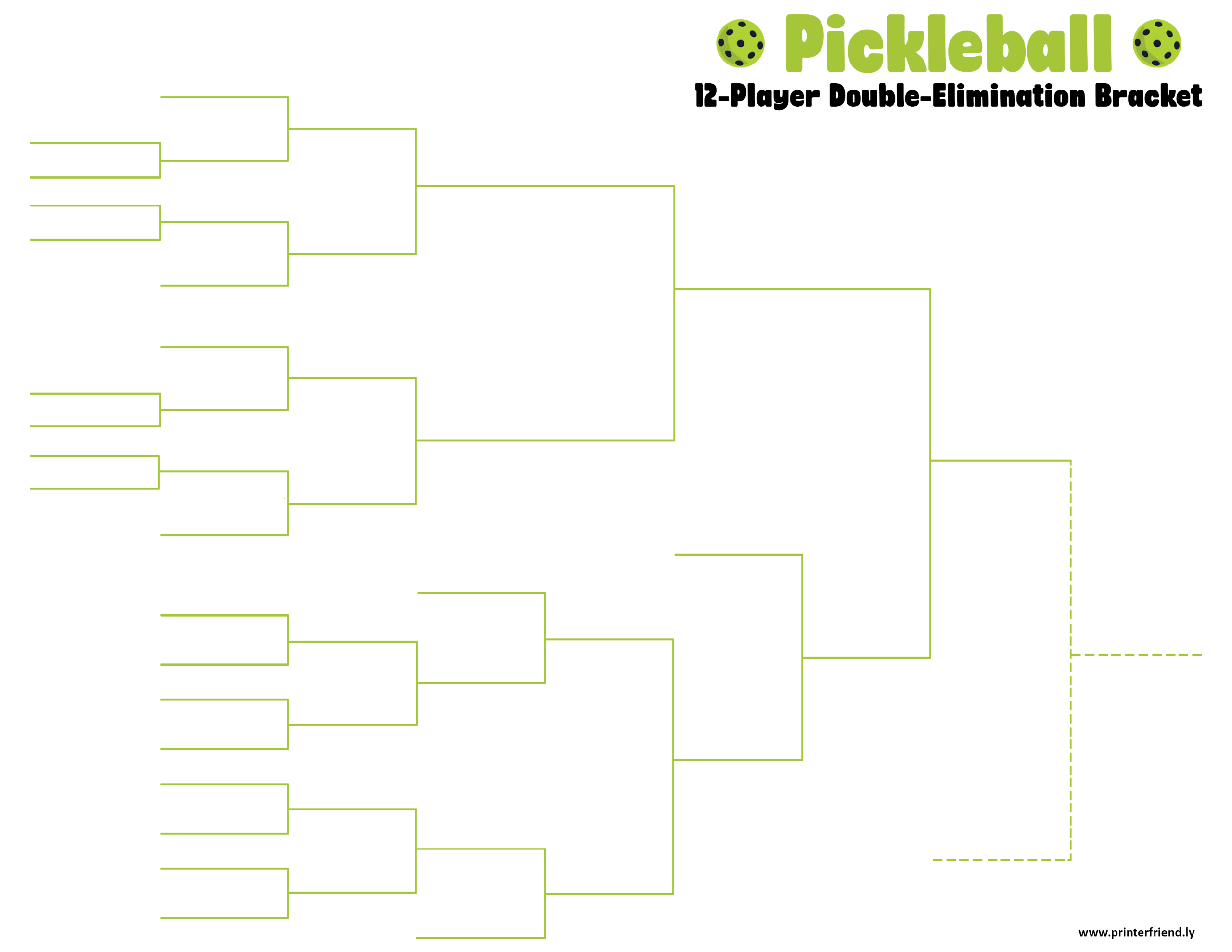
The 12-Player Pickleball Double-Elim Bracket Format
Bridging the gap between a small round-robin and a massive open draw. Requires a structural blueprint that keeps matches moving logically. Our 12-player pickleball double-elimination bracket relies on two interconnected brackets working in tandem to balance player progression and court availability.
Mastering this flow allows event hosts to project precise match start times and anticipate when peak court congestion will occur. When organizers understand how players transition between the upper and lower halves of the draw, managing player announcements and court assignments becomes a simple routine rather than a frantic guessing game.
The Winners’ Bracket (WB) Framework
The Winners’ Bracket serves as the primary highway to the championship match. Rewarding top seeds with a slightly shorter path to the final. Because a 12-player field sits between the standard 8-player and 16-player bracket templates, four high-seeded players receive an initial pass while the remaining eight fight to earn their spot in the Quarterfinals.
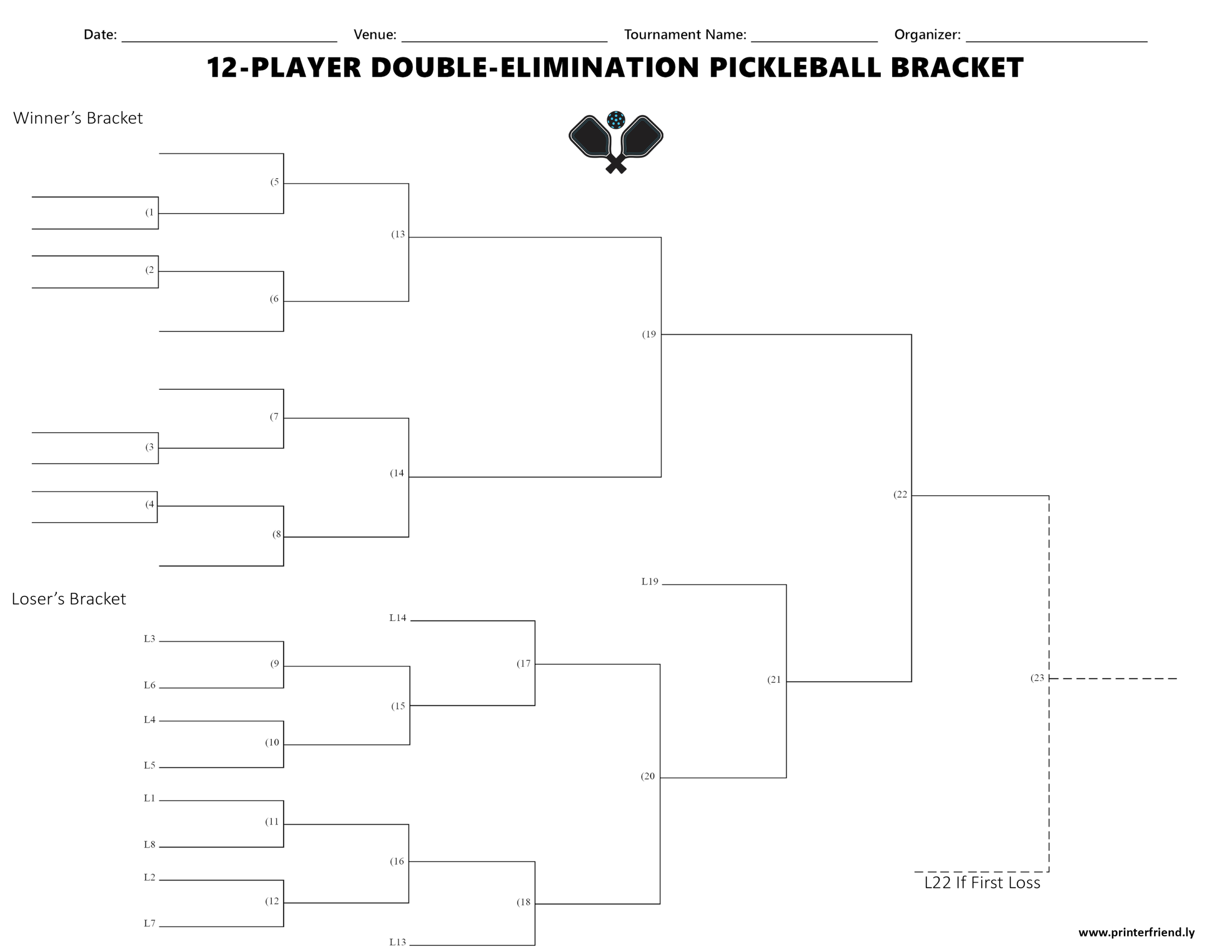
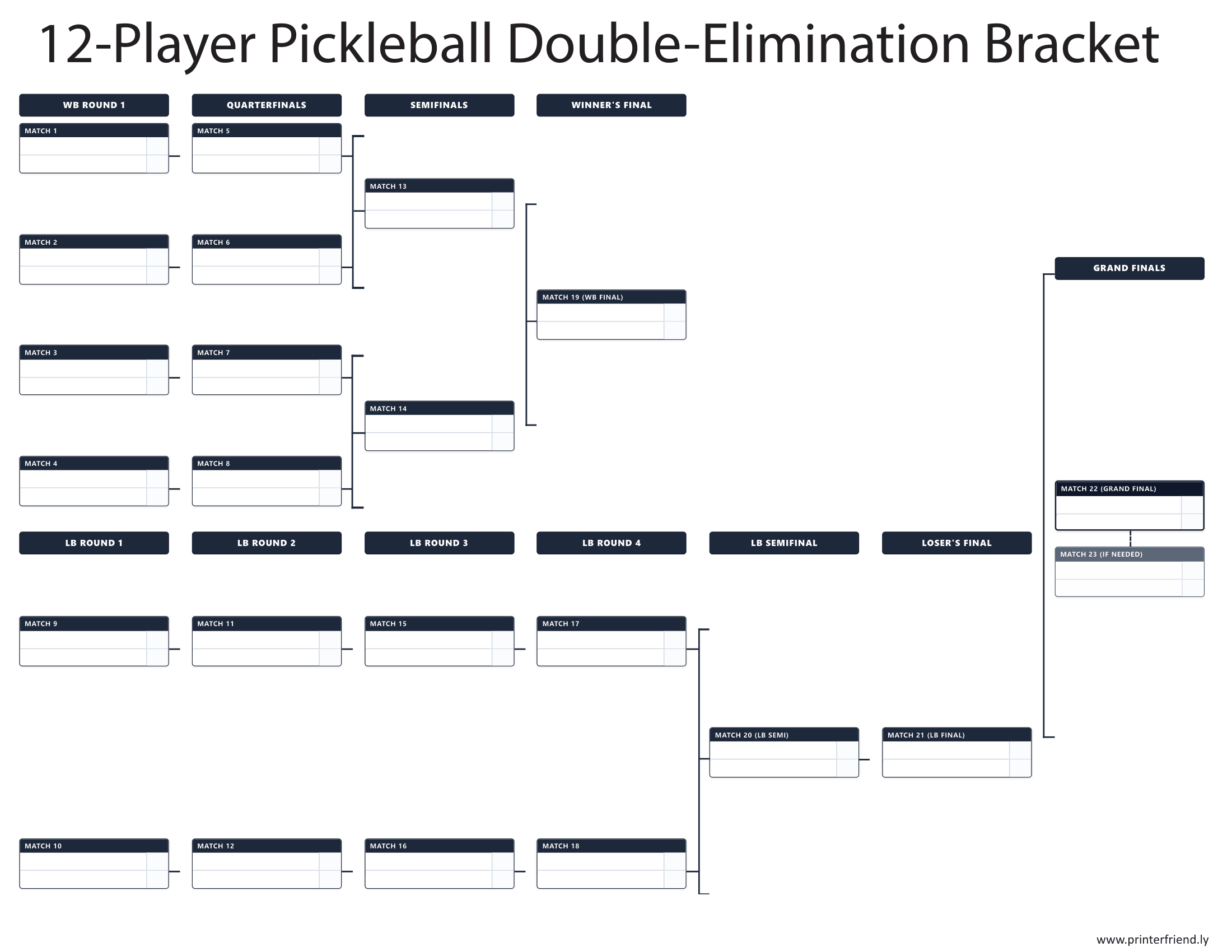
- WB Round 1 (Matches 1–4): Eight players compete across four opening matches. The top four players in your seeding matrix receive automatic Round 1 byes, directly securing their slot in the Quarterfinals.
- Quarterfinals (Matches 5–8): The four bye recipients jump into action to face the battle-tested winners of Round 1.
- Semifinals (Matches 13 & 14): The final four undefeated players clash for a guaranteed spot in the winner’s final.
- Winners’ Bracket Final (Match 19): The ultimate WB matchup. The winner punches a direct ticket to the Grand Finals (Match 22). While the loser drops down to the consolation bracket for one last shot at glory.
Staying on this upper path is the most efficient route through the tournament day, requiring fewer total games played to reach the podium. Players who remain in the Winners’ Bracket benefit from longer, standardized rest windows between matches, preserving their endurance for the final rounds.
The Loser’s Bracket (LB) Framework
The Loser’s Bracket is the endurance gauntlet of the tournament, absorbing defeated players from above and giving them an avenue back to the podium. This section requires careful structural management: drop-down paths are staggered so players entering from the Winners’ Bracket face surviving players who have already fought through lower-bracket elimination rounds, preventing immediate rematches.
- LB Round 1 (Matches 9 & 10): Early drop-downs from WB Round 1 (L3, L6, L4, L5) face off in high-stakes survival matches.
- LB Round 2 (Matches 11 & 12): Remaining Round 1 drop-downs (L1, L8, L2, L7) enter play, facing the survivors of LB Round 1.
- LB Rounds 3 & 4 (Matches 15–18): Quarterfinal losers from the Winners’ Bracket drop down into these rounds to test the stamina of the LB survivors.
- LB Semifinal & Loser’s Final (Matches 20 & 21): The final gauntlet. Match 20 determines who advances to face L19 (the loser of the Winners’ Bracket Final) in Match 21.
Navigating the lower bracket requires immense mental resilience, as a single additional loss results in total elimination. Because matches in this bracket are back-to-back, competitors must adapt quickly to fatigue while tournament directors actively manage court availability to avoid backlogs.

[ Download PDF ] | [ Download PNG ]
Grand Finals Mechanics & The “If-Necessary” Reset
The tournament culminates in a high-stakes championship climax that honors the foundational rule of double-elimination play. Everyone must lose twice to be eliminated. This introduces a unique tactical dynamic where the undefeated finalist holds a distinct safety net over the battle-hardened contender emerging from the Loser’s Bracket.
- Match 22 (Primary Final): The undefeated champion of the Winners’ Bracket plays the survivor of the Loser’s Bracket (Winner of Match 21).
- Match 23 (If-Necessary Final): If the undefeated player wins Match 22, the tournament ends immediately. However, if the Loser’s Bracket survivor hands the WB winner their very first loss of the day, it triggers the if-necessary final (L22 If First Loss). Because this is a true double-elimination tournament, both players now have one loss, requiring one final, winner-take-all showdown in Match 23.
If Match 23 is triggered, it often produces the most thrilling pickleball of the entire event. Organizers should ensure that courts on either side of the championship court are cleared to give this deciding match the spectator showcase it deserves.
Filling Out a 12-Player Pickleball Double-Elim Bracket
Managing a 12-player pickleball double-elimination tournament on game day is completely frictionless and self-executing once you know the step-by-step flow.
Step-by-Step Example: Following “Alex” (Seed #5) and “Jordan” (Seed #12)
- Initial Slotting: Write Alex (Seed #5) and Jordan (Seed #12) into Match 1 at the top of WB Round 1.
- First Match Outcome: Jordan pulls off an upset, defeating Alex 11–9. Write “Jordan” on the line advancing to Match 5 in the Quarterfinals.
- Routing to the Loser’s Bracket: Alex has taken his first loss in Match 1. Locate the printed bracket code L1 (Loser of Match 1), which points directly to Match 11 in LB Round 2. Write “Alex” on the top line of Match 11.
- Tracking Progress: While Jordan moves forward in the Winners’ Bracket to face Seed #4 in Match 5, Alex sits tight in the consolation queue until Match 11 is ready to be called.
- Logging Results: Whenever a match finishes, record the score directly inside the match box next to the player names (tracking match scores). If Alex wins Match 11, advance his name along the line to Match 16. If Alex loses Match 11, place an “X” next to his name—he is now officially eliminated, having received his full two-match guarantee.
To avoid misrouting players during busy tournament hours. Always double-check the match number identifier before writing a name into a new box. Keep a highlighters-and-pens system at the scoring table. Using one color for winners advancing right and another for losers routing down. Prevents misreads when updating a print-ready bracket on the fly.
Logistics, Court Allocation & Scheduling
To keep your 12-player pickleball double-elimination bracket schedule-friendly and avoid players lounging around for hours between matches, apply these operational strategies:
| Parameter | Recommended Setup | Operational Execution |
| Court Allocation | 3 to 4 Courts | Ideal for balancing court usage. 3 courts keep games moving back-to-back; 4 courts eliminate practically all waiting time. |
| Rest Intervals | 10–12 Minutes | Managing rest intervals keeps players fresh, while staggering court times keeps queueing fluid. |
| Match Length | 1 Game to 15 (Win by 2) | Perfect for single-day corporate or club events. Keeps total tournament time under 3.5 hours. |
| Scorekeeping | Central Bracket Master | One dedicated organizer handles score tracking to prevent mix-ups at court calls and keep streamlining queueing. |
Enforcing strict warm-up timers is the single best way to protect your schedule from inflating. Limit pre-match court warm-ups to exactly three minutes, and insist that players report to their assigned court within two minutes of their match being called to maintain a bottleneck-free tournament pace.
Quick-Reference: 12-Player Pickleball Double-Elimination Tournament Summary

[ Download PDF ] | [ Download PNG ]
- Total Matches: 22 standard matches (23 if an if-necessary final is triggered).
- Player Capacity: Exactly 12 individual players (or 12 doubles teams).
- Format Highlight: Fully print-ready, bottleneck-free, and engineered for maximum player court time.
Adopting a structured 12-player pickleball double-elimination bracket ensures that your event runs smoothly from the opening serve to the final match point. By combining clear drop-down pathways, disciplined court management, and balanced player rest cycles, you create an organized, competitive environment that players will want to return to tournament after tournament.
Related Pickleball Templates:
- Printable Pickleball Score Sheet Templates
- Printable Pickleball Tournament Brackets (Single Elimination)
- Printable Pickleball 32-Team Bracket – Double Elimination Tournament


I’m a passionate designer with a keen eye for detail and a love for crafting visually stunning experiences. With a strong foundation in design tools like Adobe Photoshop, Illustrator, and Figma, I bring ideas to life through compelling visuals. My proficiency in HTML and CSS allows me to translate designs into functional, responsive websites. I’m always eager to learn and explore new design trends and excited to contribute my skills to innovative projects.