
Running a quick four-team event should be the easiest gig in sports administration, but picking the wrong setup can ruin the whole afternoon. Single-elimination formats pack half your teams home after just one round, leaving players feeling cheated out of a proper tournament experience. Round-robins solve the playing time problem, but they require six matches—often creating scheduling logjams and anticlimactic point-differential tiebreakers to crown a champion.
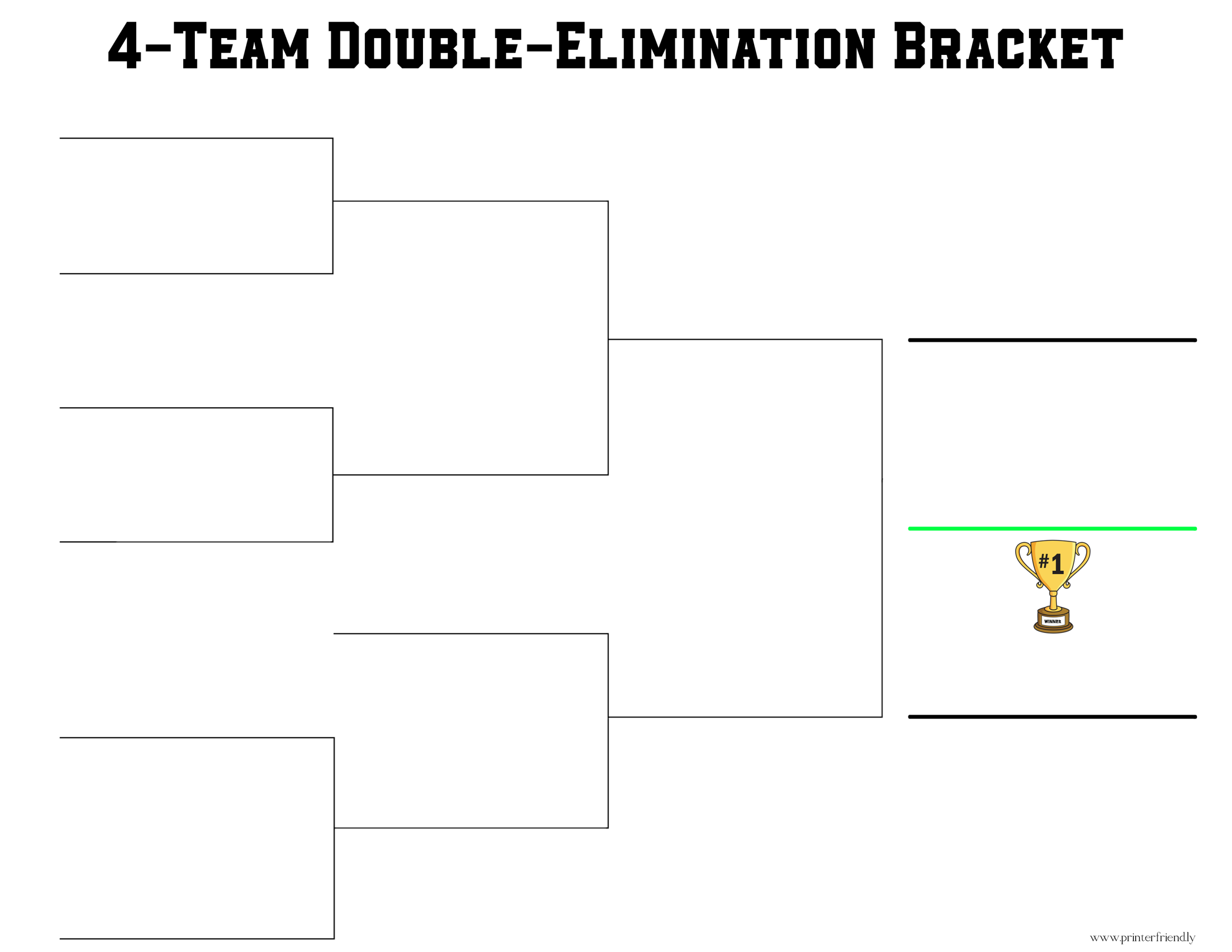
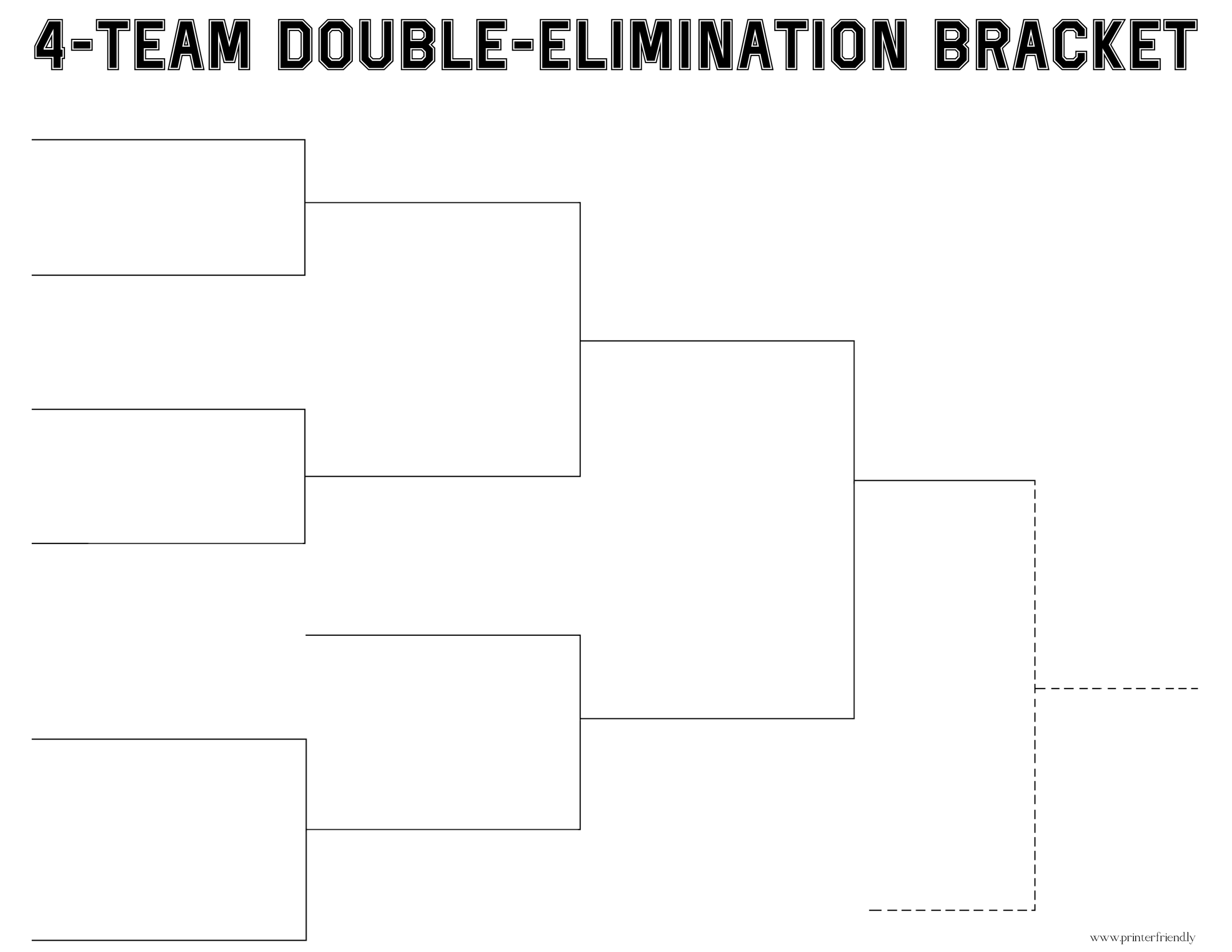
That is why the printable 4-team double-elimination bracket is considered the gold standard for small-scale tournaments. It balances competitive fairness with maximum schedule efficiency, guaranteeing every squad multiple opportunities to compete while keeping total game time strictly controlled.
This PDF file provides absolute minimum-match assurance wrapped in a forgiving second-chance format. Capping out at six to seven total games, it offers organizers a schedule-efficient, rapid-turnaround structure that guarantees high-stakes action from opening tip to the final trophy presentation.
[ Download PDF ] | [ Download PNG ]
How Two-Losses Works in a Double-Elimination Bracket
The bedrock of a 4-team double-elimination bracket is total equity: no competitor is officially eliminated until they drop two full matches. Unlike a three-team layout, a four-team setup features zero byes. Every team starts on equal footing in Round 1, earning their path strictly through on-court results.
If a squad drops its opening game, all hope is far from lost. They receive a fair-chance guaranteed route through the lower bracket to reset, refocus, and make a run for the title. Meanwhile, high seeds aim to stay as the undefeated seed in the upper bracket, while opening-round losers must immediately rebound in elimination play to survive.

[ Download PDF ] | [ Download PNG ]
Bracket Navigation: Upper vs. Lower Flow
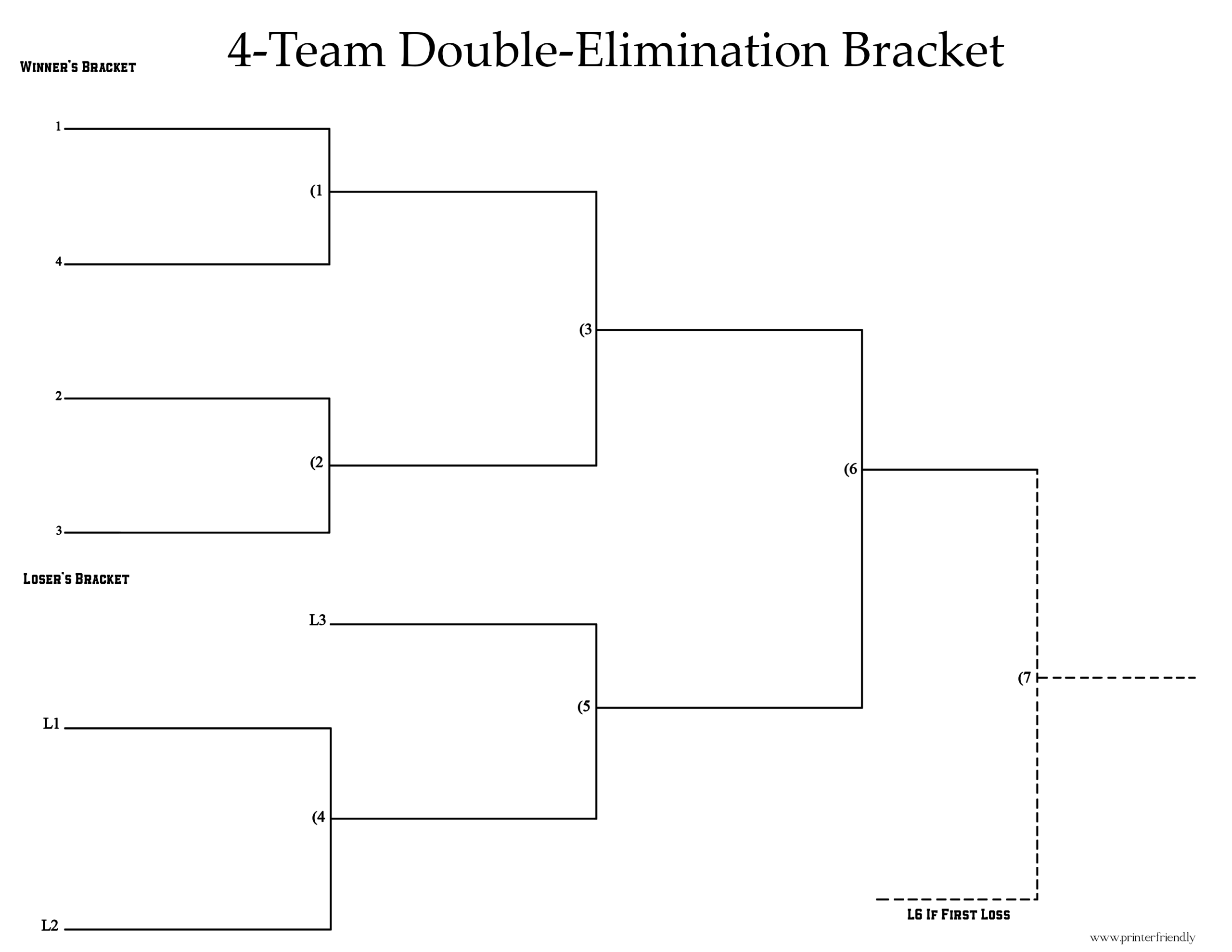
Navigating match progression in a 4-team double-elimination bracket requires a clear understanding of how teams split after Round 1. Unlike single-elimination formats where a single misstep ends your day, this structure immediately divides your tournament field into two distinct parallel tracks: an upper path for undefeated competitors and a lower path for teams mounting a comeback.
This dual-track layout creates a fascinating psychological dynamic throughout the event. While the upper bracket rewards dominance with fewer total games and longer rest periods, the lower bracket tests a squad’s raw endurance, forcing them to survive back-to-back elimination matches. Understanding how teams transition between these two routes ensures smooth table management and keeps participants clear on their exact pathway to the finals:
- Winner’s Bracket (Upper Track):
- Game 1: Seed 1 plays Seed 4.
- Game 2: Seed 2 plays Seed 3.
- Game 3: The Game 1 winner faces the Game 2 winner. The victor moves straight into the finals (Game 6) as the undefeated finalist.
- Loser’s Bracket (Lower Track):
- Defeated teams drop into the lower side to fight through survival rounds.
- Game 4: The loser of Game 1 faces the loser of Game 2 in a direct elimination match.
- Game 5: The winner of Game 4 advances to battle the loser of Game 3 for the remaining championship spot.
This dual-track system preserves unbiased progression, ensuring that only the most resilient squads meet in the final round.
Game Order & Consolation Routing (L1, L2 & L3)
With seven potential matches on the slate, maintaining organized consolation routing is vital for scorekeepers. Shorthand tags like L1, L2, and L3 ensure teams know exactly where to report next.
| Game # | Matchup | Bracket Level | Winner Destination | Loser Destination |
| Game 1 | Seed 1 vs. Seed 4 | Winner’s Bracket | Advances to Game 3 | Drops to Game 4 (L1) |
| Game 2 | Seed 2 vs. Seed 3 | Winner’s Bracket | Advances to Game 3 | Drops to Game 4 (L2) |
| Game 3 | Winner G1 vs. Winner G2 | Winner’s Bracket | Advances to Game 6 | Drops to Game 5 (L3) |
| Game 4 | L1 vs. L2 | Loser’s Bracket | Advances to Game 5 | Eliminated (4th Place) |
| Game 5 | L3 vs. Winner G4 | Loser’s Bracket | Advances to Game 6 | Eliminated (3rd Place) |
| Game 6 | Winner G3 vs. Winner G5 | Championship Match | Champion (if Winner G3 wins) | Moves to Game 7 (if first loss) |
| Game 7 | Winner G6 vs. Loser G6 | “If-Necessary” Reset | Champion | 2nd Place |
Learning how to sequence matches using this template prevents confusion at the scorer’s table and keeps court rotations running seamlessly.
Championships & The “If-Necessary” Reset
The championship final of a 4-team double-elimination bracket introduces classic tournament drama. The upper-bracket survivor (Winner G3) enters Game 6 with zero losses, while the lower-bracket survivor (Winner G5) enters with one loss.
If the undefeated team wins Game 6, they claim the title outright. However, if the lower-bracket challenger wins Game 6, they force a reset by handing the top seed their very first loss of the day. Because both squads now hold a 1-loss record, a secondary “if-necessary” game (Game 7) must be played immediately. The victor of Game 7 earns the ultimate championship trophy.
Seeded, Blind-Draw, and Fillable Double-Elimination Bracket Templates
Setting up your 4-team double-elimination bracket depends on your event’s competitive style. Standard seeding (1 vs 4, 2 vs 3) is best for ranked leagues or tournaments with established regular-season data. For casual office events, backyard cornhole, or pickup gaming setups, a blind draw keeps things fun and unbiased.
To ensure your venue looks professional, utilize a pre-formatted turnkey bracket design to create an error-free printable poster for the wall. Alternatively, digital fillable charts allow directors to bracketize results on a tablet and stream live score updates straight to participants’ phones.
Operations: Scheduling, Rest Intervals, and Tie-Breaks

[ Download PDF ] | [ Download PNG ]
Managing fatigue is essential for running an efficient 4-team double-elimination bracket. The winner of Game 4 must immediately turn around to play Game 5 against L3 (the loser of Game 3). Tournament hosts should enforce a mandatory 10-to-15-minute rest interval before Game 5 so the lower-bracket team can catch their breath.
Establishing quick score-reporting guidelines keeps your flawless tournament flow on track for seamless execution. Finally, avoid arbitrary tiebreakers at all costs; if regulation ends in a deadlock, use a sudden-death overtime period to maintain full double-elimination integrity.
Related Double-Elimination Brackets:
- Printable Pickleball 32-Team Bracket – Double Elimination Tournament
- 64-Player Double Elimination Bracket for Larger Tournaments
- Printable Pickleball 12-Player Double Elimination Bracket


I’m a passionate designer with a keen eye for detail and a love for crafting visually stunning experiences. With a strong foundation in design tools like Adobe Photoshop, Illustrator, and Figma, I bring ideas to life through compelling visuals. My proficiency in HTML and CSS allows me to translate designs into functional, responsive websites. I’m always eager to learn and explore new design trends and excited to contribute my skills to innovative projects.